
A sapphire does not always hold one colour evenly from edge to edge. In some stones, blue sits beside green, yellow meets blue, or several colours remain visibly present within the same finished gem. When those different colour zones become an important part of the face-up appearance, the stone may be described in the trade as a parti-coloured, or parti, sapphire.
The attraction is not simply that more than one colour exists. It is the way those colours occupy the stone: where they meet, how sharply they separate or blend, and how the cut turns natural zoning into the pattern we actually see.
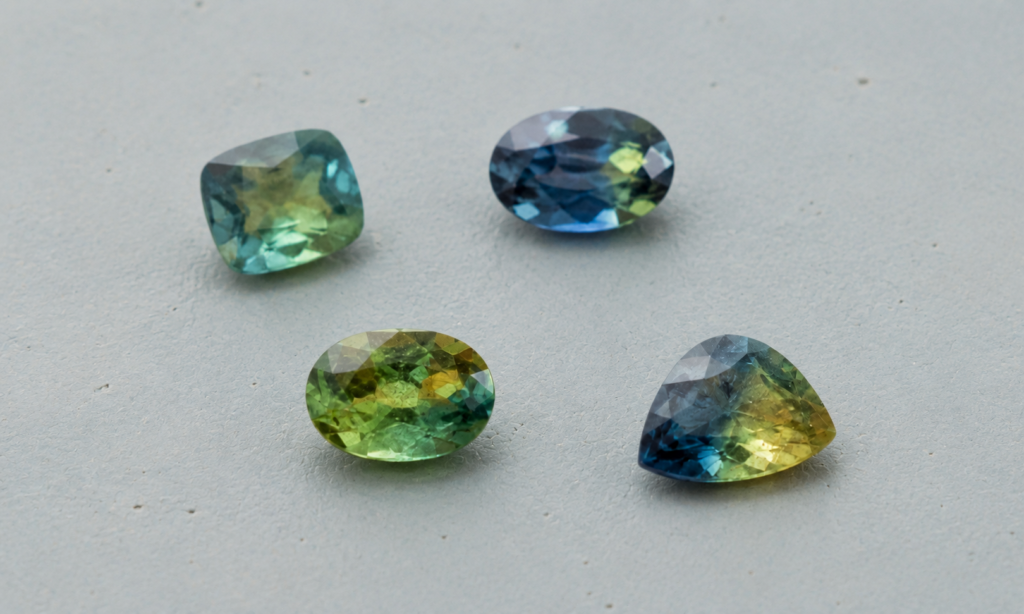
What Is a Parti Sapphire?
“Parti-coloured” is a trade description for sapphire in which different colours or clearly contrasting colour zones are visible within the stone. GIA describes parti-coloured sapphires as sapphires that show combinations of different colours, with examples including blue and orange or green and blue.
Parti is not a separate mineral variety. The stone is still corundum, just like blue, yellow, green or pink sapphire. The term also does not establish geographic origin, treatment status or quality. It tells us something about the way colour is distributed and experienced in the gemstone.
Where Do the Different Colours Come From?
Colour in a natural sapphire can develop unevenly while the crystal grows. GIA describes colour zoning as any uneven distribution of colour within a gemstone and notes that it can result from changes in growth conditions or from uneven incorporation of trace elements during formation.
That zoning can be subtle or obvious. One part of a crystal may carry stronger colour while another is lighter, or neighbouring growth zones may display distinctly different colours. In Australian sapphire, for example, coarse colour banding can create clearly separated green-and-gold or blue-and-yellow areas.
Colour Zoning Is the Heart of the Appearance
Colour zoning is common in sapphire, but it is not always treated in the same way. When the goal is a sapphire with visually uniform colour, cutters often orient the rough to minimise or disguise zoning in the face-up stone.
Parti sapphire turns that relationship around. Instead of trying to make every zone disappear into one uniform colour, the finished gem can allow contrasting colours to remain visible as part of its character.
This does not mean that every zoned sapphire is automatically attractive, or that every example of colour zoning should be marketed as parti. It means that when the different colours form a visually meaningful part of the finished stone, the zoning itself can become something to appreciate rather than something to hide.
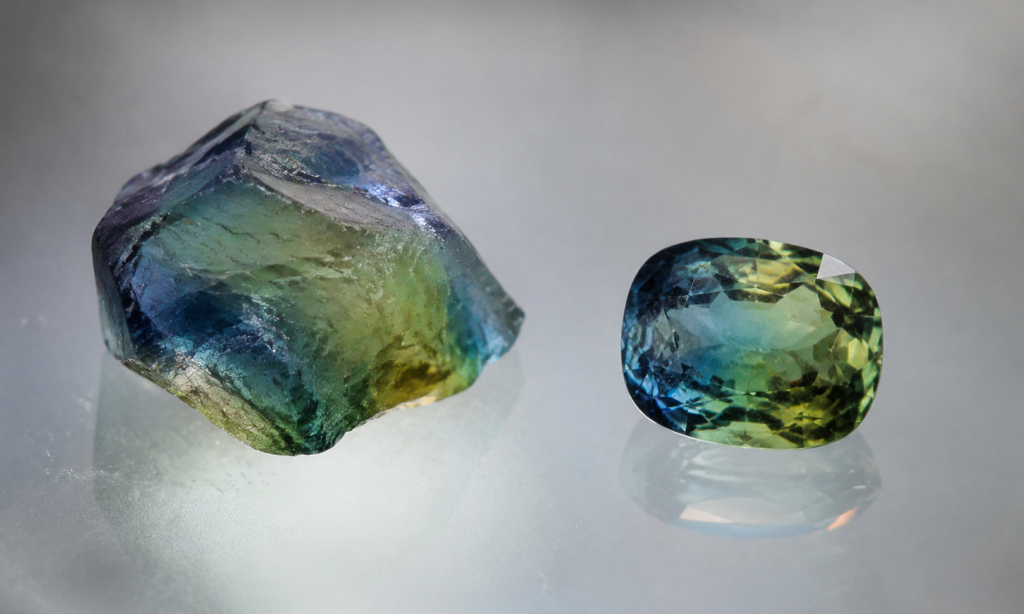
Parti Does Not Mean One Colour Combination
Blue, green and yellow combinations are especially recognisable in the parti-sapphire market, but they are not a definition of the term. GIA has documented parti-coloured sapphire in combinations including green and blue, blue and orange, green and yellow, and blue and yellow.
A parti sapphire can therefore contain two visibly different colours or a more complex arrangement of zones. What connects these stones is not a fixed palette, but the visible coexistence of different colours within one sapphire.
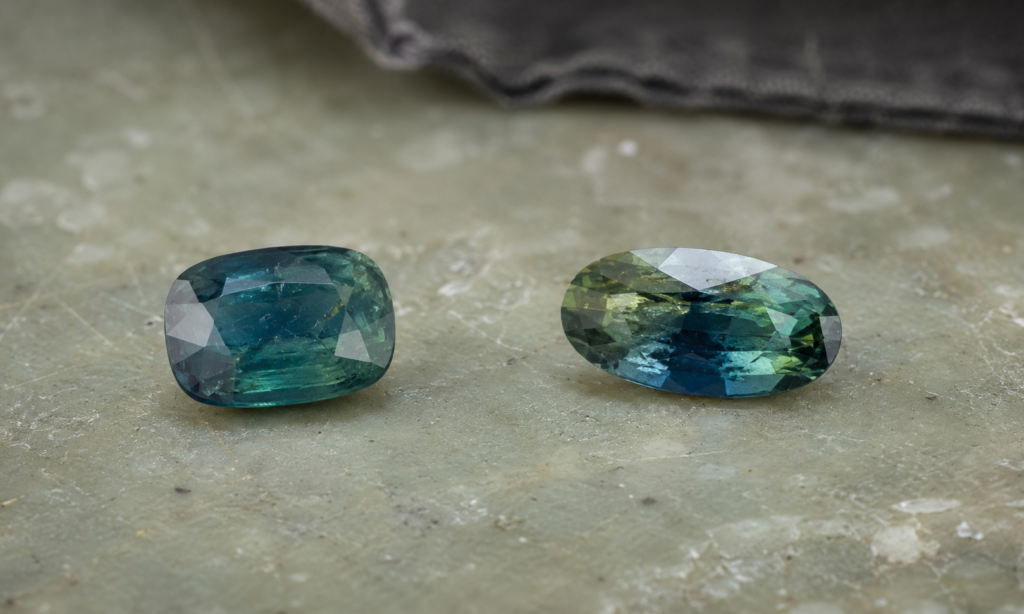
Teal and Parti Sapphire Can Overlap
Teal and parti describe different aspects of appearance. Teal refers to an overall blue-green colour character. Parti refers to visible differences in colour distribution.
A sapphire with blue and green blended into an overall teal impression may be described simply as teal. Another stone may show a clearly blue area beside a clearly green area and read much more obviously as blue-green parti. Some stones can reasonably occupy both descriptions in trade language because their overall character is teal while visible zoning remains part of the face-up pattern.
The Cut Changes the Pattern You See
A cutter cannot invent colour zones that were not present in the rough, but cutting can dramatically change how those zones appear face-up.
Orientation, outline, pavilion placement and facet arrangement influence which parts of the rough remain in the finished stone and how light travels through them. GIA notes that cutters routinely consider colour zoning when orienting sapphire rough. A concentrated zone placed near the culet, for example, can spread its visual effect across a much larger part of the face-up stone.
With parti material, the objective may be different. A cutter might preserve a division between colours, allow them to meet through the centre, or orient the rough so that one colour dominates while another appears as an accent. Two pieces of rough with similar zoning can therefore become very different finished gems.
The cutter is not creating the colours, but the cut can decide how we experience them.
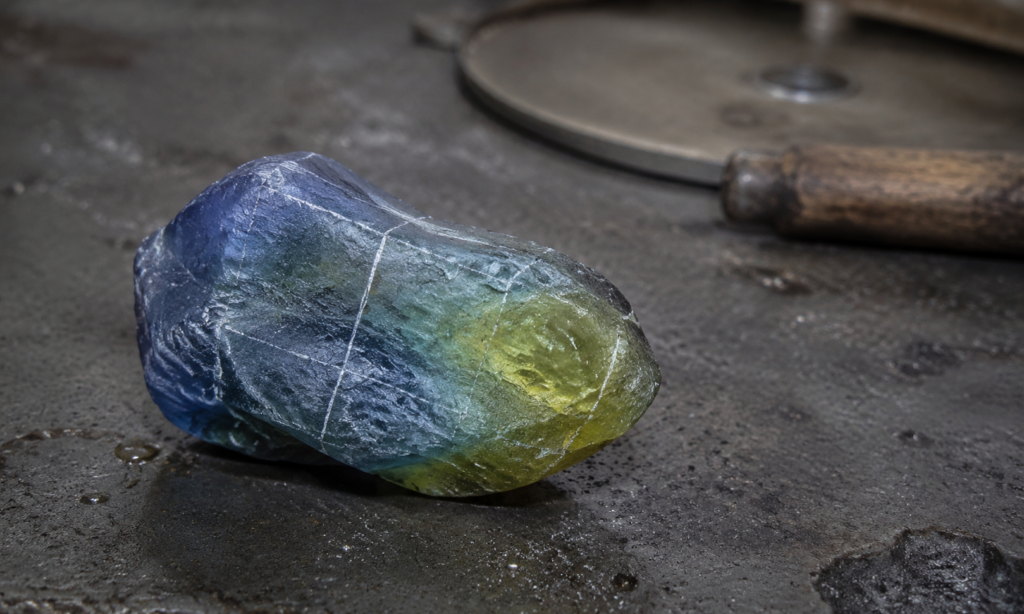
Is Colour Zoning a Flaw?
Not automatically. In many traditionally valued coloured gemstones, strong face-up zoning can reduce desirability because uniform colour is the intended appearance. GIA consequently discusses visible zoning as a value consideration for many coloured stones.
But the same physical characteristic can play a different role when the colour pattern is intentionally visible. Parti sapphire is appreciated precisely because separate colours can create an interesting composition.
That does not make every pattern equally appealing. A stone can still have an arrangement that feels unbalanced, a dark area that dominates too much of the face, or zones that a particular viewer simply does not enjoy. Parti changes the objective; it does not remove personal judgment.
Why Is Australia So Closely Associated With Parti Sapphire?
Australia has a long and well-documented sapphire history, and its deposits are strongly associated with blue, green, yellow and parti-coloured material. GIA’s work on Australian sapphire describes parti stones showing combinations such as green and yellow or blue and yellow, while earlier research notes that coarse colour banding in Australian material can create clearly separated colours.
This has made Australian parti sapphire particularly recognisable in the modern market. But “parti” is not an Australian origin designation. Colour-zoned and fully parti-coloured sapphires also occur elsewhere; GIA has, for example, documented parti-coloured material from northern Ethiopia.
Does Parti Mean Unheated?
No. Visible zoning does not by itself establish treatment history.
Heat treatment can affect colour and internal features in sapphire, and Australian sapphire has a documented history of heat treatment. The presence of visible colour zones should therefore not be used as proof that a stone is unheated.
If treatment status matters, it should be determined through appropriate gemological examination and read from the laboratory report rather than inferred from the parti appearance.
Parti Sapphire in Jewelry
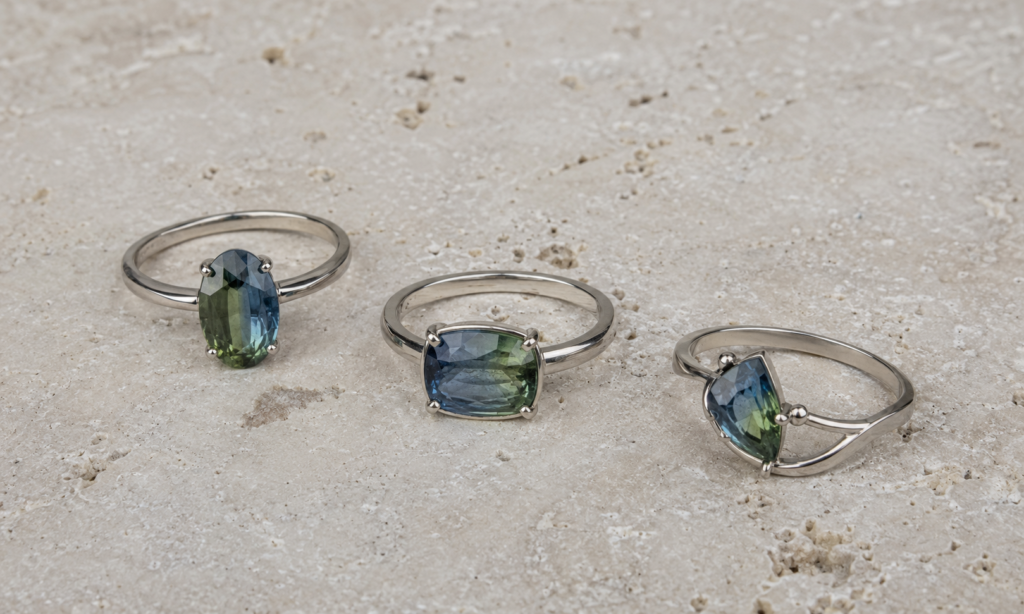
With a uniformly coloured gemstone, rotating the stone in a design may mainly change its shape orientation. With a parti sapphire, rotation can also change the way the colour composition reads.
An east-west setting can make a transition run across the hand. A north-south orientation can turn the same transition into a vertical movement. An asymmetric setting can respond to an off-centre patch of colour, while a minimal solitaire can leave the entire pattern unobstructed.
There is no universal best orientation. The useful approach is to treat the colour map of the individual stone as part of the design rather than assuming that every parti sapphire should be set in the same way.
Choosing a Parti Sapphire
There is no requirement for the colours to divide the stone perfectly in half, or for one particular combination to be considered the ideal. It is more useful to look at the individual pattern.
- Which colours do you enjoy together?
- Do you prefer a gradual transition or clearly separated zones?
- Is there one colour you would like to dominate?
- Do you enjoy the pattern when the stone is viewed normally face-up, not only in a macro photograph?
- How would you want that pattern oriented once the sapphire becomes jewelry?
A perfectly symmetrical distribution is not necessary. Sometimes an off-centre division, an unexpected patch of yellow or a strong transition from green to blue is exactly what gives one parti sapphire its individual character.
With parti sapphire, the question is not only what colours are present, but where those colours live within the stone.
No two patterns need to tell the same story. The appeal of parti sapphire comes from allowing natural colour variation to remain visible—and then deciding whether the particular arrangement in front of you is one you want to keep looking at.