
Emerald has a character that is difficult to mistake for almost any other gemstone. Its green can feel bright and fresh, deep and saturated, or cool with a bluish influence. Inside the stone, inclusions and fine fissures often create an internal landscape that is as individual as the colour itself.
This is one reason emerald is best understood on its own terms. A beautiful emerald does not necessarily need the crystal-clear appearance we might expect from some other gemstones. Colour, transparency, inclusions and cut interact differently here, and learning to read that balance is part of understanding the stone.
To understand emerald, it helps to stop expecting it to behave like every other gemstone.
Emerald Is Part of the Beryl Family
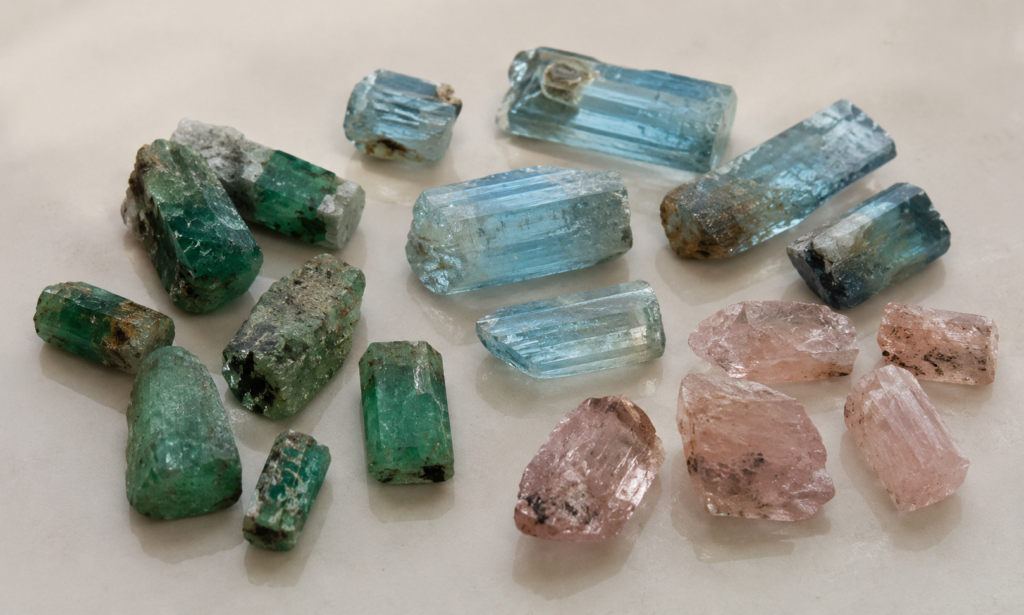
Emerald is the green to bluish-green variety of beryl, a mineral family that also includes aquamarine and morganite. They share the same basic mineral structure, yet small amounts of different elements can create gemstones with remarkably different colours and personalities.
In emerald, chromium and/or vanadium are important causes of the green colour, while iron can also influence the final appearance. These elements enter the crystal in small amounts as it forms, transforming otherwise colourless beryl into emerald.
Emerald Is Not One Green
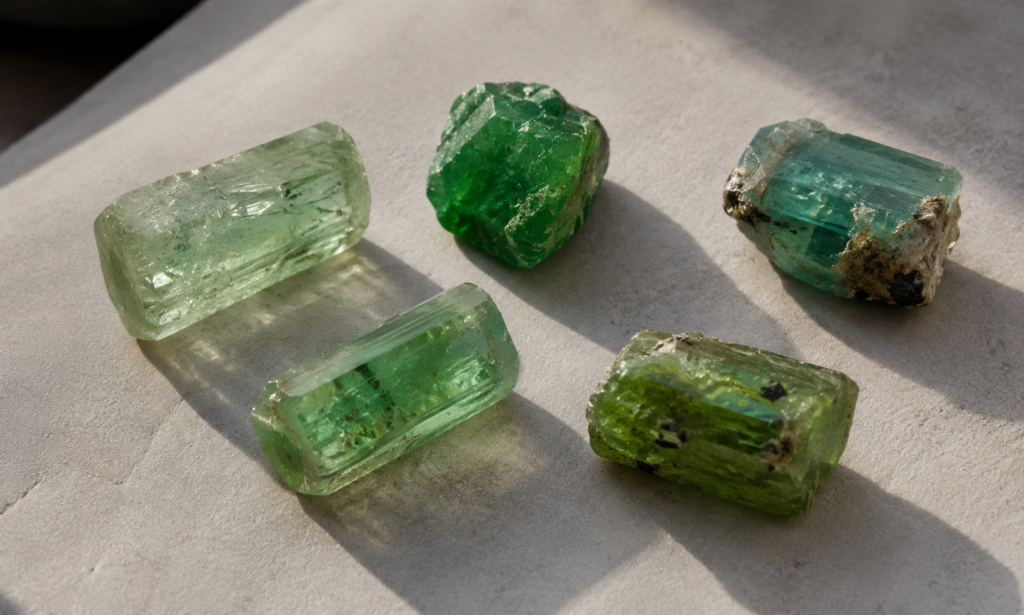
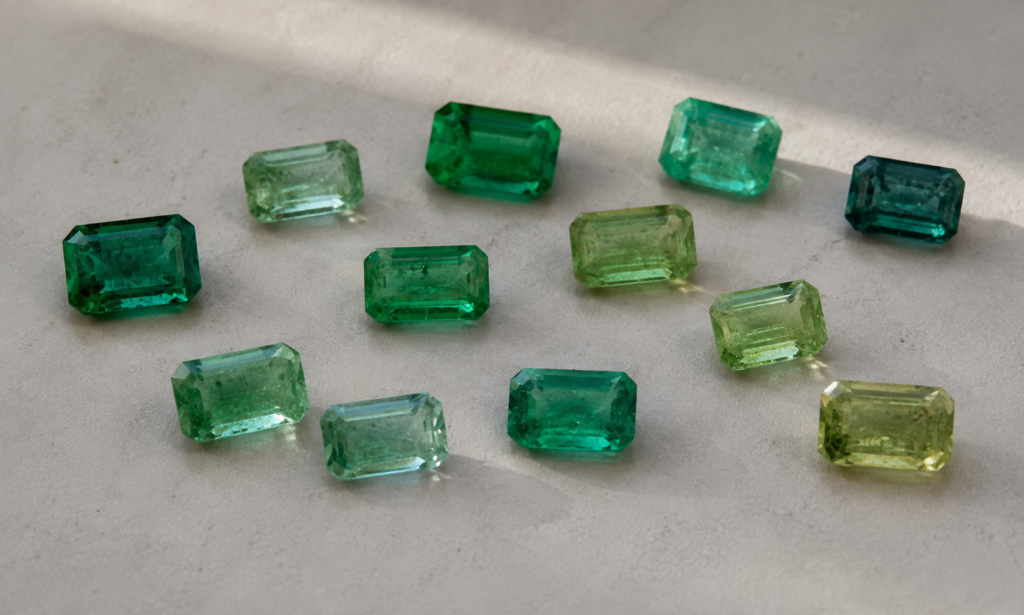
The word “emerald” may suggest one familiar green, but real stones occupy a range of appearances. Some lean toward bluish green, some appear more directly green, and others may carry a warmer influence. Tone can also vary from relatively open and bright to rich and deep.
These differences do not need to become a hierarchy. One person may be drawn to a cooler bluish green, while another prefers a richer or more open green. The important point at this stage is simply that emerald colour has more than one expression.
Why Does Emerald Often Have Inclusions?
Emerald commonly contains more visible internal features than many other familiar gemstones. During crystal growth, mineral inclusions, fluid inclusions, growth features and fissures can become part of the stone.
This is normal enough in emerald that judging it by the expectation of complete visual cleanliness can be misleading. An inclusion is not automatically a defect, but neither should every inclusion be romanticised. Its position, visibility and effect on transparency or durability all matter.
Jardin: The Garden Inside an Emerald
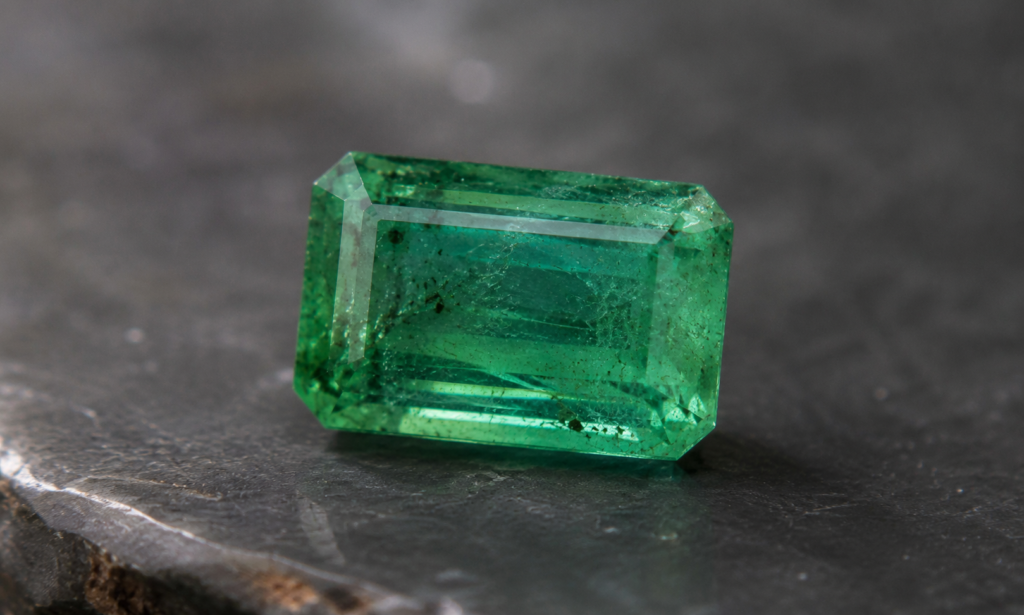
The internal features of emerald are often described by the French word jardin, meaning “garden.” Under magnification—or sometimes even to the unaided eye—fine fissures, crystals and other inclusions can create patterns that resemble branches, leaves or a miniature landscape.
It is a useful and evocative trade expression, but jardin is not a quality grade. A gentle internal texture may add individuality without dominating the stone, while heavier inclusions can reduce transparency. Certain fissures can also be relevant to durability.
Jardin describes an emerald’s internal landscape. It does not tell us by itself whether that emerald is beautiful or durable.
Why Is the Emerald Cut Called the Emerald Cut?
Emerald crystals often grow in elongated forms, and the rough can contain fissures that require careful decisions from the cutter. Preserving colour and useful weight must be balanced against protecting vulnerable areas and creating a pleasing face-up appearance.
The familiar rectangular step cut with truncated corners became closely associated with emerald partly because its geometry suits this challenge. Removing sharp corners can reduce vulnerable points, while broad step facets can present the stone’s colour in a calm, architectural way.
Despite the name, emerald does not have to be emerald cut. Oval, cushion, pear, round, cabochon and other forms are all possible. “Emerald cut” describes a cutting style, not a requirement for the gemstone.
Emerald Is Beautiful in a Different Way
With some gemstones, a crisp and highly transparent appearance may be one of the first things we notice. Emerald can ask the eye to read beauty differently. Colour may be accompanied by a softer internal texture, fine jardin or subtle variation across the stone.
That does not mean transparency stops mattering. A heavily included emerald can appear sleepy or closed, just as an unfortunate fissure can affect durability. The difference is that inclusions are understood in context rather than treated as an automatic reason to dismiss the gemstone.
Emerald does not ask us to ignore inclusions. It asks us to understand them in context.
Where Do Emeralds Come From?
Important emerald sources include Colombia, Zambia, Brazil, Ethiopia, Afghanistan and Pakistan, among others. Different geological environments can produce tendencies in colour, inclusions and trace-element chemistry that help gemologists study geographic origin.
Origin, however, should not be treated as a promise that every stone from one country will look alike. Individual emeralds from the same source can vary considerably, while stones from different origins can sometimes overlap visually.
Are Emeralds Usually Treated?
Clarity enhancement is common in the emerald trade. Because many natural emeralds contain fissures that reach the surface, oil or other filling substances may be introduced to make those fissures less visible and improve the apparent transparency of the stone.
A natural emerald that has received clarity enhancement remains a natural emerald. Treatment is a separate piece of information that should be disclosed and understood because the type and extent of enhancement can matter for care and value.
Laboratory reports can describe the presence and, depending on the laboratory, the degree of clarity enhancement. The details deserve their own discussion; for an introduction to emerald, the important point is simply that enhancement is common and should not be confused with whether the stone itself is natural.
Is Emerald Durable Enough for Jewelry?
Emerald has a Mohs hardness of about 7.5 to 8, which gives it good resistance to scratching in many everyday situations. Hardness, however, is only one part of durability.
Natural fissures can make the toughness of one emerald different from another. This does not mean emerald is unsuitable for jewelry. Emerald has been worn in rings, earrings, necklaces and other pieces for centuries. It simply benefits from thoughtful setting, sensible wear and care appropriate to the individual stone.
Natural Emerald and Synthetic Emerald Are Not the Same
Synthetic emerald is grown in a laboratory and can have essentially the same mineral identity and crystal structure as natural emerald. It is different from a simple green imitation such as glass or cubic zirconia.
Natural and laboratory-grown emerald should not be distinguished by colour alone. When identity matters, appropriate gemological testing provides a more reliable answer than visual assumptions.
What Should You Notice When Looking at an Emerald?
You do not need to begin with a grading formula. Start by noticing how the parts of the gemstone work together.
- Colour: Is the green cooler, warmer, brighter or deeper—and which character are you naturally drawn to?
- Transparency: Does light move through the stone in a way that keeps it feeling open and alive?
- Inclusions: Do you experience the internal features as gentle character, or do they dominate the face-up view?
- Cut: Does the shape feel balanced, and does the cutting support the colour and overall presence of the stone?
- Overall impression: When you first look at the emerald, what captures your attention?
Sometimes the most useful first question is not “How clean is it?” but “What do I notice first?” If colour and overall presence reach you before the inclusions do, that tells you something meaningful about how the stone works as a whole.
Emerald Does Not Need to Be Perfect
Two emeralds of similar size, origin and colour can still feel remarkably different because their transparency, cut and internal worlds are different. That individuality is one of the reasons emerald remains so compelling.
Understanding emerald is therefore less about learning to overlook imperfection and more about learning which features matter, how they interact, and when they find a balance that works in the individual stone.
Emerald is not beautiful because its imperfections do not matter. It is beautiful when colour, transparency and its internal character find a balance that feels right in the individual stone.