
Emerald can challenge the way we learn to look at gemstones. In many stones, visual cleanliness is easy to admire. Emerald often arrives with something else: colour, transparency and an internal landscape sharing the same space.
Natural emeralds commonly contain inclusions visible to the unaided eye. That does not make every inclusion beautiful, and it does not make clarity unimportant. It simply means that beauty in emerald cannot always be understood by asking how close the stone comes to looking flawless.
A beautiful emerald does not need to look perfect. It needs to let its beauty arrive before its imperfections do.
What Do You Notice First?
One of the simplest ways to begin looking at an emerald is to notice the order in which you see it.
Does the green reach you first? Do you notice brightness, depth or the shape of the stone? Or does one inclusion immediately pull your attention away from everything around it?
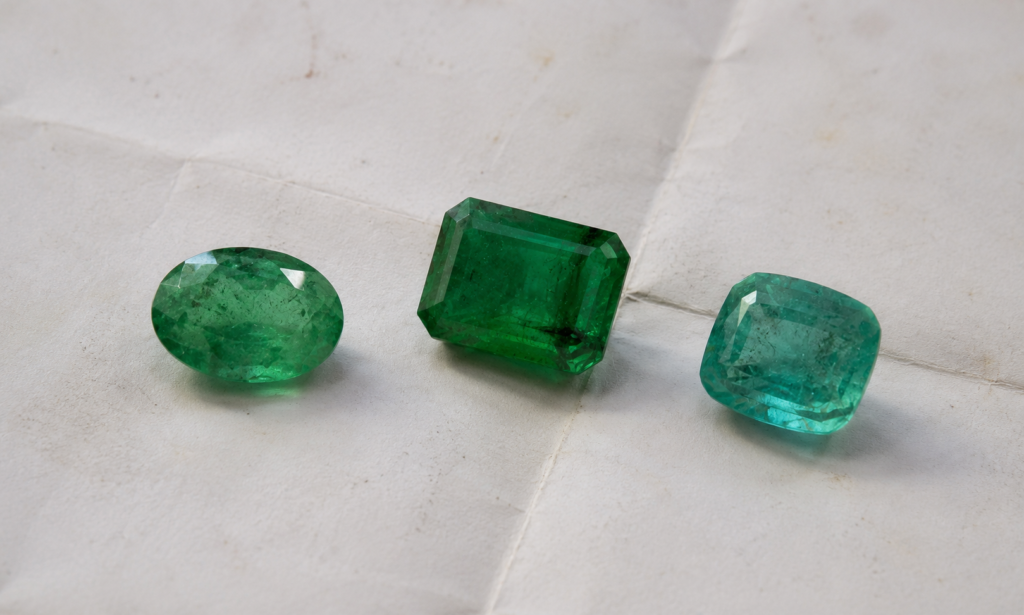
Two emeralds can both contain visible inclusions and still create very different impressions. In one stone, fine internal features may sit quietly behind a strong green colour. In another, a large central or strongly contrasting inclusion may become the dominant feature of the face-up view.
The useful question is therefore not simply whether inclusions exist. It is whether they overpower the gemstone as a whole.
Colour Can Lead the Stone
Colour is central to emerald’s identity. But beautiful emerald colour does not need to mean one exact shade that everyone should prefer.
One emerald may feel open and fresh. Another may carry a richer, deeper green. A cooler bluish-green stone can create a very different mood from one that reads as a more direct green. Individual preference matters because these different expressions do not create the same emotional response.
When the colour has enough presence, visible jardin can remain part of the stone without becoming its entire identity.
In a beautiful emerald, colour does not have to hide the inclusions. It only needs to remain the stronger impression.
Transparency Is Not the Same as Looking Flawless
Clarity and transparency are closely connected in emerald, but it is useful to think about what the eye actually experiences. An emerald can contain inclusions that are easy to see and still allow enough light through the stone to feel open and transparent.
Another stone may not have one dramatic inclusion, yet a dense concentration of internal features can make it appear cloudy, sleepy or closed. In that case, the overall transparency may be affected more strongly.
This is why simply counting inclusions rarely tells the whole story. Their size, position, contrast and combined effect on transparency matter more than their existence alone.
An emerald can be visibly included and still feel transparent.
When Jardin Becomes Texture
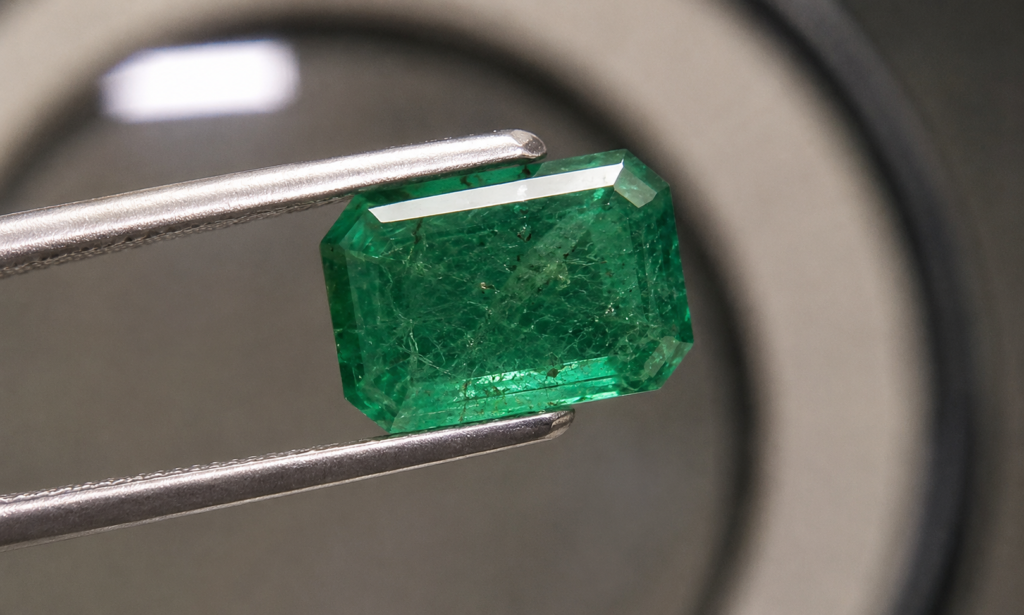
Emerald inclusions are often described by the French word jardin, meaning “garden.” Fine fissures, small crystals, fluid features and other natural growth characteristics can create an internal landscape unlike the clean interior expected of some other gemstones.
In some emeralds, this jardin behaves almost like texture. It gives the eye something to discover beneath the colour without taking control of the whole stone. The emerald still reads first as green, luminous or rich; the internal world appears afterward.
That does not mean more jardin is automatically better. Dense inclusions can reduce transparency, strongly contrasting inclusions can interrupt the face-up appearance, and significant fissures may also be relevant to durability.
A useful distinction is that natural does not mean irrelevant, and visible does not automatically mean unattractive.
Not Every Inclusion Has the Same Effect
The word “inclusion” covers many different internal features, and their visual impact can vary considerably.
- Fine, dispersed features may create texture without becoming the first thing the eye notices.
- Central or strongly contrasting inclusions can attract attention more quickly because of their position or colour.
- Dense internal features can reduce transparency and make an emerald appear more closed.
- Significant fissures deserve attention not only for appearance but also because they can affect the durability of the individual stone.
So accepting inclusions as normal in emerald should never mean ignoring what those inclusions actually do. Understanding them allows us to be more nuanced, not less selective.
Cut Decides How the Character Is Seen
An emerald cutter works with a piece of rough that already contains its colour, internal features and structural limitations. Cutting cannot simply erase that history. Instead, the cutter decides how the finished stone will present it.
Orientation, depth, proportions and facet placement can influence how light moves through the gemstone and how strong or dark its colour appears. The cutter also has to consider fissures and vulnerable areas while deciding how much useful rough to preserve.
A thoughtful cut therefore does more than create a shape. It can support colour, brightness and balance while reducing the visual or structural impact of difficult areas in the rough.
A thoughtful cut does not remove an emerald’s character. It decides how that character is seen.
Sometimes the Internal World Makes the Stone More Individual
Imagine two emeralds with similar size, shape and green colour. Their internal landscapes can still be completely different.
One may contain fine branching fissures. Another may hold tiny crystals or soft-looking fluid features. These patterns can give each natural stone a visual individuality that becomes familiar the longer you look at it.
This should not be confused with using inclusions as proof of natural origin—laboratory-grown emeralds can also contain internal features. The point is simpler: within an individual emerald, the arrangement of its internal world contributes to how that particular stone looks and feels.
Two emeralds may share a colour. They will not share exactly the same internal world.
Beauty Changes with Distance
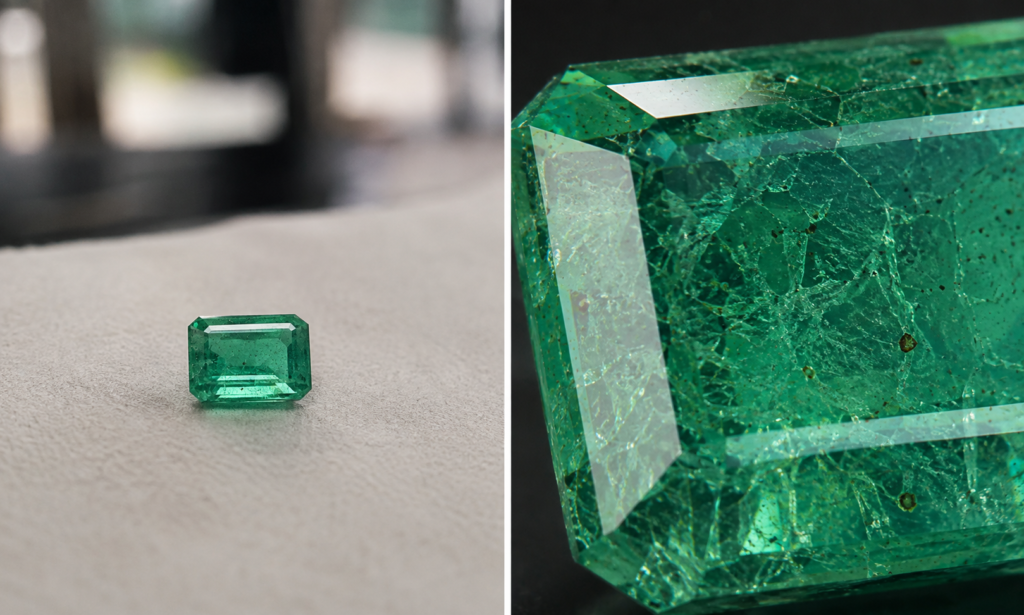
Modern gemstone photography lets us examine emeralds at a scale far larger than we normally see them. Macro images are valuable because they can reveal inclusions, fissures and other details that should not be hidden.
But jewelry is not experienced only through a macro lens. On a hand, at conversational distance or as light changes while the wearer moves, the eye may register colour, shape and overall presence before it resolves fine internal details.
Both views are useful. The close view helps us understand the stone. The normal view helps us experience how it actually presents itself.
Magnification helps us understand an emerald. It should not become the only distance from which we judge its beauty.
There Is No Need for One Formula
It is tempting to turn gemstone beauty into a formula: a certain percentage for colour, another for clarity, another for cut. Emerald resists that simplification particularly well.
One stone may have extraordinary colour and clearly visible jardin yet create a compelling overall impression. Another may be cleaner but have a colour or presence that simply does not speak to you in the same way.
This does not mean quality factors disappear. Colour, transparency, inclusions and cut all matter. What changes is the way we use them: as tools for understanding what we see rather than rules that decide what everyone must prefer.
When the Stone Arrives Before the Flaws
When an emerald feels beautiful, we may still know exactly where its inclusions are. We can see them honestly. We do not need to pretend that they are absent or that every one of them adds value.
But they may not be the first thing we want to say about the stone. The first impression might instead be its green, its depth, its brightness or simply the way the whole gemstone holds our attention.
That is one of the most useful ways to understand emerald beauty: not as the absence of imperfection, but as the balance that determines whether those imperfections dominate the stone or become only one part of its character.
Perhaps a beautiful emerald is not a stone without imperfections, but a stone whose character reaches you before you begin counting them.