

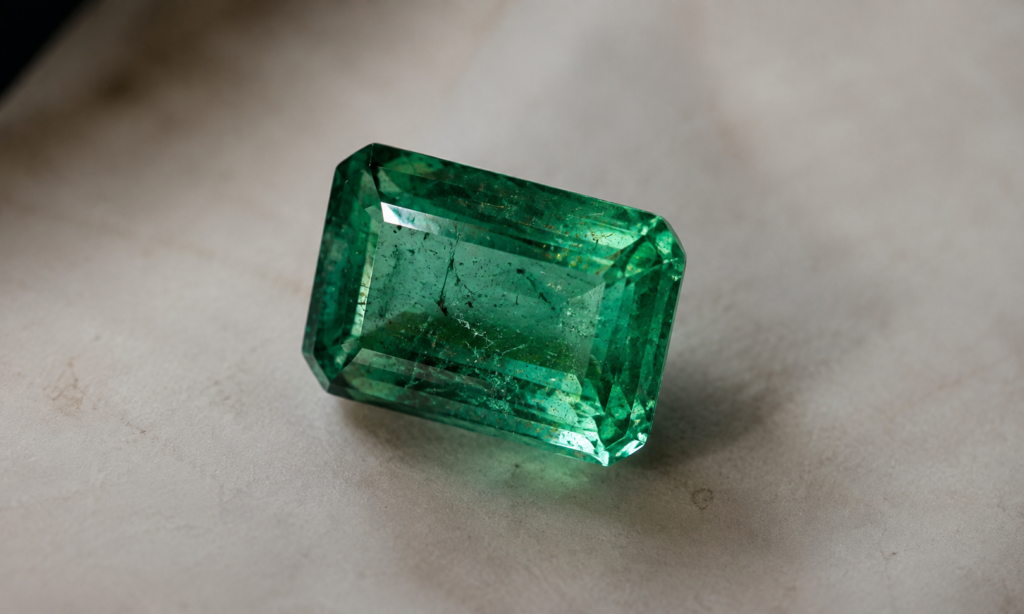
Look closely into a natural emerald and the interior is rarely empty. Fine fissures may cross the stone. Tiny crystals can sit inside it. Fluid inclusions, clouds and growth features can create an internal landscape that looks completely different from one emerald to another.
This is normal enough that eye-visible inclusions are commonly accepted in emerald. But accepting inclusions does not mean treating every inclusion as beautiful or unimportant. The useful question is not simply whether an emerald has inclusions. It is what those inclusions do to the stone.
Why Are Inclusions So Common in Emerald?
Before an emerald becomes a polished gemstone, it is a crystal growing within a geological environment. During that history, foreign crystals, liquids and gases can become trapped as inclusions. Crystals can also fracture, and some fractures may partially heal as geological processes continue.
Emeralds are particularly well known for this complex internal world. Fluid inclusions, partially healed fissures, needles and solid mineral crystals are among the features gemologists commonly encounter.
Before an emerald became a polished gemstone, it was a crystal growing inside an active geological environment. Its interior can preserve traces of that history.
Jardin: Why Emerald Inclusions Became a “Garden”
The French word jardin means “garden,” and it has become a familiar trade expression for the mossy, branching or garden-like internal appearance seen in many emeralds.
Jardin is not the scientific name of one particular inclusion. What we experience visually as an emerald’s garden can involve different features—crystals, fluid inclusions, fine fissures, growth structures and combinations of them.
The term is useful because it describes an impression: an interior that contains texture, depth and structure rather than an empty transparent space.
Not All Inclusions Look the Same
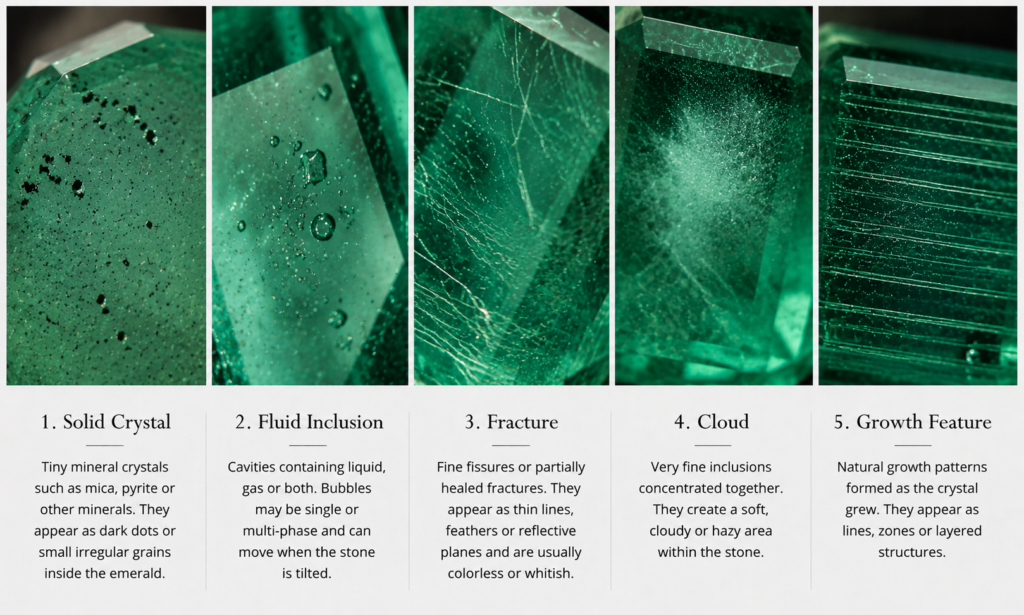
The word “inclusion” covers many different things. An emerald can contain several kinds of internal features at the same time.
- Solid crystals can appear as tiny mineral crystals enclosed within the emerald.
- Fluid inclusions are small cavities containing liquid, gas and sometimes solid phases trapped during the stone’s geological history.
- Fine fissures and partially healed fractures can appear as lines, branches or reflective internal patterns.
- Clouds or concentrations of very small inclusions can soften the appearance of part of the stone.
- Growth features can record aspects of how the crystal developed.
These categories are useful for understanding what might be present, but an emerald should not be reduced to a checklist of microscopic features. What matters visually is how all of them interact in the finished stone.
Inclusions Can Tell Gemologists a Story
To a gemologist, inclusions are not useful only for judging clarity. They can contain information about how a gemstone formed.
Microscopic inclusion scenes can contribute to separating natural emerald from laboratory-grown material. They are also an important part of geographic-origin work, where laboratories compare internal features with trace-element chemistry, spectroscopy and reference samples from known deposits.
Some inclusion scenes are associated more strongly with particular geological environments or sources, but there is considerable overlap between emerald deposits. Similar-looking inclusions can occur in stones from different countries, and some emeralds do not contain sufficiently diagnostic features.
An inclusion can be information. But one familiar-looking inclusion should not automatically become proof of origin.
Visible Does Not Mean the Same Thing as Distracting
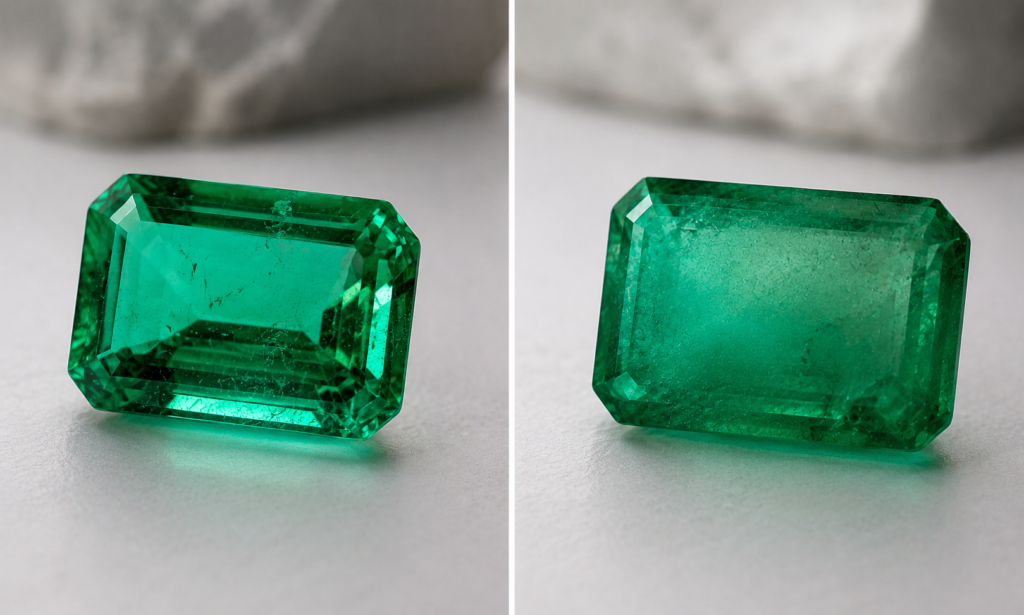
Two emeralds can both have inclusions visible to the unaided eye and still look remarkably different.
In one, fine jardin may be distributed through the stone while colour and transparency remain the dominant impression. In another, a dark or strongly reflective feature directly beneath the table may attract the eye immediately.
Both stones are “visibly included,” but that description alone does not tell us how the inclusions affect their appearance.
Position, contrast, density and reflection all matter. An inclusion near an edge may behave very differently visually from a similar feature sitting in the centre of the face-up view.
Clarity and Transparency Are Related—but Not Identical
Clarity describes the internal and external features we can observe in a gemstone. Transparency describes how effectively light can pass through it. In emerald, the two are closely connected, but looking only for individual inclusions can miss the larger visual effect.
An emerald can have obvious jardin and still feel relatively open because light continues to move through the stone. Another may lack one dramatic inclusion but contain enough fine internal material to appear cloudy or closed.
A visibly included emerald can still feel open. A heavily clouded emerald can feel closed without one dramatic inclusion.
When Does an Inclusion Affect Beauty?
There is no need to turn emerald clarity into a rigid formula, but a few observations help explain why some inclusions feel quiet while others dominate.
- Position: Is the feature directly beneath the table, near the edge or somewhere less visually prominent?
- Contrast: Does it blend gently into the stone, or is it dark or bright enough to pull attention immediately?
- Density: Are the internal features fine and dispersed, or concentrated enough to reduce transparency?
- Reflection: Does a fissure flash strongly as the stone moves, making it more noticeable from certain angles?
- Overall impression: After noticing the inclusions, does the emerald still read as a complete gemstone rather than as a collection of internal features?
The effect matters more than the mere presence.
When Does an Inclusion Become a Durability Question?
Appearance and durability are separate questions. A small crystal enclosed within the body of an emerald may have little structural significance, while a substantial fissure can deserve more attention.
Surface-reaching fractures are particularly relevant because emerald is commonly fissured and is less tough than some other familiar jewellery gemstones. The size, position and extent of a fissure can influence how a cutter, setter or jeweller handles the individual stone.
This does not mean every visible fissure makes an emerald unsuitable for jewellery. It means structural features should be understood rather than dismissed simply because inclusions are normal in emerald.
Beauty and durability are two different questions. A thoughtful evaluation considers both.
Why Are Emeralds Often Clarity Enhanced?
Many emeralds contain fissures that reach the surface. When air occupies those fissures, the optical difference between the emerald and the material inside the opening can make the fissure more visible.
For this reason, clarity enhancement is common in the emerald trade. Oils, resins or other suitable filling materials can be introduced into surface-reaching fissures to reduce their visibility and improve apparent clarity.
The treatment does not erase the original fissure. It changes how easily that fissure can be seen. The type and extent of enhancement are therefore separate pieces of information worth understanding when evaluating an emerald.
Can a Very Clean Natural Emerald Exist?
Yes. Natural emeralds with no inclusions visible to the unaided eye do exist, but they are rare. When attractive colour, strong transparency, desirable size and exceptional clarity occur together, the combination can be particularly uncommon.
Recognising that rarity does not require us to treat every included emerald as inferior. It simply keeps the discussion balanced: clarity still matters, while visible inclusions remain normal enough that they must be judged by their effect rather than by their presence alone.
Clean emeralds can be exceptional because they are uncommon. Included emeralds can be exceptional for entirely different reasons.
Why Macro Photography Changes the Way We See Clarity
A gemstone only a few millimetres across can fill an entire screen in a macro photograph. Features that are subtle at normal viewing distance can suddenly appear large and prominent.
This is useful. Magnification helps reveal fissures, inclusions and other details that should not be hidden when they matter to understanding the stone. But the scale of the image also changes our perception of proportion.
Magnification reveals information. It also changes proportion.
A complete view of clarity therefore benefits from both perspectives: inspect closely enough to understand the internal features, then return to a realistic viewing distance to see how strongly those features influence the emerald as a whole.
Learning to Read an Emerald
Seeing an inclusion does not need to trigger an immediate conclusion. Instead, it can begin a series of more useful questions.
- What kind of visual effect does the feature create?
- Where is it positioned?
- Is it obvious at a normal viewing distance or mainly under magnification?
- Does it noticeably reduce transparency?
- Could it be relevant to durability?
- And after considering all of that, how does the emerald work as a whole?
This is a more useful way to understand emerald clarity than treating every visible feature as equivalent.
The Interior Is Part of the Story
Long before an emerald reached a cutting wheel or a jewellery bench, it was a crystal forming within the earth. Minerals, fluids, growth processes, fractures and geological events could all leave traces inside it.
Some of those traces eventually become what the trade poetically calls jardin. They can add visual character and provide gemological information. They can also reduce transparency or, in some cases, raise questions about durability.
Understanding emerald clarity therefore requires neither celebrating inclusions blindly nor dismissing them automatically. It means learning to see what is inside the stone—and then understanding how much that interior changes everything else we see.
An emerald’s inclusions are part of the stone’s history. Learning how they affect the whole emerald is part of learning how to see it.