


Emerald clarity treatment can sound more mysterious than it really is. Words such as oil, resin, minor, moderate and no indications of clarity enhancement often appear in laboratory reports and trade conversations, yet they describe something quite specific: what has been done to make certain fissures in an emerald less visible.
Natural emeralds commonly contain fissures, and some of those fissures reach the surface. When a suitable filling substance enters a surface-reaching fissure, the optical contrast can be reduced and the fissure may become less apparent.
Clarity enhancement does not remove an emerald’s fissures. It makes some surface-reaching fissures less visible.
Why Are Emeralds Commonly Clarity Enhanced?
Emerald has a long history of clarity enhancement because fissures are so common in the material. Filling a surface-reaching fissure with an oil or another suitable substance can reduce how strongly that fissure stands out from the surrounding emerald.
This does not turn a natural emerald into a synthetic gemstone. It does not heal the crystal or erase the original fracture. The emerald remains natural; its clarity has been enhanced.
Treatment changes what we see. It does not rewrite how the crystal originally grew.
What Does the Filler Actually Do?
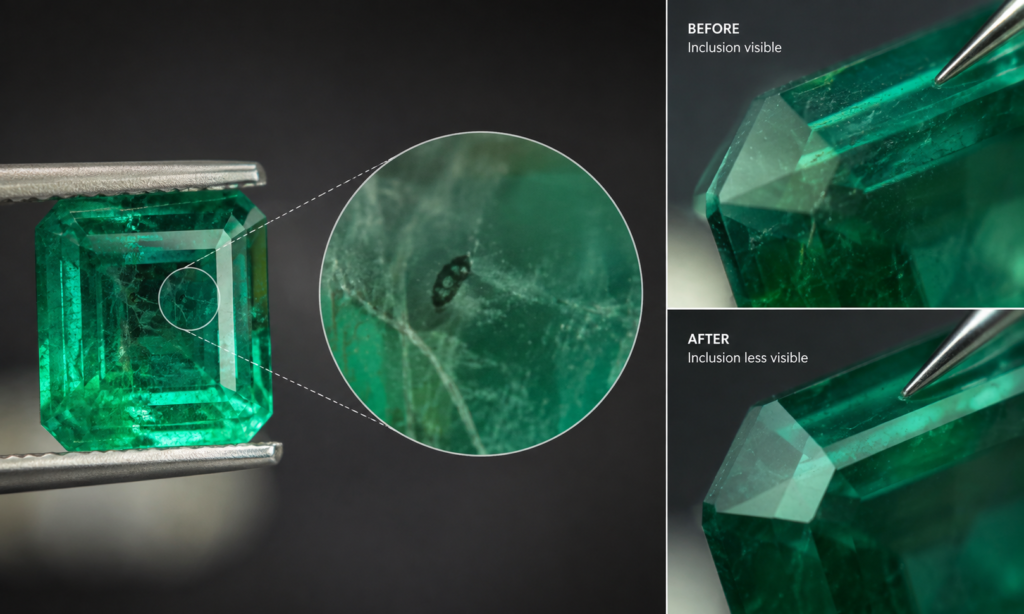
A surface-reaching fissure containing air can be conspicuous because light encounters a strong optical boundary between emerald and the material inside the opening. Replacing some of that air with a transparent filler whose optical properties are closer to the host gemstone can reduce the contrast.
The fissure has not disappeared. It has simply become more difficult to see.
Why Oil?
Oil has been used to improve the apparent clarity of emeralds for centuries. A low-viscosity oil can enter fine surface-reaching fissures and make them less visible.
Cedarwood oil is one of the traditional fillers frequently discussed in the emerald trade, but “oiled emerald” should not automatically be read as “cedarwood oil.” Different oils and filling substances can be used, and laboratories may not always identify or report the exact substance present.
Then What Is Resin?
Oil is not the only material used for emerald clarity enhancement. Artificial resins and other polymer-type substances can also be introduced into surface-reaching fissures.
The basic optical purpose is similar: reduce the visibility of the fissure. The physical behaviour of the filler, however, can differ. Some resins are more viscous than traditional oils, and some formulations can harden or polymerise after they are introduced.
That difference is worth understanding without turning it into a simple hierarchy of “oil good, resin bad.” The exact filler, its stability and its effect on the stone are separate pieces of information.
Oil and Resin Are Not the Same Thing
| Oil | Resin / Polymer-Type Filler | |
|---|---|---|
| Basic purpose | Reduce visibility of surface-reaching fissures | Reduce visibility of surface-reaching fissures |
| Physical character | Liquid oil | Properties vary; some materials are more viscous or can harden |
| Long-term behaviour | Can migrate, dry or change over time | Depends strongly on the formulation and whether it polymerises |
| Disclosure | Clarity enhancement should be disclosed | Clarity enhancement should be disclosed |
| Does it make the emerald synthetic? | No | No |
Neither column tells us, by itself, whether the emerald is beautiful. It tells us something about how its clarity has been altered.
What Do Minor, Moderate and Significant Mean?
Gemological laboratories can describe the extent of clarity enhancement using terms such as minor, moderate and significant, although exact terminology and procedures can vary between laboratories.
These descriptions are not measurements of how many millilitres of oil or resin are inside the stone. They are laboratory assessments of the extent of clarity enhancement observed in the emerald at the time of examination.
In broad terms, minor indicates a limited degree of enhancement, moderate indicates a greater extent, and significant indicates more extensive enhancement. The wording should always be read according to the issuing laboratory’s own reporting system.
The terminology describes the extent of enhancement—not the beauty of the emerald.
Does Minor Oil Mean Fewer Inclusions?
Not necessarily.
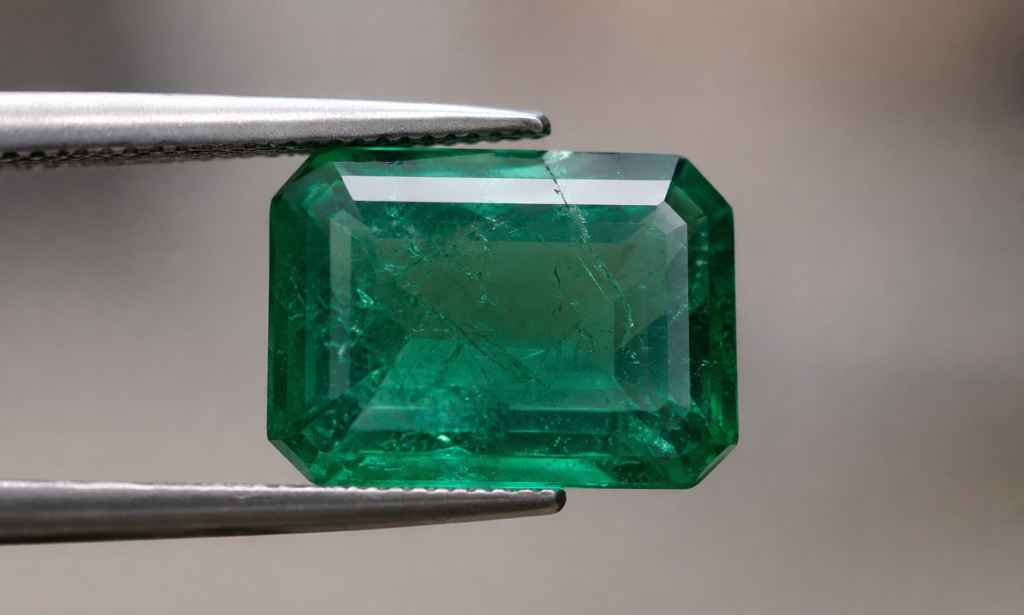
A filler can enter fissures that reach the surface, but an emerald may also contain enclosed mineral crystals, fluid inclusions, closed fissures and growth features that are not filled in the same way.
An emerald described as having minor clarity enhancement can therefore still have a clearly visible jardin. Likewise, an emerald that appears relatively clean should not automatically be assumed to have no clarity enhancement.
Clarity describes what we see within the stone. Enhancement describes an intervention that changes the visibility of some features.
What Does “No Oil” Actually Mean?
“No oil” is widely used in the market, but when reading a laboratory report it is better to pay attention to the laboratory’s exact wording. A report may state that no indications of clarity enhancement were detected, or use another defined expression within that laboratory’s system.
That finding does not mean the emerald has no inclusions or no fissures. It does not automatically mean the colour is more beautiful, the origin is more desirable or the stone will appeal more strongly to every person.
What it can mean in the market is rarity. Fine natural emeralds combining desirable colour, transparency and size with no detectable clarity enhancement can command substantial premiums because that combination is uncommon.
Can Oil Change Over Time?
Yes. Some oils can dry, migrate or otherwise change with time and exposure. If filler leaves a fissure or its optical properties change, the fissure may become more visible again.
This does not mean the emerald itself has suddenly developed a new fracture. The appearance of an existing fissure may simply have changed as the filler changed.
Re-treatment or re-oiling can sometimes be performed by an experienced specialist. Any new treatment should become part of the stone’s current disclosure.
Can Resin Be Removed?
There is no useful universal answer because resin-type fillers vary considerably. Their stability and reversibility depend on their composition, whether they have hardened or polymerised, and how they were introduced into the stone.
Some fillers can be more difficult to remove than traditional oils. For that reason, statements such as “resin is permanent” or “resin can always be removed” are too broad. Valuable emeralds should be assessed by a specialist before attempting cleaning, filler removal or re-treatment.
Does Clarity Enhancement Affect Value?
It can. When other important factors are comparable, emeralds with less clarity enhancement—or with no indications of enhancement—can receive a market premium, particularly at the exceptional end of the market.
Real emeralds, however, are rarely identical in every other respect. Colour, transparency, size, cut, origin, overall condition and the individual beauty of the stone all contribute to how it is perceived and valued.
A moderately enhanced emerald with a colour someone finds extraordinary may be more personally compelling than an untreated emerald whose appearance does not speak to them.
Treatment is part of an emerald’s value story. It is not the whole story.
Does Treatment Make an Emerald Less Natural?
No. Natural versus laboratory-grown and treated versus untreated describe different things.
| Stone | What It Means |
|---|---|
| Natural emerald + clarity enhancement | A natural emerald whose surface-reaching fissures have been filled to improve apparent clarity |
| Natural emerald + no indications of clarity enhancement | A natural emerald in which the laboratory did not detect clarity enhancement under its examination criteria |
| Laboratory-grown emerald | Emerald material grown by a synthetic process rather than formed naturally in the earth |
A treated natural emerald is still a natural emerald. Treatment should be disclosed because it is important information about the stone, not because it changes its geological origin into something synthetic.
Why Disclosure Matters
Clarity enhancement does not need to be frightening. The problem arises when important treatment information is unknown, withheld or represented inaccurately.
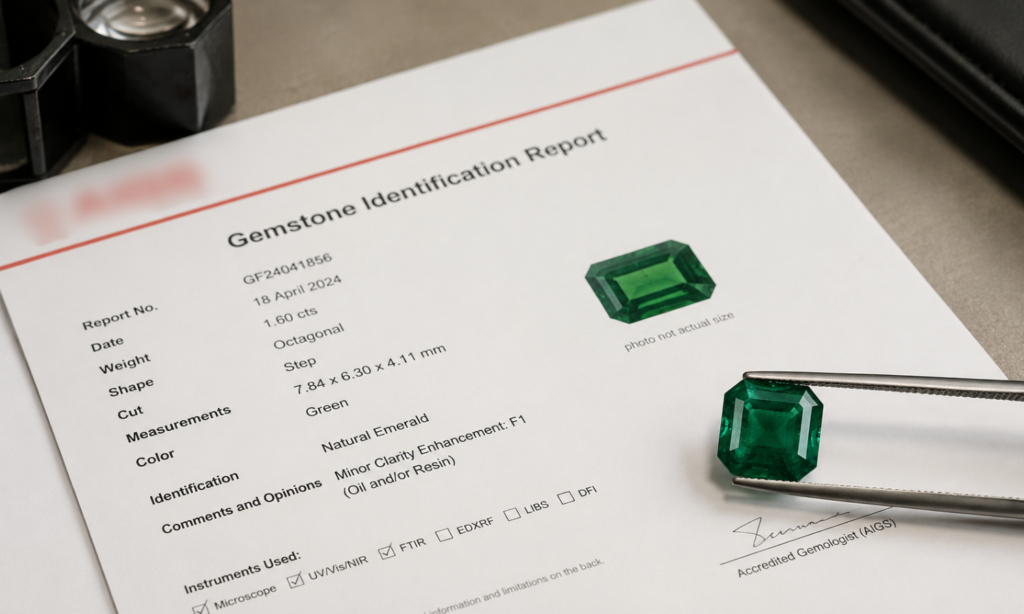
Knowing that an emerald is natural, whether clarity enhancement has been detected, the reported extent of that enhancement and—when it can be established—the nature of the filler gives the buyer a clearer picture of what they are considering.
Disclosure does not make a treated emerald less beautiful. It makes the transaction more transparent.
How Should an Enhanced Emerald Be Cared For?
Emerald deserves thoughtful cleaning because both its fissures and the substances used to fill them can be sensitive to aggressive treatment.
Ultrasonic and steam cleaning are generally not recommended for emerald. High heat and harsh chemicals can also affect fillers or make existing fissures more problematic. Gentle cleaning with lukewarm water, mild soap and a soft cloth or brush is a safer approach for routine care.
For a valuable emerald, or whenever the treatment history is uncertain, professional advice is preferable before deep cleaning, repair or resetting.
Treatment Is Information
When a laboratory report says minor, moderate, significant or no indications of clarity enhancement, it is tempting to translate the words immediately into “good” or “bad.” That loses much of what the information is actually telling us.
Treatment information helps explain how the emerald’s present appearance relates to its natural fissures. It can inform value, care, disclosure and our understanding of the individual stone.
It should be considered alongside colour, transparency, cut, condition and the overall impression of the emerald—not used as a substitute for looking at the gemstone itself.
Clarity enhancement does not decide whether an emerald is beautiful. It tells us something important about how the emerald we see today came to look the way it does.