

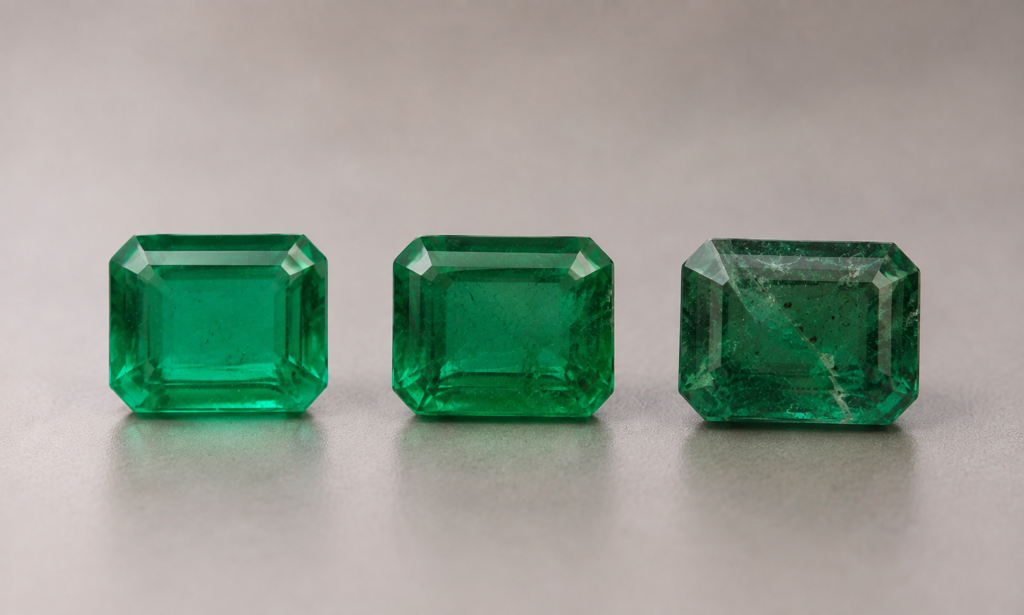
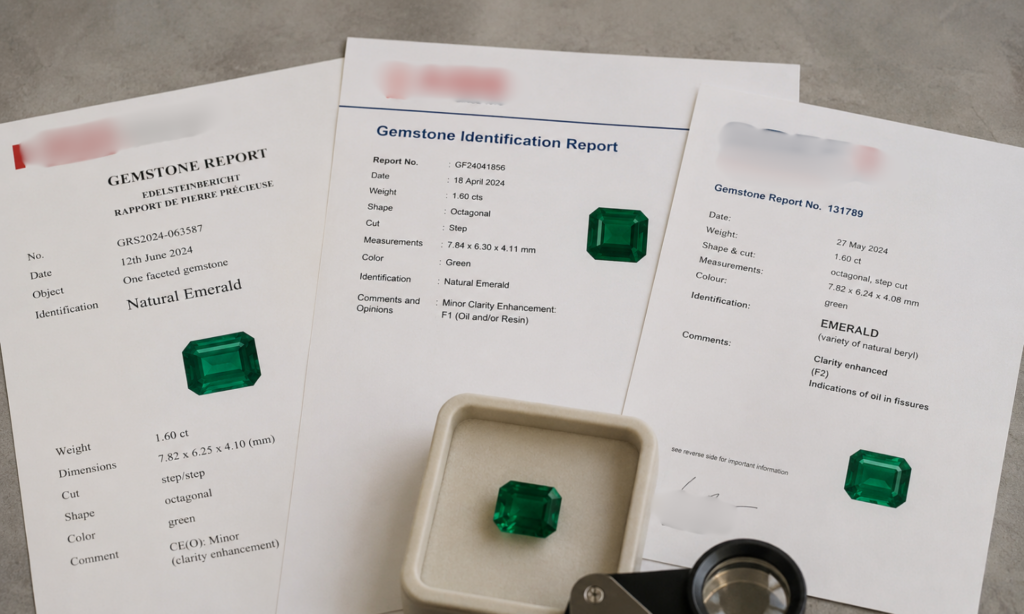
Place two emeralds side by side. One laboratory report says minor clarity enhancement. The other says moderate clarity enhancement. It is tempting to choose the first stone immediately, before looking closely at either emerald.
But minor, moderate and significant are not beauty grades. They describe a laboratory’s assessment of the extent of clarity enhancement detected in an emerald. Understanding that distinction makes these words much more useful.
Minor, moderate and significant describe the extent of clarity enhancement detected by a laboratory. They are not grades of an emerald’s beauty.
They Do Not Measure How Much Oil Was Poured Into the Stone
One of the easiest misconceptions is to read the terms as quantities of liquid: minor means a little oil, moderate means a medium amount, and significant means a large volume. That is not what the terminology is designed to communicate. Laboratories assess the extent of clarity enhancement according to their own defined procedures; they are not extracting the filler and measuring it by volume.
Think of the words as an assessment of enhancement—not a measurement of liquid.
How Can a Laboratory Evaluate the Extent?
Emerald clarity enhancement commonly involves filling surface-reaching fissures with oil, resin or another transparent substance to make those fissures less visible. Under magnification and appropriate lighting, trained gemologists can examine fissures for evidence of filler and features associated with clarity enhancement. The laboratory then evaluates the extent according to its own methodology and reporting system.
Laboratories do not all use identical terminology, scales or report formats. A treatment description should therefore be understood within the system of the laboratory that issued it.
What Does Minor Clarity Enhancement Mean?
In a laboratory system using the term minor, it broadly indicates that clarity enhancement has been detected but its extent is assessed at the lower end of that laboratory’s scale.
What Minor Tells You
It tells you that the laboratory detected clarity enhancement and assessed its extent as limited according to its criteria.
What Minor Does Not Tell You
It does not tell you that the emerald is clean, beautifully coloured, highly transparent, more durable, from a particular origin or automatically better value. A minor-enhanced emerald can still contain abundant jardin, mineral crystals, fluid inclusions and other internal features.
What Does Moderate Clarity Enhancement Mean?
Moderate indicates a greater extent of clarity enhancement than minor within a laboratory system that uses those categories. What it does not mean is “medium-quality emerald.” A moderately enhanced emerald can still have beautiful colour, strong transparency, an attractive cut and considerable visual presence.
The treatment information simply becomes a more important part of understanding the stone. It may be useful to consider how much its present appearance depends on filled fissures, how stable the filler may be, and how the emerald should be cared for over time.
Moderate describes treatment extent, not mediocrity.
What Does Significant Clarity Enhancement Mean?
Significant indicates a more extensive degree of clarity enhancement according to the issuing laboratory’s scale. This deserves attention because filler and the fissures it occupies may play a larger role in the emerald’s apparent clarity. Changes to filler over time could therefore have a more noticeable effect on appearance in some stones.
But significant enhancement does not mean synthetic. A naturally formed emerald can be significantly clarity enhanced and remain a natural emerald. Natural origin and treatment history describe different things.
Significant enhancement does not make an emerald synthetic. It makes the treatment history more important to understand.
Putting the Three Terms Side by Side
| Report wording | Broad meaning | What it does not mean |
|---|---|---|
| Minor | Limited extent of clarity enhancement within the laboratory’s scale | Automatically beautiful, clean or structurally stronger |
| Moderate | Greater extent of clarity enhancement | A medium-quality emerald |
| Significant | More extensive clarity enhancement | A synthetic or fake emerald |
These are broad explanations rather than universal thresholds. Exact terminology and assessment criteria depend on the issuing laboratory.
Why Two Laboratories May Not Use Exactly the Same Wording
Gemological laboratories develop their own examination protocols, comparison standards and report language. Some use categories such as minor, moderate and significant. Others may use additional subdivisions or different wording.
A treatment description belongs to the laboratory system that issued it.
Does Minor Mean the Emerald Has Only Small Fissures?
No. The extent of clarity enhancement and the complete physical structure of every fissure are not the same measurement. A treatment assessment does not map how many fractures exist, their exact dimensions, where each sits or how the stone will respond to mechanical stress.
Treatment extent is not a durability grade.
Does Significant Mean the Emerald Will Break?
No. Significant enhancement by itself does not predict that an emerald will break. Durability depends on the actual fissures and other structural features present—their location, extent and relationship to vulnerable areas—as well as how the emerald is set, worn and handled. A report term alone is not a mechanical-strength test.
Can the Treatment Assessment Change Later?
A laboratory report records observations made when the emerald is examined. An emerald might later be re-oiled, have filler removed or partially lost, or undergo re-treatment with another filling substance. Oil can also migrate or change over time. If the treatment condition changes sufficiently, a future examination may not necessarily describe the stone exactly as an earlier report did.
Why Does the Market Often Prefer Lower Enhancement?
When emeralds are genuinely comparable in other important respects, the market can place a premium on stones with less clarity enhancement, particularly fine emeralds in which no enhancement is detected. Rarity is part of the reason.
But real emeralds vary in colour, transparency, size, cut, origin, clarity, condition and overall presence. A moderately enhanced emerald with exceptional colour can be more valuable—or simply more desirable to a particular person—than a minor-enhanced emerald with less compelling appearance.
Lower enhancement can add rarity. It does not automatically create beauty.
How Should You Actually Read the Report?
- Confirm identity. Is the emerald natural or laboratory-grown?
- Read the treatment finding. Was clarity enhancement detected?
- Read the reported extent. What category did the laboratory assign?
- Identify the laboratory. Understand the wording within that laboratory’s reporting system.
- Return to the gemstone. Look at colour, transparency, inclusions, cut and physical condition.
- Consider value in context. Decide whether the price reflects the whole emerald rather than one line on the report.
A Better Question Than “Is Minor Good?”
Asking whether minor is “good” turns a useful piece of information into a verdict. A better question is: What is this emerald like as a whole? Do you respond to its colour? Does it feel transparent and alive? Are the inclusions distracting at a normal viewing distance? What is the treatment extent? Is the physical condition appropriate for the intended jewellery? And does the price make sense once those factors are considered together?
Minor, moderate or significant can help answer part of that evaluation. None of them can complete it alone.
Read the Word, Then Look at the Stone
Minor, moderate and significant are valuable terms because they help communicate the extent of clarity enhancement observed by a laboratory. The problem begins when we ask those words to tell us things they were never designed to answer: whether the colour is beautiful, whether we will personally love the stone, whether every fissure is structurally harmless or whether the price is fair.
Read the treatment level carefully. Understand what it tells you—and what it does not. Then return to the emerald.
The report describes the stone, but it does not experience the stone for you.