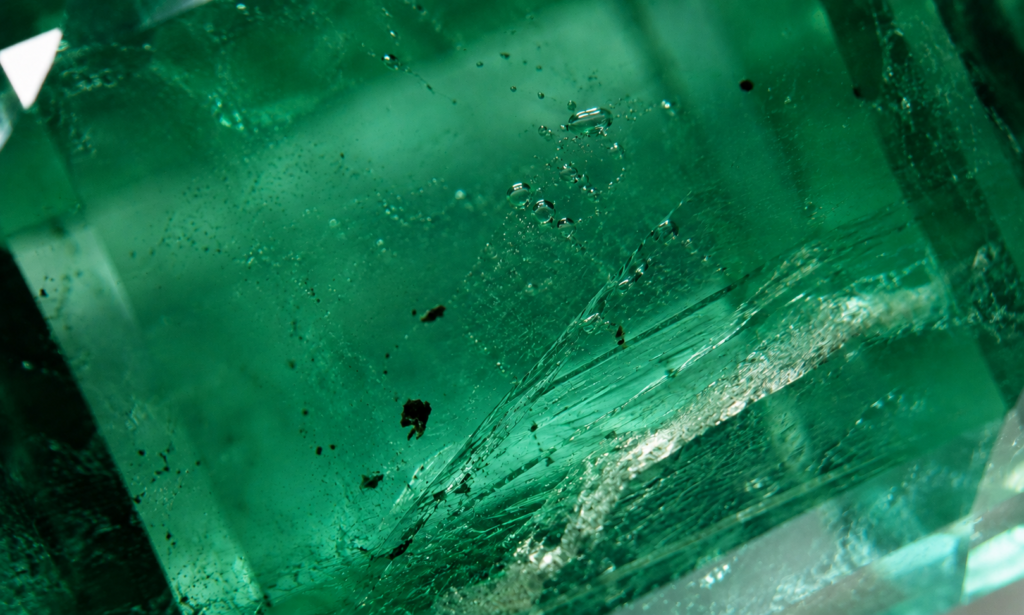

Place an emerald beside several familiar transparent gemstones and its interior can look unusually busy. Crystals, fluid inclusions, fissures, clouds and the garden-like scenes known as jardin are common enough that visible inclusions have become part of how emerald is understood.
The interesting question is not simply why emerald has inclusions. It is why its geological history so often leaves such a visible record inside the finished gemstone.
To understand why emeralds are so often included, we have to go back to the unusual conditions that allow an emerald to exist at all.
Emerald Needs an Unusual Geological Meeting
Emerald is the green to bluish-green variety of beryl. Beryl contains beryllium, while emerald colour is associated principally with chromium and/or vanadium.
The geological ingredients needed to create emerald are not always naturally concentrated in the same rocks. Important emerald deposits therefore depend on unusual geological processes that bring beryllium-bearing material into contact with rocks, fluids or environments capable of supplying the colouring elements.
That meeting can involve fluid movement, reactions between rocks, metamorphism, fractures and changing chemical conditions. There is no single formation mechanism shared by every emerald deposit, but complexity is a recurring part of the story.
The same unusual geological encounter that makes emerald possible also gives the crystal opportunities to record what was happening around it.
How Does Nature Bring the Ingredients Together?
Emerald deposits occur in more than one geological setting. In some deposits, hydrothermal fluids play a central role. In others, emerald formation is associated with metamorphic or metasomatic reactions, or with interactions involving beryllium-bearing pegmatitic material and chromium-bearing rocks.
The details differ from Colombia to Zambia and from one deposit to another. What matters for understanding inclusions is that emerald commonly forms in active geological environments where rocks react, fluids move and minerals crystallise together.
That is why it would be too simple to say that every emerald forms from the same kind of hydrothermal fluid. The routes are different, even when some of the evidence preserved inside the crystals can look superficially similar.
A Crystal Does Not Grow in an Empty Space
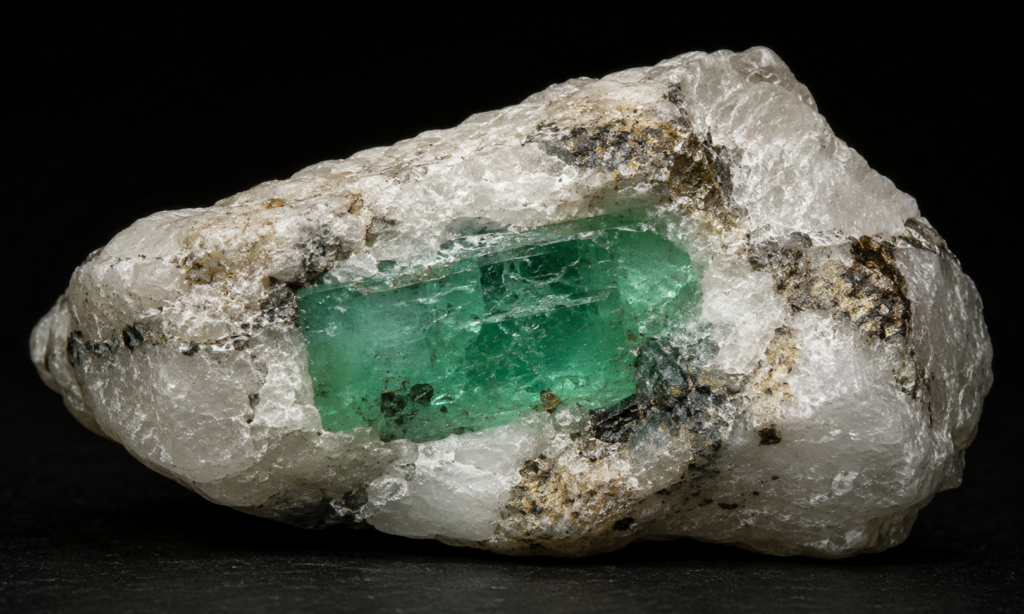
A growing emerald is surrounded by a geological environment: host rock, neighbouring minerals, fluids, chemical reactions, pressure and sometimes fractures. As the crystal develops, material associated with that environment can become enclosed within it.
Solid mineral crystals are one example. Depending on the deposit, emeralds can contain mica-group minerals, calcite, pyrite, magnetite and many other mineral inclusions. Their identity reflects the particular rocks and processes associated with formation.
An inclusion can be something the emerald met while it was growing.
Some Inclusions Are Trapped Fluids
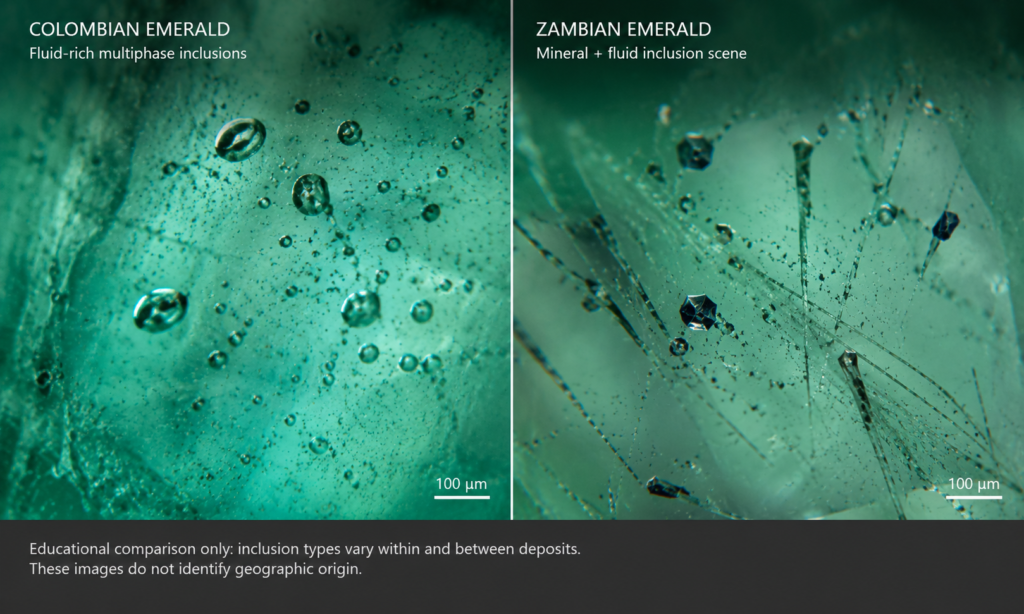
Tiny cavities inside emerald can preserve fluids associated with its geological history. Under magnification, some appear as two-phase or multiphase inclusions containing combinations of liquid, a gas bubble and one or more solid phases.
These microscopic scenes can preserve evidence of the fluid systems involved in emerald formation or later geological events. Gemologists study their shapes, contents and relationships to the host crystal because they can provide useful information about how a stone formed.
Not every fluid inclusion represents exactly the same moment in a crystal’s history. Primary, secondary and pseudosecondary relationships can record different stages, so the safest interpretation is that these inclusions can preserve evidence of fluids associated with the emerald’s geological history.
Some emerald inclusions are tiny remnants of fluids associated with the geological environment that shaped the crystal.
Emerald Can Also Record Fracturing and Healing
An emerald’s story does not necessarily end when its first crystal faces form. Rocks continue to move and geological conditions continue to change. A crystal can fracture while still underground, fluids can enter those fractures, and portions of a fissure can later heal.
Partially healed fissures and related internal patterns are common features in natural emeralds. This means some of what we see inside a finished stone may record events that happened after an earlier stage of crystal growth.
An emerald can record not only how it grew, but what happened to it while it was still inside the earth.
Colombia Shows One Version of the Story
Colombian emerald deposits provide a particularly distinctive geological example. In important Colombian deposits, hot saline hydrothermal fluids moved through fractured sedimentary rocks. Chemical reactions within this system created conditions in which emerald could crystallise in veins and fractures.
Fluid inclusions preserved in Colombian emeralds can reflect that fluid-rich environment. Famous multiphase inclusion scenes are part of the microscopic character associated with these stones.
But a familiar inclusion scene should never become an automatic origin label. Multiphase inclusions can occur in emeralds from other sources as well. Modern geographic-origin determination considers microscopy together with chemical and spectroscopic evidence rather than relying on a single inclusion.
Zambia Tells a Different Geological Story
The Kafubu area of Zambia illustrates a different route. Emerald formation there is associated with reactions involving beryllium-bearing pegmatitic or hydrothermal material and chromium-bearing metamorphic rocks.
Zambian emeralds can preserve mineral inclusions related to that environment, including minerals such as actinolite, phlogopite, magnetite, hematite and dravite. The exact inclusion population varies from stone to stone.
The interior of an emerald can reflect the environment that created it.
So Why Are Emeralds Often More Included Than Many Other Gemstones?
It is safer to say that emerald tends to be more visibly included than many familiar faceted gemstones rather than claiming it is the most included gemstone. Several factors come together.
Its formation requirements are unusual. Beryllium must encounter the colouring elements and suitable conditions required for emerald crystallisation.
Fluid-rich geological processes are important in many deposits. Fluids can become part of the microscopic record preserved inside the crystal.
Emerald grows among other minerals. Solid crystals from its geological environment can become enclosed during growth.
Fracturing and healing can become part of its history. Fissures and partially healed fractures can preserve later geological events.
The market also accepts visible inclusions in emerald. Eye-clean natural emerald is rare, so transparent and attractive emeralds with visible inclusions are routinely faceted and valued. This makes the included nature of emerald especially visible in the finished-gem market.
The last point is important. What we see in jewellery is shaped not only by geology, but also by which rough is considered worth cutting as a transparent gemstone.
Aquamarine Makes the Comparison Especially Interesting
Aquamarine and emerald belong to the same beryl mineral family, yet their clarity expectations can be dramatically different. Faceted aquamarine is commonly found with high apparent clarity, while visible inclusions are normal in emerald.
Their shared mineral structure does not mean they shared the same geological journey. Many aquamarines crystallise in pegmatitic environments capable of producing large, relatively clean beryl crystals. Emerald requires the additional geological circumstance of bringing beryllium together with chromium and/or vanadium under suitable conditions.
Same mineral family does not mean the same geological journey.
Are Emeralds Included Because They Are “Fragile”?
No. Inclusion formation should not be confused with softness or fragility. Many inclusions were trapped during crystal growth or formed through geological events while the emerald was still underground.
Emerald has a Mohs hardness of about 7.5 to 8, but hardness measures resistance to scratching, not resistance to every kind of breakage. Existing fissures can affect toughness, which is why the physical condition of an individual stone still matters.
In other words, included does not mean soft, and hardness does not mean an absence of fractures.
What Looks Like an Imperfection Can Become Evidence
To the unaided eye, an inclusion may simply look like an internal mark. Under the microscope, the same feature can become information.
Gemologists use inclusion scenes as part of natural-versus-synthetic identification, treatment detection and geographic-origin work. Mineral crystals, growth structures, fluid inclusions and healed fissures can all contribute clues.
Those clues must be interpreted carefully. Similar features can occur in multiple deposits, so modern origin determination combines microscopic observation with techniques such as spectroscopy and trace-element chemistry.
What looks like an imperfection to the eye can become evidence under the microscope.
Does That Mean More Inclusions Are Better?
No. Understanding why an inclusion exists does not automatically make it desirable.
Dense inclusions can reduce transparency, obscure colour or make an emerald appear cloudy. Certain fissures can also matter to durability. A geological story explains how internal features may have formed; it does not turn the quantity of inclusions into a quality scale.
A geological story can explain an inclusion. It does not automatically make the inclusion desirable.
The Garden Is a Record of Formation
The traditional word jardin—French for garden—captures the visual impression of emerald’s internal world. But after looking at how emerald forms, that garden can be understood as more than a decorative pattern.
It may contain evidence of crystal growth, surrounding minerals, fluids, fractures, healing and the geological environment through which the emerald developed. Different stones need not show the same garden because they did not necessarily share the same sequence of events.
The garden inside an emerald is not a pattern placed there for beauty. It is a record left by formation.
Emerald Carries Its Geological History Inside It
Emerald requires unusual conditions to exist. Beryllium-bearing material must meet the elements that create emerald colour. Rocks interact. Fluids may move. Crystals grow among other minerals. Fractures can open and partially heal.
Millions of years later, a cutter opens a window into that history and we see crystals, fluid inclusions, fissures and jardin beneath the polished surface.
Those features are not automatically beautiful, and they are not automatically problems. They are evidence that the interior of an emerald can preserve part of the geological process that made the gemstone possible.
Emeralds are often included not because nature failed to make them clean, but because their formation can leave a remarkably visible record of the conditions that made them possible.