



Today, Zambia is one of the most important names in the emerald world. The Kafubu area has become a major source of fine and commercial emerald, supported by large-scale modern mining and detailed geological exploration.
Yet the story began very differently. When beryl mineralisation was recorded in the Kafubu area in 1928, the occurrence was not immediately recognised as economically important.
One of the world’s great emerald regions was recognised long before the world understood what it had found.
The Story Begins in Copper Country
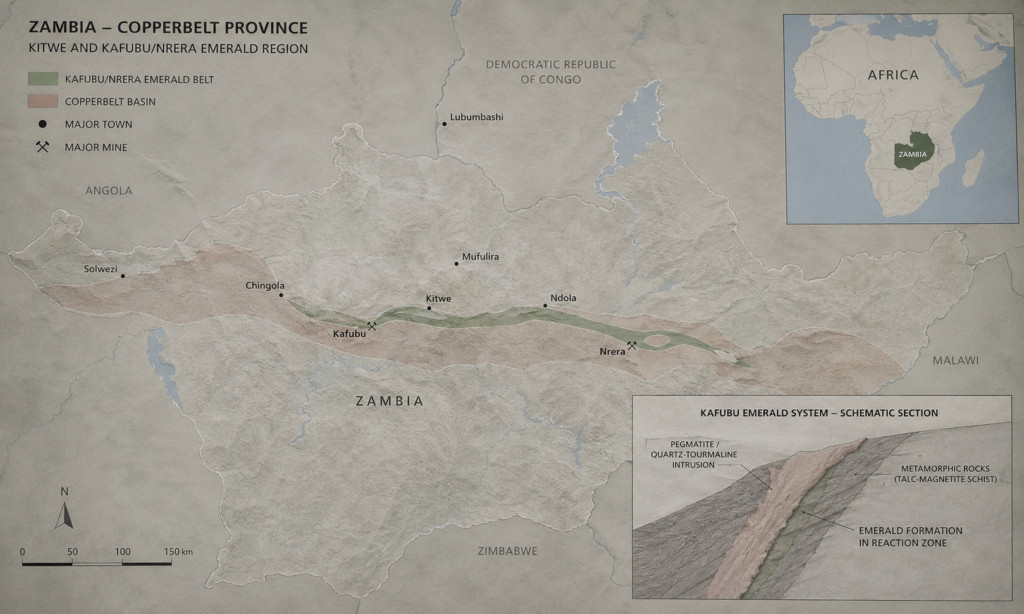
Kafubu lies near Kitwe in Zambia’s Copperbelt Province, a region shaped by generations of copper prospecting, mining infrastructure, geological work and industrial development. Zambia’s emerald story therefore emerged inside a country already deeply familiar with mineral exploration.
The people studying the ground were often looking first for metals. Emerald was present, but it was not yet the main story.
1928 — Beryl Is Found at Kafubu
In 1928, geologists working for the Rhodesia Congo Border Concession Company recorded beryl mineralisation in the Kafubu area near what later became known as the Miku mine. Further investigation continued into the early 1930s, but the occurrence was initially judged to have limited economic significance.
The emerald was there. The industry was simply looking for something else.
The Deposit Was Not Forgotten
Kafubu did not disappear from geological attention. Exploration continued intermittently through the following decades, including work by Rhokana Company in the 1940s and Rio Tinto Mineral Search of Africa in the 1950s.
By the 1960s and early 1970s, the area was being examined more systematically. Zambia’s Geological Survey Department mapped and documented the deposits, laying important groundwork for the commercial expansion that followed.
The 1970s Changed Everything
The 1970s marked the real turning point. Additional emerald-bearing areas were identified around Kafubu, including localities such as Kamakanga, Pirala, Fibolele and Fwaya-Fwaya.
As local discoveries combined with better geological understanding, exploration and production expanded rapidly. Kafubu shifted from an interesting beryl occurrence into an emerging commercial emerald district.
Zambian emerald did not rise through centuries of legend. It rose through discovery, geology and production.
Success Created a New Problem
Once the value of Kafubu’s emerald became clear, access to the deposits became more difficult to manage. Informal and unauthorised mining increased, and questions of land, licences and control became increasingly important.
The government responded by creating the Ndola Rural Emerald Restricted Area, or NRERA, to regulate a large portion of the emerald-producing zone.
The moment Kafubu’s value became clear, the question was no longer whether emerald was there—but who would be allowed to mine it.
1980 — Kagem Enters the Story
By 1980, state involvement in the emerald sector had become much more structured. Kagem Mining Ltd. emerged as a major operation in the Kafubu area, with substantial government ownership at the time.
Kagem would become one of the most important names in modern emerald production. Fine Zambian emerald has been produced from the operation for decades, and the mine eventually developed into a highly mechanised large-scale coloured-stone operation.
By the 1980s, Zambia Was No Longer a Minor Source
During the 1980s, Zambia became firmly established as an important international emerald source. Kafubu was capable of producing both fine stones and significant quantities of commercial material.
That consistency mattered. Zambia did not become important only because of occasional exceptional gems; it also became valuable to the jewellery industry because the deposits could support a broader and more regular supply.
Geology Made Industrial Mining Possible
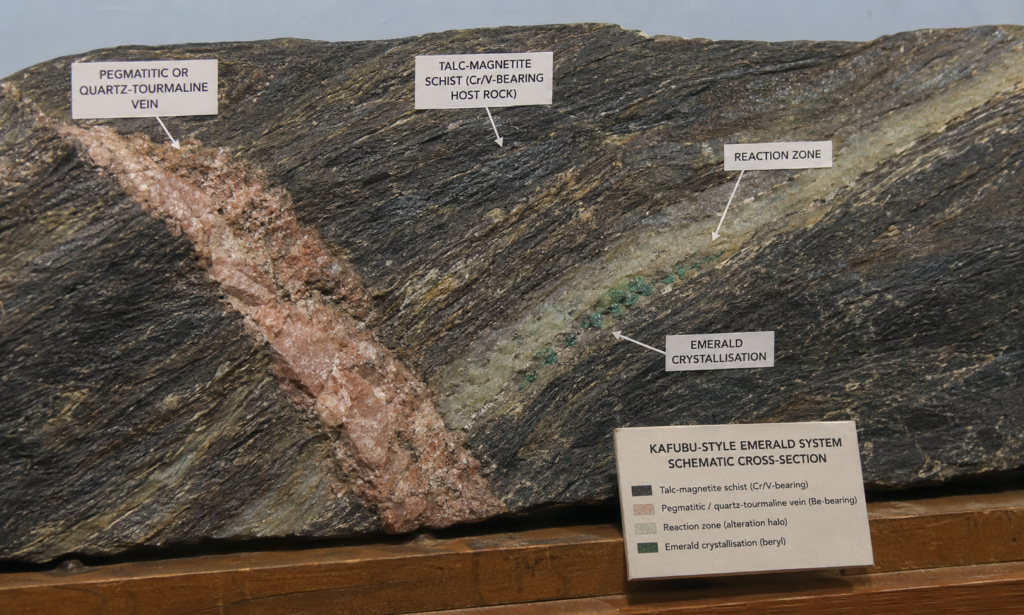
Kafubu emerald formed through geological processes very different from the black-shale hydrothermal system associated with Colombia. In the Kafubu area, beryllium-bearing pegmatitic or quartz-tourmaline material interacted with chromium- and vanadium-bearing metamorphic rocks, particularly talc-magnetite schist.
Emerald developed in reaction zones created by this interaction. This geological relationship became not only an explanation of formation, but a practical guide for exploration and mining.
Colombia and Zambia became two great emerald origins through very different geological journeys.
The Rock Itself Tells You Where to Look
At Kafubu, miners and geologists follow specific rock relationships rather than excavating randomly. Talc-magnetite schist, pegmatitic or quartz-tourmaline veins and the reaction zones between them are important exploration targets.
Structures where several geological features intersect can be especially favourable. The magnetic character of magnetite-rich host rocks has also helped geologists locate promising zones.
At Kafubu, geology does not merely explain where emerald formed. It tells miners where to dig.
Zambian Emerald Developed Its Own Visual Reputation
As Zambian emerald became more familiar to the international trade, it developed a recognised visual character. Many stones are associated with cooler green to bluish-green hues and, in some material, deeper tone.
Kafubu emerald commonly contains more iron than typical Colombian material, which can influence colour and absorption. But these are tendencies, not rules.
Zambian emerald has a recognised character, not a compulsory colour.
Its Internal World Is Different Too
The microscopic world of Kafubu emerald also reflects its geology. Documented inclusions include blocky fluid inclusions, mica-group minerals, amphibole such as actinolite, magnetite, hematite, phlogopite, dravite and partially healed fissures.
These features can provide evidence about the host rocks and processes involved in formation, although no single inclusion should be treated as automatic proof of Zambian origin.
The inclusions inside a Zambian emerald can preserve pieces of the rocks that helped create it.
Zambia Helped Change What the Emerald Market Looked Like
For much of modern gem history, international ideas about fine emerald were heavily influenced by Colombia. Zambia introduced a major alternative source capable of supplying both fine-quality stones and substantial commercial production.
This helped broaden the market’s understanding of what an important emerald origin could be. Fine emerald did not have to come from one geological environment or display one narrow visual character.
The Rise of Large-Scale Mechanised Mining
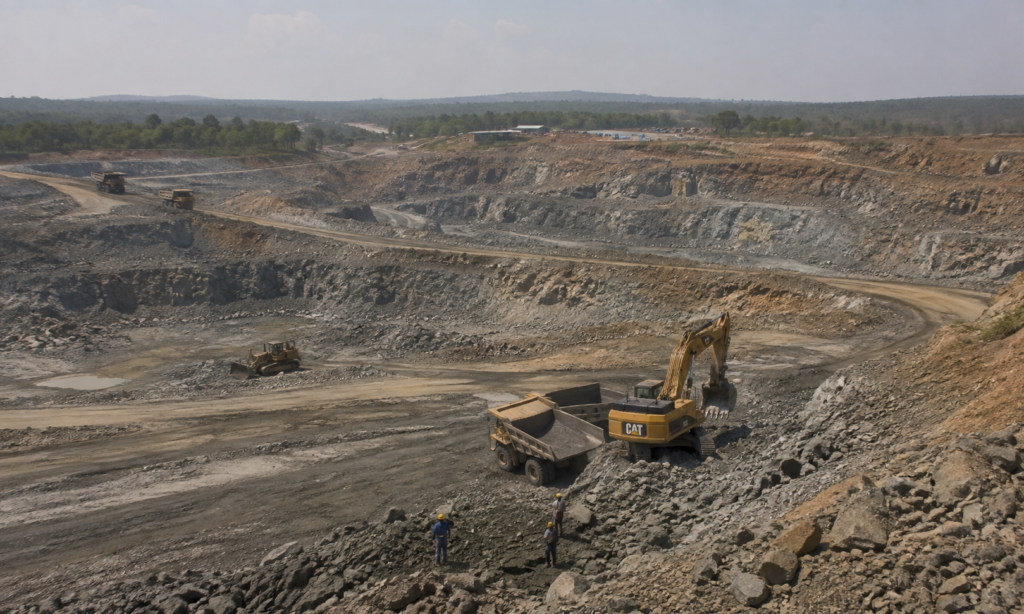
Kagem and other major operations also changed the visual image of coloured-stone mining. Modern Zambian emerald production can involve geologists, drilling, excavators, large open pits, controlled processing and extensive sorting systems.
Large areas of rock may need to be removed to expose comparatively narrow emerald-bearing reaction zones.
Zambia helped bring emerald mining into the era of modern industrial geology.
2004–2008 — Another Major Transition
In the 2000s, the ownership and operating structure of Kagem changed again. Gemfields became increasingly involved in exploration and mining in the Kafubu region.
By 2008, the modern ownership structure of Kagem had been established with Gemfields holding the majority interest and the Government of the Republic of Zambia retaining a significant minority stake.
The Auction System Changed How Rough Reached the Market
Modern Zambian emerald production is not only a mining story. It is also a distribution story. Large quantities of rough are sorted into categories and sold through organised auctions to international buyers.
From there, material moves to cutting centres and eventually into jewellery markets around the world. Mine, sorting, auction, cutting and jewellery became connected parts of the modern Zambian emerald supply chain.
Zambia Became Important Not Only for Exceptional Stones
Some gemstone origins become famous primarily through a small number of legendary stones. Zambia’s importance has another dimension: its ability to produce emerald at scale.
That includes commercial goods, calibrated material, fine transparent stones and occasional exceptional gems. The combination made Zambia important to both collectors and the broader jewellery trade.
Some origins become famous through a handful of legendary stones. Zambia also became important through the ability to produce emerald at scale.
Large Scale Does Not Mean Every Stone Is the Same
Industrial mining does not standardise nature. One large operation can produce highly included rough, small calibrated material, fine transparent emerald and rare exceptional stones from the same broader deposit system.
A large mine can create consistency of supply. It cannot make nature produce identical emeralds.
Kagem Is Important — But Zambia Is Not Only Kagem
Kagem is central to modern Zambian emerald history, but the country’s emerald story includes many other operations and localities. The Kafubu district has included mines and concessions such as Grizzly, Chantete, Kamakanga, Pirala, Fwaya-Fwaya and Miku, alongside smaller-scale licences and artisanal activity.
Zambia also has emerald occurrences outside the main Kafubu district. The country should not be reduced to a single company or mine.
Kagem is part of the Zambian emerald story, not the definition of it.
Can You Recognise a Zambian Emerald by Eye?
Experienced people in the trade may describe an emerald as having a Zambian appearance based on colour, tone, transparency or inclusion character. But that observation is not reliable proof of geographic origin.
Modern laboratories use microscopy, spectroscopy and trace-element chemistry, supported by reference collections, to evaluate origin. Overlap between sources means some cases can remain difficult or inconclusive.
“Looks Zambian” is an observation. “Origin: Zambia” is a gemological conclusion.
Zambia Did Not Replace Colombia
The rise of Zambia should not be told as a story in which one origin defeated another. Colombia and Zambia became important through different geological, historical and commercial paths.
Colombia carries centuries of international prestige and a distinctive sedimentary hydrothermal story. Zambia’s modern rise is tied to schist-hosted geology, twentieth-century exploration, mechanised production and the ability to supply the global market at scale.
Both origins can produce fine to exceptional emerald.
Zambia did not need to become another Colombia. Its importance came from becoming Zambia.
What Zambian Origin Really Tells You
The phrase Zambian emerald describes geographic origin. It does not automatically tell you the stone’s exact colour, transparency, clarity, treatment, beauty, value or specific mine.
A laboratory report that identifies Zambia should not automatically be translated into Kagem unless the evidence specifically supports that conclusion.
The country tells you where the emerald formed. The individual stone tells you what it became.
From Overlooked Beryl to a Modern Emerald Powerhouse
The story comes full circle in Kafubu. Beryl was documented in 1928, studied and initially regarded as having limited economic importance. Decades of exploration, geological mapping and local discovery gradually changed that assessment.
Commercial production expanded. Mining areas were reorganised. Kagem grew. Modern geological methods guided excavation. Rough entered structured international markets. Zambia became one of the defining origins of the modern emerald trade.
This is not the story of an ancient emerald legend rediscovered. It is the story of a geological resource the modern world gradually learned how to see.
In 1928, Kafubu looked like a minor beryl occurrence. Less than a century later, it had helped reshape the global emerald market.