

Brazil is one of the world’s important emerald-producing countries, yet the phrase Brazilian emerald carries a different kind of reputation from names such as Colombia or Zambia. Brazil’s emerald story is spread across several states, mining districts and generations of discovery.
That diversity is the first thing worth understanding. A Brazilian emerald cannot be reduced to one mine, one colour or one period of production.
To understand Brazilian emerald, it helps to stop imagining Brazil as a single emerald deposit.
Brazil Looked for Emerald Long Before It Became a Major Producer
Portuguese explorers searched for green precious stones in Brazil centuries before the country developed a major modern emerald industry. The possibility of emerald was part of the mineral imagination surrounding Brazil long before significant commercial production became established.
The irony is that Brazil’s modern importance as an emerald source arrived much later. Major production developed principally during the twentieth century, especially from the 1960s and 1970s onward.
Brazil searched for emerald for centuries before emerald finally became one of its modern gemstone industries.
The Modern Story Begins in Bahia
Bahia became one of the early centres of Brazil’s modern emerald production. Mining areas such as Carnaíba and Socotó gained importance from the 1960s onward and produced substantial quantities of emerald.
The output covered a broad commercial range. Some material was suited to beads, cabochons and carvings, while other production could yield facetable and finer-quality stones.
This is an important theme in the Brazilian story: high production volume does not mean every stone has the same appearance, quality or purpose.
Then Goiás Became Important
Santa Terezinha de Goiás became another major chapter, particularly from the 1970s through later decades. At periods in its history, it ranked among Brazil’s most important emerald-producing areas.
The district developed around numerous workings, including small-scale and independent mining. Its rise demonstrates how the centre of Brazilian emerald production has shifted as new deposits were discovered and older areas changed.
Brazil’s emerald centre of gravity has moved more than once.
And Then Came Minas Gerais
Minas Gerais eventually became central to the modern reputation of fine Brazilian emerald, particularly through the Itabira–Nova Era region.
The state was already famous for minerals and gemstones, but discoveries around Itabira and Nova Era gave Brazil a new emerald identity—one increasingly associated not only with volume, but also with fine faceted material.
Among the most important names in this story is Belmont.
Belmont Began as a Cattle Ranch
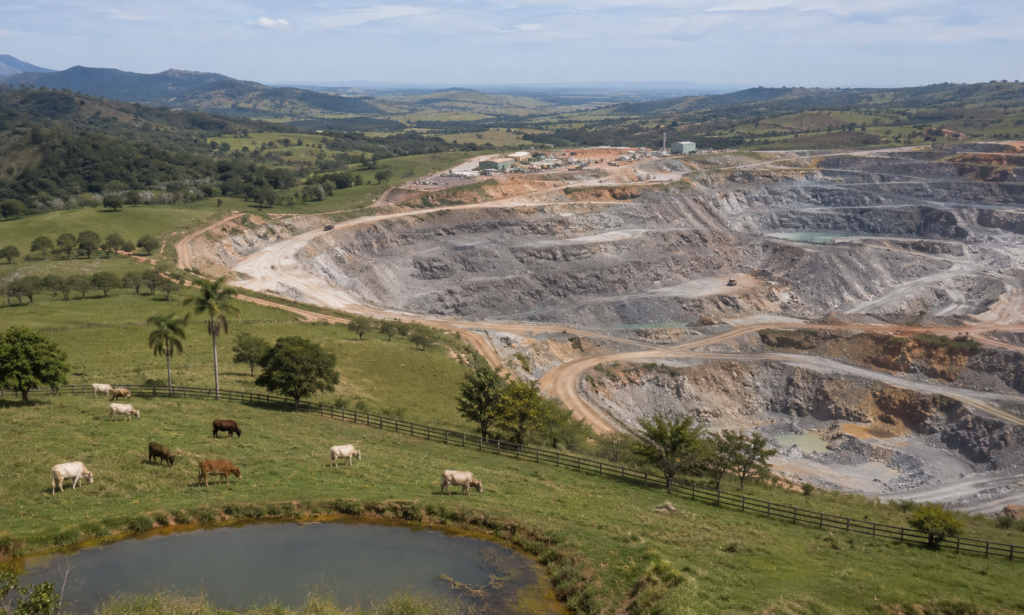
The Belmont property was originally a cattle ranch. Emerald was discovered there in 1978, transforming the future of the land.
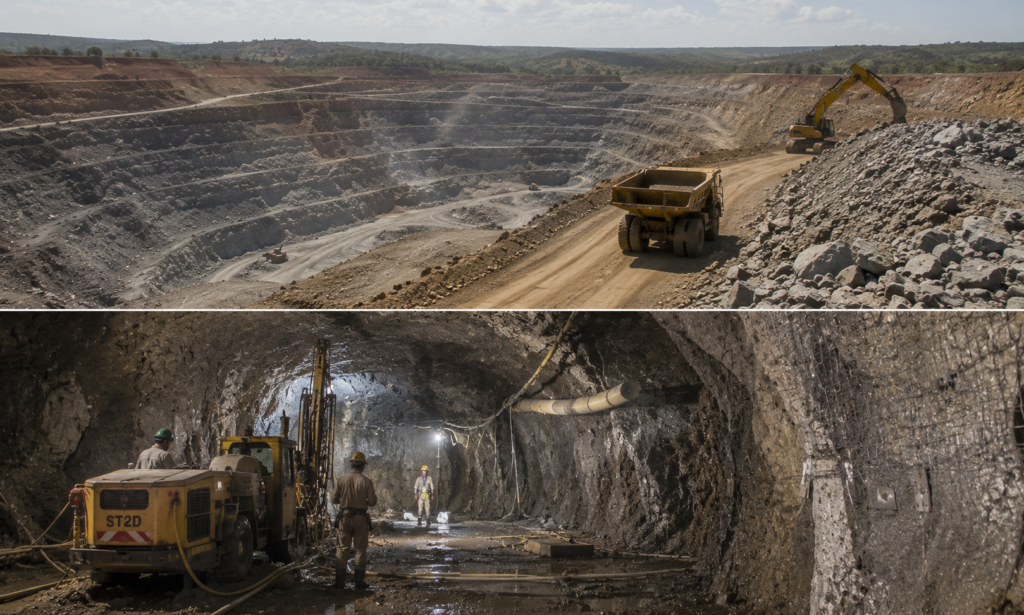
What followed was not simply another small gemstone working. Belmont developed from open-pit extraction into a sophisticated mining operation with geological exploration, processing systems and later underground mining.
One of Brazil’s most important emerald mines did not begin as a gemstone mine at all. It began as a cattle ranch.
The Discovery Changed the Region Around It
Belmont helped stimulate further exploration around Itabira and Nova Era. In 1988, an important emerald discovery at Capoeirana near Nova Era added another major source to the district.
Significant quantities of potentially gem-quality material emerged, reinforcing the idea that the area represented a broader emerald-producing geological belt rather than the success of one isolated mine.
The Itabira–Nova Era story therefore became one of districts and deposits, not simply Belmont alone.
Brazilian Emerald Is Not One Mine — or Even One State
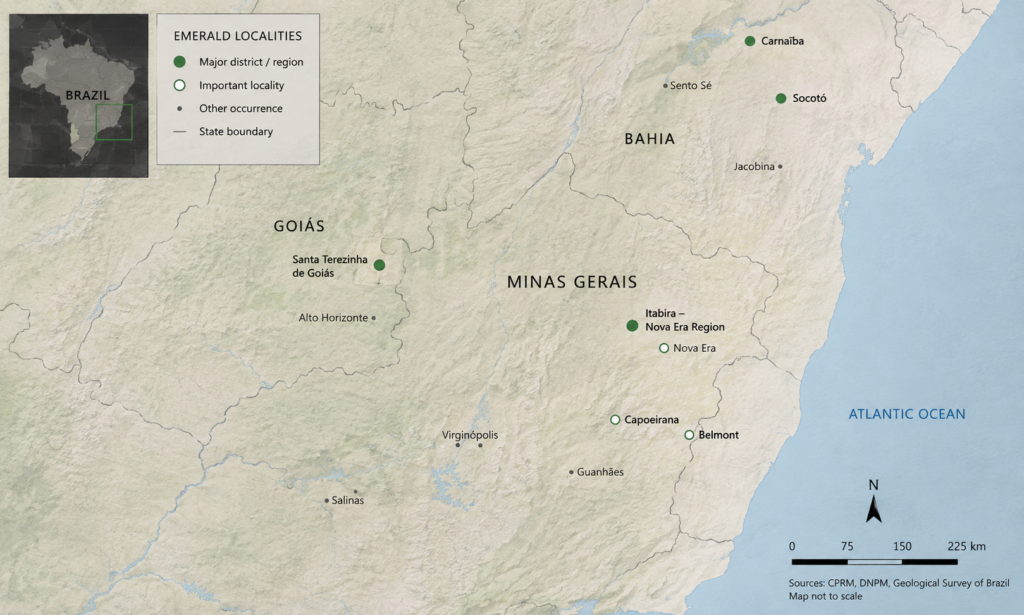
Brazil’s emerald geography is unusually broad. Bahia includes important districts such as Carnaíba and Socotó. Goiás became known for Santa Terezinha. Minas Gerais includes the Itabira–Nova Era region, with names such as Belmont and Capoeirana alongside other workings.
Other emerald occurrences exist as well. The phrase Brazilian emerald therefore identifies a country of origin, not a specific deposit.
Brazil is the origin. The mine is another question.
Why Does Brazil Have So Many Gemstones?
Emerald belongs to a much larger Brazilian gemstone story. Brazil is also famous for tourmaline, aquamarine, topaz, quartz, chrysoberyl and many other gem materials.
Its geological diversity created numerous environments in which unusual combinations of minerals could form. In important Brazilian emerald deposits, beryllium-bearing material interacted with rocks capable of supplying chromium and vanadium—the elements responsible for emerald’s green colour.
The details vary from one deposit to another, which is another reason Brazilian emerald should not be treated as a single geological recipe.
Brazilian Emerald Forms Differently from Colombian Emerald
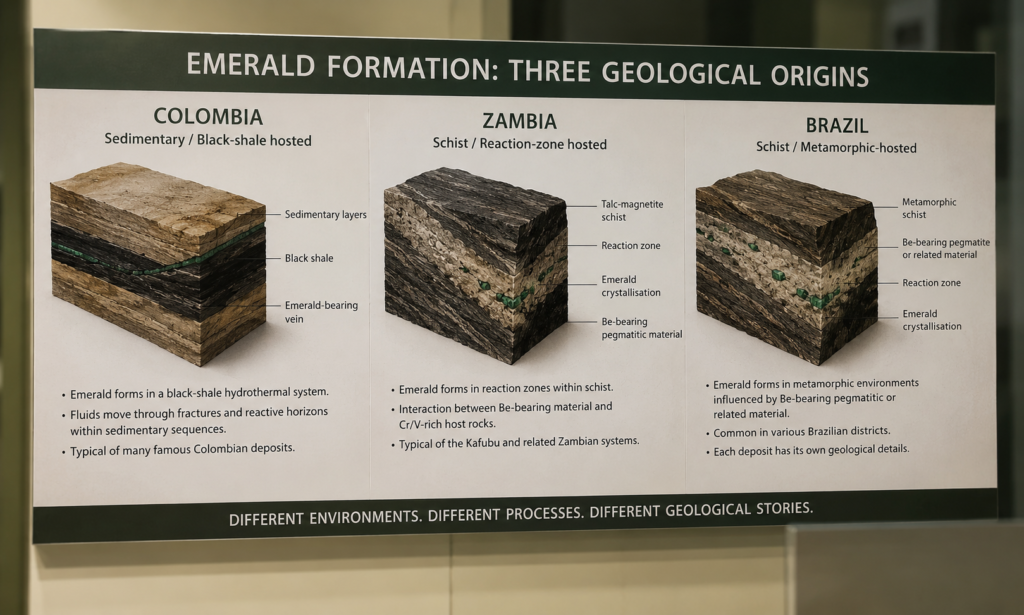
The contrast with Colombia is especially useful. Many famous Colombian emerald deposits formed in a sedimentary, black-shale hydrothermal environment.
Several important Brazilian deposits instead belong broadly to metamorphic systems in which beryllium-bearing pegmatitic or related material interacted with chromium- and vanadium-bearing rocks. In that broad sense, parts of the Brazilian geological story have more in common with other schist-hosted emerald systems, although each deposit retains its own geological details.
The same gemstone can be created through remarkably different geological stories.
Brazil Had a Reputation Problem
For many years, Brazilian emerald was not automatically associated in the international trade with the prestige attached to the finest Colombian material. Large quantities of commercial-grade production helped create an image that did not always reflect the full quality range available from Brazil.
Discoveries and production from the Itabira–Nova Era region helped challenge that perception. Fine stones with attractive colour, good transparency and quality suitable for high-end faceting demonstrated that Brazilian origin could not reasonably be treated as shorthand for lower quality.
The market gradually had to revise an older assumption.
Fine Brazilian Emerald Can Be Very Fine Indeed
Brazil produces a broad spectrum of emerald. Commercial material is part of the story, but so are fine and occasionally exceptional faceted stones.
Well-documented production from Minas Gerais has included notable transparent gems of significant size and quality. Those stones matter because they demonstrate a simple point: origin and quality are separate questions.
Brazilian origin should not be mistaken for a quality grade—either low or high.
What Does Brazilian Emerald Usually Look Like?
There is no single visual formula for Brazilian emerald. The country’s multiple deposits can produce lighter, medium and deeper greens, including stones with bluish-green character, across a wide range of transparency and clarity.
Even within Brazil, different mining areas can produce noticeably different material. And appearances can overlap with emerald from other countries.
Brazilian emerald has a range, not a uniform.
Some Brazilian Emerald Can Look Surprisingly Open
Certain production from the Nova Era region has become known for faceted stones with good transparency and a relatively open visual appearance. This can surprise people who expect every emerald to display a dense internal landscape.
It does not mean Brazilian emerald is always cleaner than material from other origins, nor that every stone from Nova Era will share the same clarity. It simply demonstrates how broad emerald’s natural range can be.
Some Brazilian deposits have shown that emerald can retain its natural character while presenting a surprisingly open, transparent face.
Brazilian Emerald Mining Exists at Very Different Scales
Brazil’s emerald industry includes very different forms of mining. Independent miners, often associated with the Brazilian garimpeiro tradition, have played an important role in several districts.
At the other end of the scale are highly organised operations such as Belmont, where modern exploration, engineering, processing and mine planning have been applied to coloured-stone production.
Brazilian emerald is produced by very different hands, at very different scales.
Belmont Became a Modern Mining Case Study
Belmont illustrates how sophisticated coloured-gemstone mining can become. Geological surveys, drilling, modelling, mine planning, processing and sorting all contribute to locating and recovering emerald-bearing zones.
The operation is useful because it removes some of the mystery from gemstone mining. A beautiful crystal may be natural, but finding it economically can require substantial geological knowledge and engineering.
From Open Pit to Underground
Belmont’s mining methods evolved as the deposit was developed. Open-pit mining accessed material closer to the surface, while underground development became increasingly important as mining moved deeper.
This transition demonstrates that a gemstone deposit is not a static hole in the ground. Mining strategy changes with geology, depth, access and economics.
A gemstone deposit changes the way it must be mined as the easiest material is exhausted.
Brazil Is Also a Cutting Country
Brazil’s gemstone identity extends beyond extraction. The country has longstanding traditions of mineral trading, gem cutting and jewellery production, particularly in major gemstone regions such as Minas Gerais.
In parts of the emerald industry, mining, sorting and fashioning can therefore exist within the same broader regional value chain rather than every piece of rough leaving the country immediately after extraction.
This gives the Brazilian story another dimension: the country is not only a place where gemstones are found, but also a place where people have developed expertise in understanding and working with them.
Why Is Brazilian Emerald Usually Less Famous Than Colombian?
Part of the answer is simply time. Colombia has had centuries in which emeralds from its mountains circulated through royal collections, international trade networks and the cultural imagination.
Brazil became a major modern emerald producer much later, principally from the second half of the twentieth century onward. Its international reputation has therefore had decades rather than centuries to develop.
Colombia had centuries to build an emerald legend. Brazil has had decades.
The difference in fame should not automatically be interpreted as a difference in the beauty of any two individual stones.
Does Brazilian Origin Carry the Same Kind of Premium?
Origin premiums in emerald are shaped by history, rarity, collector preference and market perception as well as the gemstone itself. Colombian origin can carry particular prestige in parts of the fine emerald market because of its long-established reputation.
Brazilian origin generally operates differently. A fine Brazilian emerald can still be highly valuable, but its price is often driven strongly by the actual qualities of the individual stone rather than by the country name alone.
Sometimes an origin adds prestige to a gemstone. Sometimes the gemstone has to build the prestige of its origin.
Can You Identify Brazilian Origin by Appearance?
Not reliably. Brazil itself produces too broad a range of emerald for one colour or transparency profile to define the country, and material from different global origins can overlap in appearance.
When geographic origin has meaningful commercial importance, laboratory determination relies on multiple lines of gemological and analytical evidence rather than a visual impression alone.
A stone can look consistent with Brazilian material without appearance proving that it formed in Brazil.
What “Brazilian Emerald” Actually Tells You
At its most precise, Brazilian emerald is a statement of geographic origin. It does not automatically mean Belmont, Nova Era, Bahia, Goiás or any other specific locality.
Nor does the country name tell you the exact colour, clarity, transparency, treatment, cut, beauty or value of the finished gemstone.
Brazil tells you where the story began. It does not tell you how the finished emerald will look.
What Should You Know Before Buying One?
The most useful question is not simply, “Is Brazilian emerald good?” The better question is, “What is this particular emerald like?”
Look at its colour, transparency, clarity character, cut, treatment and overall visual presence. If geographic origin materially affects the description or price, a respected laboratory report can add useful evidence.
Brazilian emerald should not be chosen merely because it may cost less than a comparable Colombian stone, and it should not be dismissed because it lacks the Colombian name.
Buy the emerald first. Understand the origin second.
An Origin Still Writing Its Reputation
Brazil’s modern emerald history moved through different regions and different eras: early production in Bahia, the rise of Santa Terezinha in Goiás, the discovery of Belmont on a cattle ranch in 1978, the Capoeirana discovery near Nova Era in 1988, and the growing importance of the Itabira–Nova Era district.
Along the way, Brazilian emerald moved beyond an older reputation centred largely on commercial material. Fine stones demonstrated that the country’s quality range was much broader than the stereotype.
Brazil entered the modern emerald story later than Colombia, and its identity continues to evolve. That may be precisely what makes the origin interesting.
Brazil may have entered the modern emerald story later than Colombia, but its finest stones have spent the last few decades rewriting what “Brazilian emerald” can mean.