
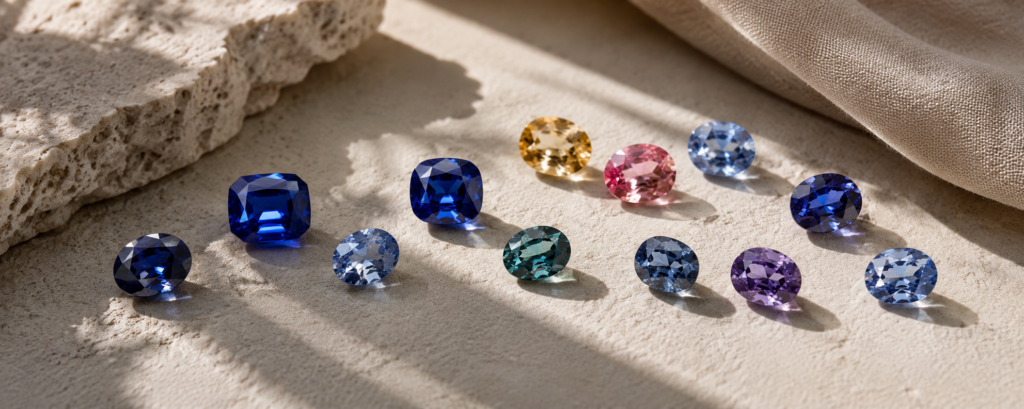
Place several tourmalines on a table and, without their names, they can look like entirely different gemstones. Pink, red, peach, yellow, green, blue, teal, purple, brown and black can all belong to the same extraordinary gemstone family. Some crystals can even contain more than one colour at once.
That range is not a side note to tourmaline. It is central to its identity.
Tourmaline does not have a signature colour. Its signature is colour itself.
What Exactly Is Tourmaline?
Tourmaline is not one simple mineral with one fixed chemical recipe. It is a group of closely related minerals that share a similar crystal structure while allowing substantial chemical variation.
Gemologically important members include elbaite, dravite, liddicoatite, uvite and others. Most jewellery buyers do not need to memorise the mineral species, but the group structure explains why tourmaline can vary so dramatically.
Tourmaline is better understood as a gemstone family than as one simple mineral recipe.
Why Does Tourmaline Come in So Many Colours?
Tourmaline’s crystal structure can accommodate different elements, and those chemical differences influence how the crystal absorbs light. Iron, manganese and other elements or colour-producing mechanisms can contribute to the wide palette seen in natural tourmaline.
The exact chemistry can become complex, but the useful idea is simple: tourmaline is unusually flexible chemically, and that flexibility gives nature many ways to create colour.
Tourmaline’s colour range is not an accident. It is written into the flexibility of its chemistry.
Sometimes One Crystal Contains More Than One Colour
The chemistry surrounding a tourmaline crystal can change while the crystal is growing. When that happens, different growth zones can develop different colours.
This produces bi-colour and parti-colour tourmaline, including combinations such as pink and green. Instead of always being something a cutter tries to hide, colour zoning can become the defining feature of the finished gemstone.
In tourmaline, colour zoning is not always something to hide. Sometimes it becomes the entire design of the gemstone.
What Is Watermelon Tourmaline?
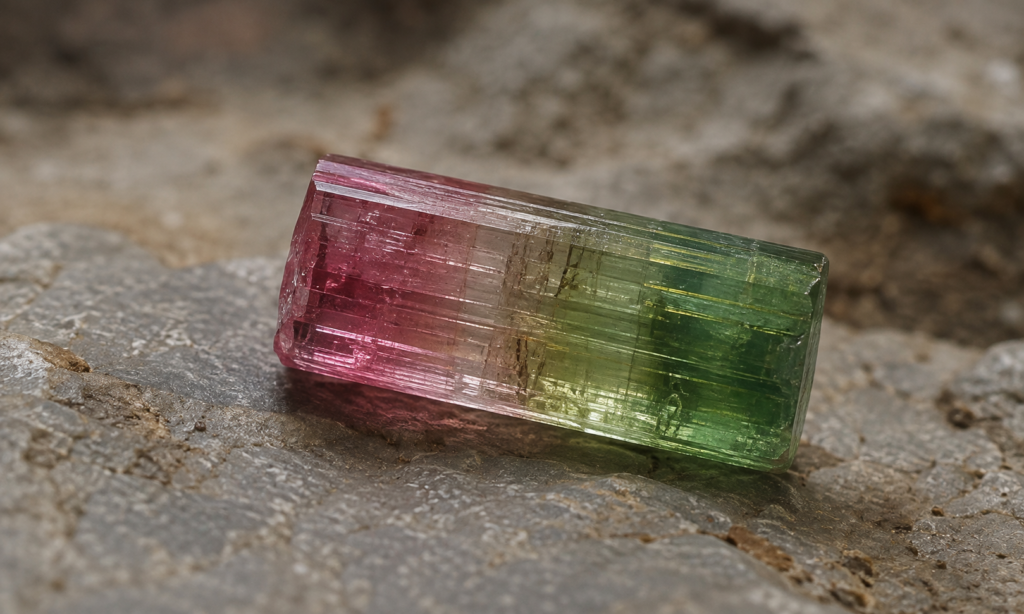
Watermelon tourmaline is one of the best-known examples of colour zoning. A crystal may show a pink or reddish centre surrounded by green, producing a watermelon-like appearance when cut across the crystal.
Watermelon is not a separate tourmaline mineral species. It is a descriptive name for a distinctive colour pattern—and a good example of how crystal growth itself can become part of a gemstone’s visual design.
Why Does Tourmaline Have So Many Names?
Tourmaline terminology can initially seem confusing because its names do not all describe the same kind of information.
Names such as rubellite and indicolite are associated principally with colour. Chrome tourmaline refers to particular green material associated with chromium and/or vanadium. Paraíba describes copper-bearing tourmaline meeting particular colour and gemological conventions, while watermelon and parti-colour describe colour patterns.
Tourmaline names can describe colour, chemistry, origin or pattern—and sometimes the trade mixes these ideas together.
Paraíba Changed the Tourmaline World
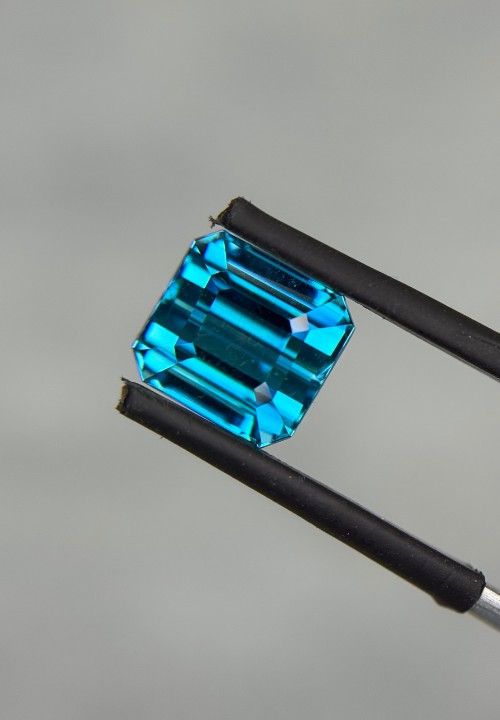
The discovery of vivid copper-bearing tourmaline associated with Paraíba, Brazil, revealed another extreme of tourmaline’s colour potential. Intense blue, greenish blue and blue-green material created a distinct place in the gem market, with related copper-bearing tourmaline later found elsewhere.
Paraíba deserves its own story, but its broader significance is easy to understand: even within an already colourful gemstone family, tourmaline was still capable of surprising the market.
Paraíba did not introduce a new gemstone. It revealed another extreme of what tourmaline could become.
Tourmaline Can Change Colour Depending on Direction
Tourmaline commonly shows pleochroism, meaning its colour or colour intensity can appear different when viewed along different crystallographic directions.
This matters to cutters. The orientation chosen for the finished gemstone can influence whether the face-up colour appears attractive, too dark or otherwise different from what the rough initially suggested.
With tourmaline, the colour inside the crystal is only part of the story. Direction matters too.
Why Are So Many Tourmalines Long and Rectangular?
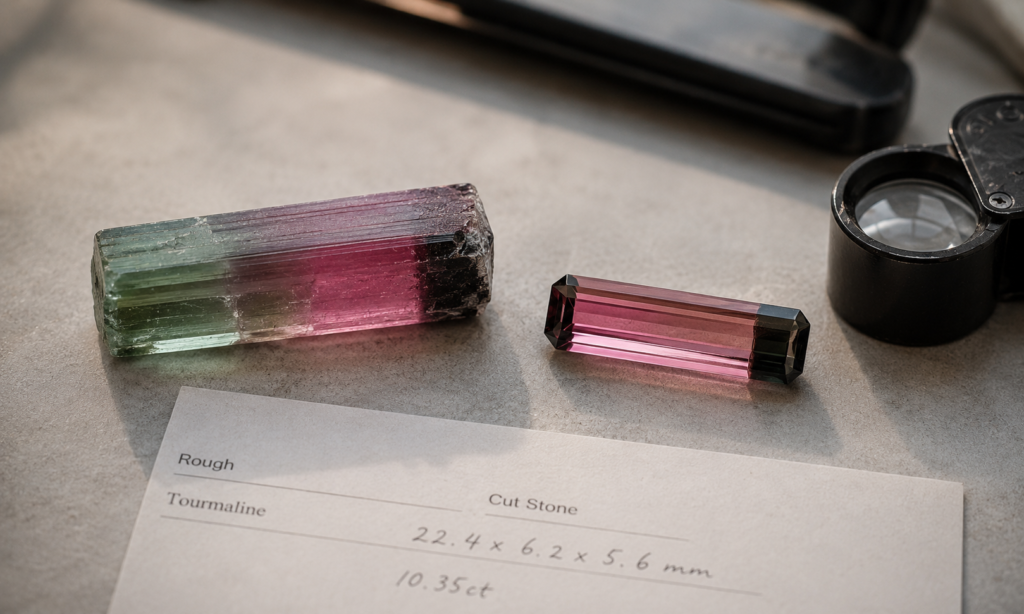
Tourmaline commonly forms as elongated prismatic crystals. A cutter working with valuable rough usually considers the original crystal shape when deciding how to preserve weight, manage colour and create an attractive finished stone.
That is one reason elongated rectangles, long cushions, elongated ovals and related shapes appear frequently in tourmaline. The gemstone does not have to be long—the rough simply makes elongated designs a natural solution in many cases.
Is Tourmaline Usually Clean?
Clarity expectations vary across tourmaline colours and varieties. Pink-to-red tourmaline, for example, is often encountered with more eye-visible inclusions than many green-to-blue stones.
That does not make one colour inherently better than another. It means the natural material available to the market can differ, so a reasonable clarity expectation should consider the kind of tourmaline being examined.
A fair clarity expectation for one tourmaline colour may not be fair for another.
Is Tourmaline Treated?
Treatment does occur in tourmaline, but there is no single treatment story that applies to every colour. Heating may be used with some material to modify colour, while irradiation can be used with certain pink or red material. Other forms of enhancement are also possible.
The important point for an introductory guide is simply that colour variety and treatment variety are separate questions. A future treatment-focused article can examine the subject in greater detail.
Treatment exists in tourmaline, but it is not one single treatment story across every colour and variety.
Where Does Tourmaline Come From?
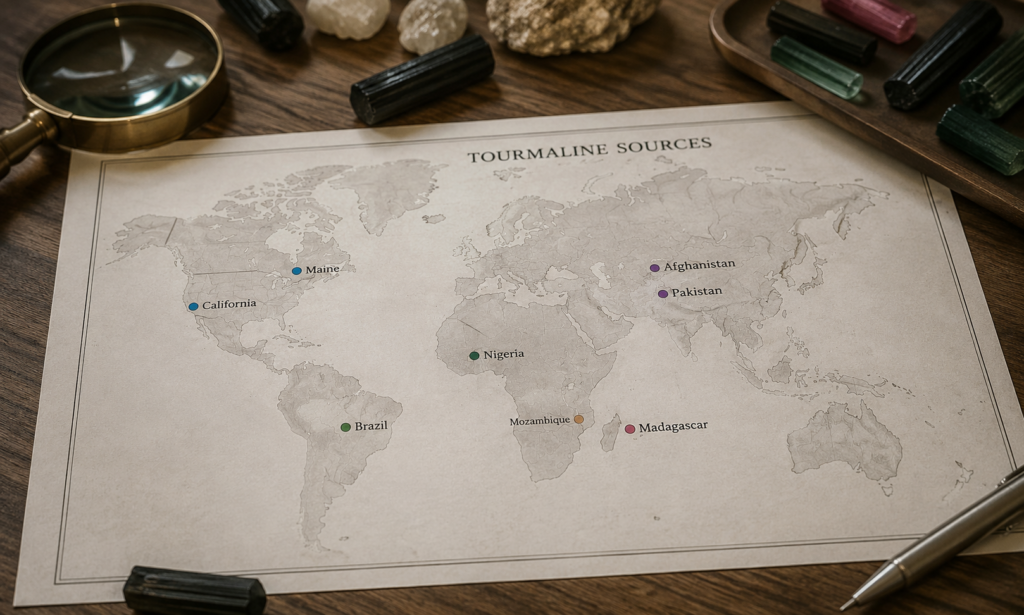
Important tourmaline sources are spread widely around the world. Brazil has played an especially important role, while Afghanistan, Pakistan, Mozambique, Madagascar, Nigeria and other African sources have supplied significant gem material. Maine and California are historically important sources in the United States.
As with colour, a country name should not be treated as a rigid visual formula. Individual deposits can produce different material, and the same country can produce tourmaline in many colours.
Is Tourmaline Durable Enough for Jewellery?
Tourmaline measures approximately 7 to 7.5 on the Mohs hardness scale, making it suitable for many forms of jewellery when designed and worn thoughtfully.
It is generally stable to light and common chemicals, although high heat can be damaging. Warm soapy water is a sensible cleaning method for most tourmaline jewellery, while the setting and condition of the individual stone should always be considered.
Rings, earrings, pendants and other pieces can all work well with tourmaline. As with any coloured gemstone, durability is a combination of the material, the cut, the setting and how the jewellery is worn.
A Gemstone That Refuses One Definition
Sapphire may first bring blue to mind. Emerald is inseparable from green, and ruby from red. Tourmaline resists that kind of single-colour identity.
Its chemistry can create an enormous palette. Its growth can place several colours inside one crystal. Pleochroism can change what we see with direction, while the natural crystal shape can influence the form chosen by the cutter.
Even its history reflects that diversity. The name tourmaline is associated with the Sinhalese word toramalli, historically connected with mixed or assorted gems, and tourmaline was once confused with other gemstones before its mineral identity became better understood.
What once made tourmaline difficult to classify has become one of the qualities that makes it most distinctive.
Tourmaline is difficult to define by one colour because its beauty has never belonged to just one.