
Zircon can look almost restless in the light. Move a well-cut stone and white flashes, spectral colours and changing facet patterns can appear in quick succession. What we casually call sparkle is not one single property. In zircon, several different behaviours of light are happening at the same time.
What looks like one kind of sparkle is actually several different things happening to light at once.
“Sparkle” Is Not One Gemological Property
When someone says a zircon sparkles, they may be noticing several effects together. Brightness or brilliance describes light returning toward the eye. Fire is the appearance of spectral colours created by dispersion. Scintillation is the changing pattern of bright and dark flashes seen as the gemstone, light or observer moves.
Sparkle is the impression. Light return, fire and flashes are some of the things creating it.
Zircon Bends Light Strongly
Zircon has relatively high refractive indices. Refraction describes the change in direction of light as it passes from one material into another. Inside a faceted zircon, this strong interaction with light gives the cutter considerable optical potential. Pavilion facets can redirect light and, when proportions and angles work well, return part of it through the crown toward the observer.
Zircon begins with strong optical potential. The cut decides how much of that potential we actually see.
Zircon Also Has Very High Luster
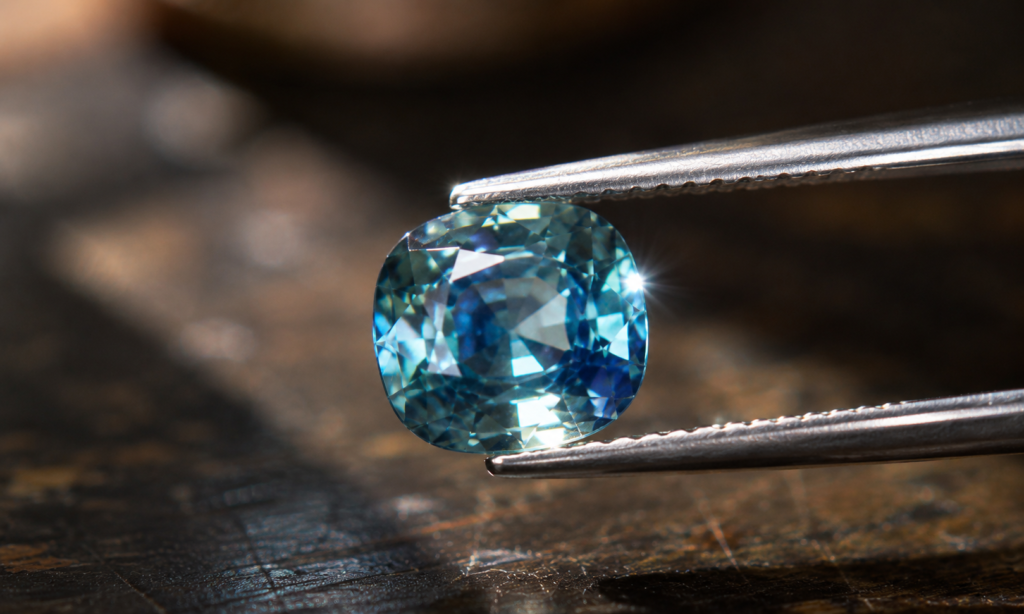
Not all of zircon’s brightness comes from deep inside the gemstone. A well-polished zircon can show strong surface reflections because the mineral has high luster. Those bright polished surfaces combine with internal light return, adding another layer to the lively appearance.
Some of zircon’s brightness happens before light even travels deeply into the stone.
Then Comes the Fire
One of zircon’s most recognisable optical qualities is strong dispersion. Dispersion separates white light into spectral colours. When conditions are right, a zircon can therefore return flashes of red, orange, yellow, green, blue and violet rather than only white light.
Zircon does not only return light. It can return white light as colour.
Why Is Fire Easier to See in Some Zircons Than Others?
The potential for strong dispersion belongs to zircon as a material, but visible fire depends on more than the mineral alone. Cut, proportions, lighting, viewing angle, movement, clarity and body colour all influence what reaches the eye. Colourless zircon can make spectral flashes particularly easy to notice, while blue, golden or other body colours frame those flashes differently.
The potential for fire belongs to zircon. How clearly we see it belongs to the stone, the cut and the light together.
Zircon Has Another Trick: Double Refraction
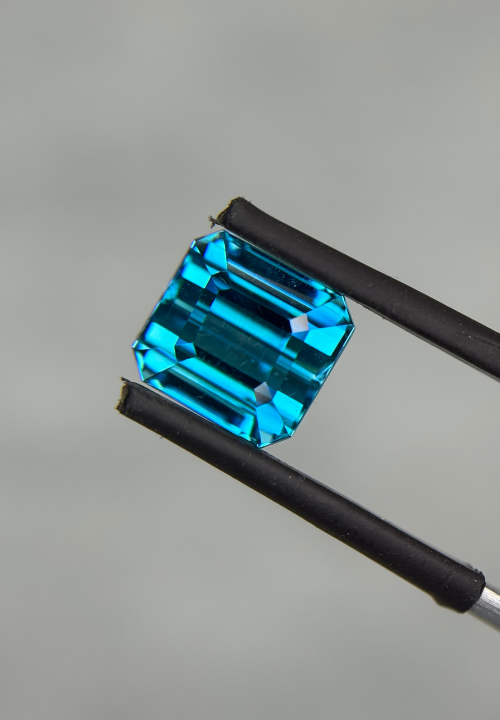
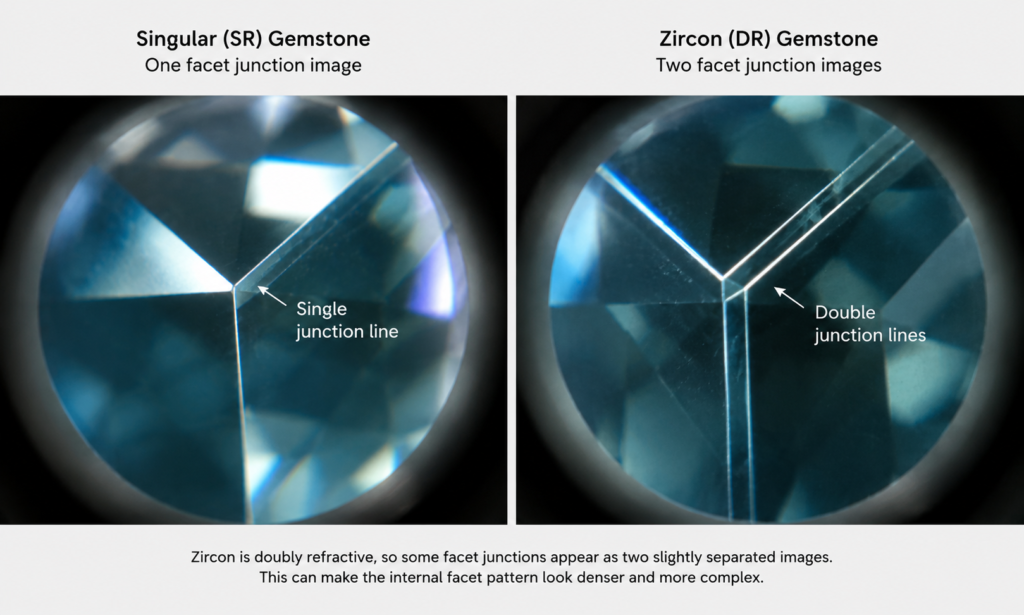
Zircon is doubly refractive. In most directions, light travelling through the crystal can split into two rays. Zircon’s birefringence can be strong enough for this effect to become visible in a faceted gemstone, especially when looking through the crown toward facet junctions on the far side.
Zircon does not simply bend light. In many directions, it splits the light into two paths.
Why Can It Look Like Zircon Has More Facets Than It Really Does?
Because of double refraction, some facet junctions viewed through zircon can appear as two slightly separated images. This can make the internal facet pattern seem denser and visually busier than the physical number of facets alone would suggest. It contributes to zircon’s distinctive optical character, but should not be interpreted literally as the stone producing twice as much light.
Part of zircon’s lively appearance comes from seeing more than the facets that are physically there.
Does Every Zircon Show Obvious Doubling?
No. The visibility of doubling depends on crystal orientation, viewing direction, cut, stone size and the angle from which the gemstone is examined. In some orientations the effect may be subtle from the centre of the table and easier to notice through another part of the crown. Not seeing obvious doubling immediately does not by itself establish that a stone is not zircon.
Doubling is part of zircon’s optical nature, but it does not present itself equally from every direction.
Cut Turns Optical Properties Into Visible Beauty
High refractive indices, dispersion, luster and birefringence give zircon possibilities; they do not guarantee an attractive finished gemstone. If proportions allow too much light to escape, or if a stone has a prominent window or lifeless areas, some of that optical potential can be lost. Facet arrangement, angles, symmetry and polish all influence the face-up result.
Optical properties give zircon possibilities. Cutting decides how those possibilities become visible.
Why Are Brilliant Cuts So Common in Zircon?
Brilliant-style and mixed cuts are common choices for zircon because they can emphasise light return and fire. Rounds and ovals are therefore frequently seen. Historically, a modified brilliant sometimes called a zircon cut used additional pavilion facets, taking advantage of a gemstone already known for lively optical effects.
The traditional zircon cut did something wonderfully literal: it gave an already lively gemstone even more facets to work with.
Does More Facets Always Mean More Sparkle?
No. Adding facets adds surfaces, but sparkle does not increase in a simple relationship with facet count. Proportions, angles, polish, lighting and material all matter. A more complicated pattern is not necessarily more beautiful.
More facets create more surfaces. They do not automatically create more beauty.
Why Does Zircon Sparkle More When It Moves?
Movement reveals scintillation. As the relationship between the gemstone, light source and observer changes, facets that were bright can become dark while others begin to flash. This alternating pattern is difficult to communicate fully in a still photograph and is one reason a slowly moving zircon can feel much more alive than the same stone in a single frame.
A still photograph can show zircon’s colour. Movement reveals its rhythm.
Does Zircon Sparkle More Than Diamond?
There is no single useful answer because sparkle is not one measurement. Zircon and diamond have different optical properties and cutting traditions. Zircon can show strong fire and characteristic doubling; diamond has its own optical character. The useful question is how each material handles light.
Zircon and diamond can both be brilliant, but they do not speak the same language of light.
Does Colour Change How Sparkle Feels?
Yes, in the way we perceive it. Colourless zircon can place spectral fire against a neutral body, while blue, golden, orange or other zircons combine flashes with their own body colour. The underlying optical properties belong to the mineral, but colour changes the visual context in which we experience them.
The light belongs to the mineral. The colour changes how we experience it.
Sparkle Is Also Why Zircon Deserves Care
Zircon can be brittle and its facet edges may abrade with wear. Protecting it from unnecessary knocks and abrasion helps preserve the crisp polished surfaces that contribute to its bright appearance.
Protecting zircon’s facets is also protecting the surfaces that make its light look so crisp.
So Why Does Zircon Sparkle So Much?
The answer is a combination. High luster creates bright surface reflections. High refractive indices give light strong interaction with the gemstone. Dispersion separates white light into fire. Double refraction can create visible facet doubling. Cutting determines how effectively these properties appear face-up, while movement turns static light patterns into scintillation.
Zircon sparkles because several different behaviours of light are layered on top of one another.
A Gemstone Full of Moving Light
A still zircon can show colour and cut. With movement, its optical personality becomes clearer: light bends, separates into colour, splits into two paths and flashes from one group of facets to another.
Zircon is not simply a bright gemstone. It is a gemstone in which light bends, separates, doubles and moves—and that is why it can feel so alive.