
Zircon is often introduced through electric blue and intense fire, but green zircon reveals a quieter and scientifically unusual side of the mineral. Its colour can range from yellowish and olive greens to deeper forest tones and cooler greenish blues. In some material, that green is connected not only to chemistry, but also to changes the crystal has experienced over geological time.
Not every zircon announces itself with electric blue. Some reveal the mineral through a quieter shade of green.
Green Is a Natural Part of Zircon’s Palette
Green occurs naturally within zircon’s broad colour range. Chemically pure zircon would be colourless, while trace elements, structural effects and geological history can contribute to the colours we see. Green zircon should not be understood as blue zircon that somehow fell short of becoming blue.
Green is not a failed version of blue zircon. It is one of zircon’s natural identities.
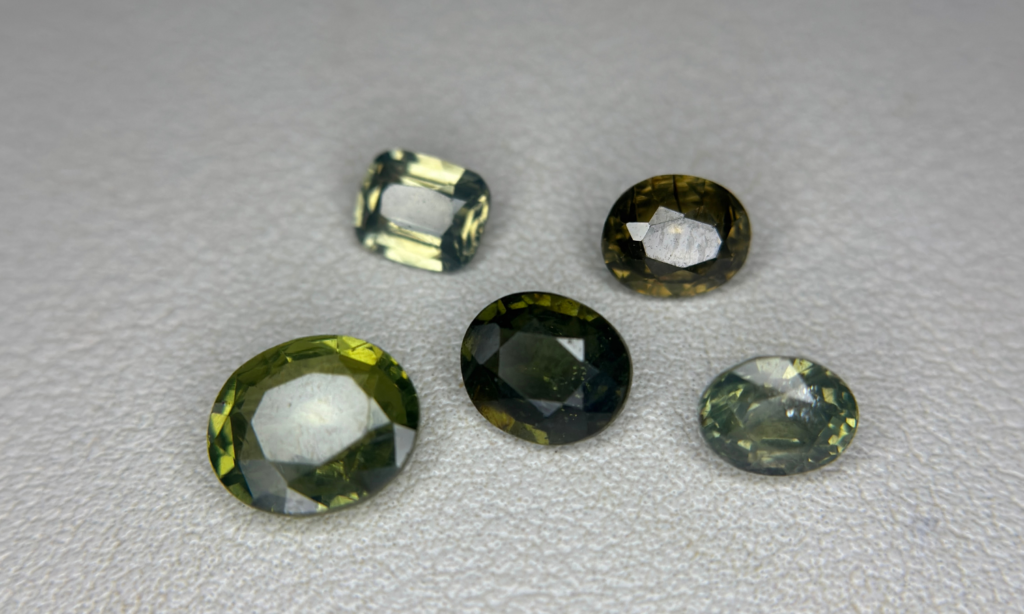
There Is No Single “Zircon Green”
The word green covers a wide visual territory. A zircon may lean yellowish, olive, brownish, bluish or slightly gray, and its tone can range from relatively open to very deep. These modifiers do not automatically create a quality hierarchy. They create different characters.
Green zircon is better understood as a family of greens than as one ideal shade.
Green Zircon Has an Unusual Connection to Time
Zircon can incorporate trace uranium and thorium when it forms. Over immense geological periods, radioactive decay can gradually disrupt the crystal lattice from within. This process is called metamictization. Low zircon, in which this structural change has become extensive, is typically associated with dark green appearances.
In some green zircon, colour is connected to the history of the crystal itself.
What Is a “Low Zircon”?
Gemologists may describe zircon as high, intermediate or low according to the condition of its crystal structure. High zircon remains relatively intact; intermediate material shows greater radiation-related change; low zircon has experienced much more extensive structural disruption. These are mineralogical descriptions, not beauty or quality grades.
A “low” zircon is not being given a low quality grade. The word describes its crystal structure.
Does Green Zircon Always Mean Low Zircon?
No. Green appearance alone cannot establish zircon’s structural category. High zircon can also occur in green or greenish colours, while low and intermediate material can vary. Laboratory observations have documented greenish blue high zircon as well as greenish yellow low zircon.
Green can be a clue to zircon’s structural history. It is not a diagnosis by itself.
Why Can Low Zircon Become Green?
It is tempting to reduce the explanation to “uranium makes zircon green,” but the story is more complex. Trace radioactive elements undergo decay, that decay damages the lattice over time, and structural defects can alter the way the material absorbs light. Chemistry, radiation history and degree of crystallinity can therefore work together in the appearance of metamict zircon.
The green is not simply an ingredient. In some zircon, it is part of a much longer geological process.
Sri Lanka Has a Particularly Interesting Green Zircon Story
Green metamict zircons from Sri Lanka are well known in gemological literature and the gem trade. Sri Lanka’s alluvial gem deposits have produced zircon alongside many other gemstones, giving green metamict material a notable place in the country’s zircon story. This does not mean every green zircon is Sri Lankan, nor can origin be established from green colour alone.
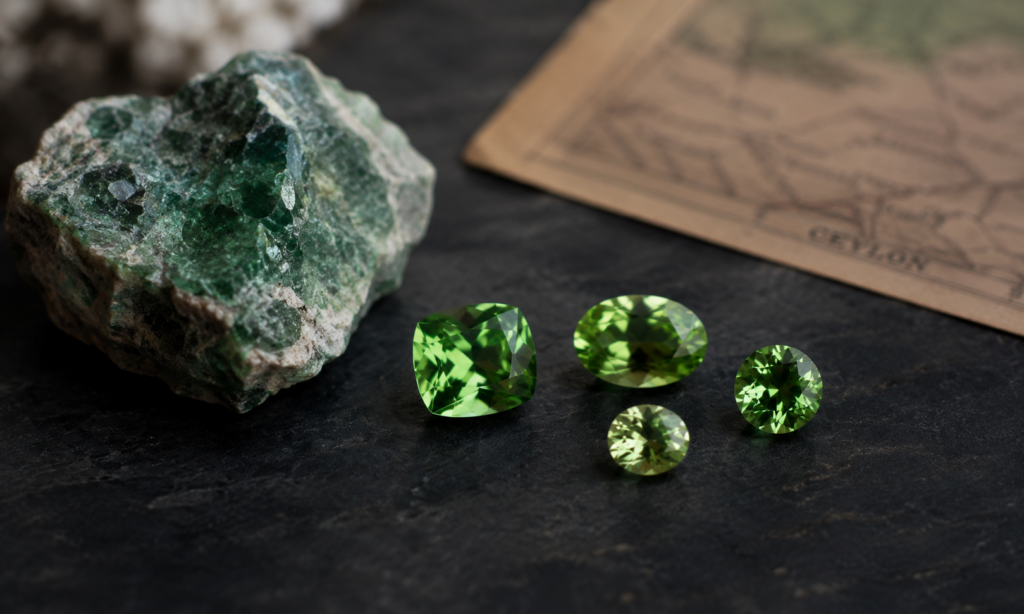
Some Green Zircon Can Behave Strangely Under Different Light
GIA has documented individual zircon specimens that appeared green under some light sources but shifted toward grayish purple under others because of the interaction between the stone’s absorption features and the spectral output of the illumination. Such behaviour has occasionally been observed in material associated with the Mogok area of Myanmar.
This is not something to expect from every green zircon. It is an example of how unusual individual stones can be.
Some green zircons remind us that colour belongs not only to the gemstone, but to the conversation between gemstone and light.
Does Green Zircon Still Have Zircon’s Famous Fire?
Yes. Green zircon is still zircon, so the mineral’s refractive behaviour, dispersion and double refraction remain part of its optical identity. Body colour changes how those effects are perceived. In a deeper olive or forest-green stone, spectral flashes may feel more restrained than in colourless zircon, while the overall appearance can gain depth and richness.
The fire is still zircon. The green simply changes the way we experience it.
Darker Is Not Automatically Better—or Worse
Some green zircons have a deep tone, but darkness itself is not automatically a defect or an advantage. A more useful question is whether the face-up stone still allows its green to be experienced. A deep forest or olive zircon may be appealing precisely because it feels moody, provided its colour and light remain present rather than closing into near-blackness.
The question is not whether the green is light or dark. It is whether the stone still lets you experience the green.
What About Heat Treatment?
Heat treatment adds another layer to zircon’s story. Heating can change colour, and sufficiently high temperatures can also partially restore crystallinity in some radiation-damaged zircon. The result depends on the individual material, so green zircon should not automatically be assumed untreated, nor should heating be expected to produce one predictable outcome.
In zircon, heat can affect more than appearance. It can interact with the history written into the crystal structure itself.
Is Green Zircon Radioactive?
Some zircon contains trace radioactive elements and can be very slightly radioactive. The mechanism is important to understanding metamictization, but ordinary zircon used in jewelry is not considered a radiation health risk.
The science is unusual. The jewelry is not something to fear.
Why Green Zircon Can Be Interesting for Jewelry
Green zircon brings together zircon’s optical character with a body colour that can feel earthy, cool, deep or quietly saturated. It does not need to imitate emerald, tsavorite or green tourmaline. Its combination of green colour, fire and double refraction gives it a visual language of its own.
Green zircon does not need to imitate emerald to justify being green.
What Should We Look for in a Green Zircon?
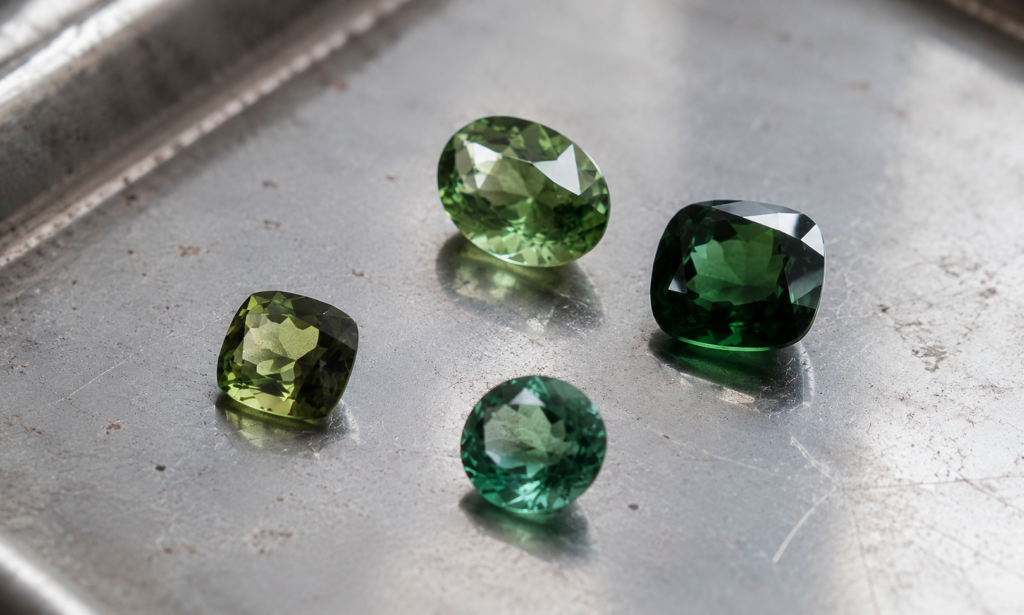
Green zircon can present itself very differently from one stone to another. In lighter material, the colour may feel more open and the flashes of light easier to notice. Deeper stones can create a denser, more atmospheric green, while yellow, blue, brown or gray modifiers can shift the character again. Cut adds another variable, influencing how much colour and light we experience face-up.
There is no single expression of green that a zircon needs to achieve. Colour, tone and light simply give each stone a different character.
Green Zircon Is More Than a Colour
Green zircon can connect colour, chemistry, radiation, crystal structure, geological time and light in a single gemstone. In metamict material especially, its appearance can hint at changes that occurred inside the crystal long before it was cut and polished.
In some gemstones, colour tells us what elements are present. In green zircon, it can also hint at what the crystal has lived through.
The Unexpected Green
Blue may be zircon’s most familiar modern identity, but green reveals another side: sometimes earthy, sometimes deep, occasionally unusual under changing light, and scientifically connected to one of zircon’s most remarkable structural stories.
Green zircon is unexpected not because zircon should not be green, but because behind that green can be a story of light, structure and geological time.