
Zircon can impress quickly. Vivid colour, fire and bright flashes can catch the eye immediately. At Sookjai, that first impression matters—but it is only the beginning. We want to know whether the colour, light, cut and character continue to hold our attention.
Zircon can catch the eye with light. What keeps our attention is how the whole stone comes together.
We Begin With Colour
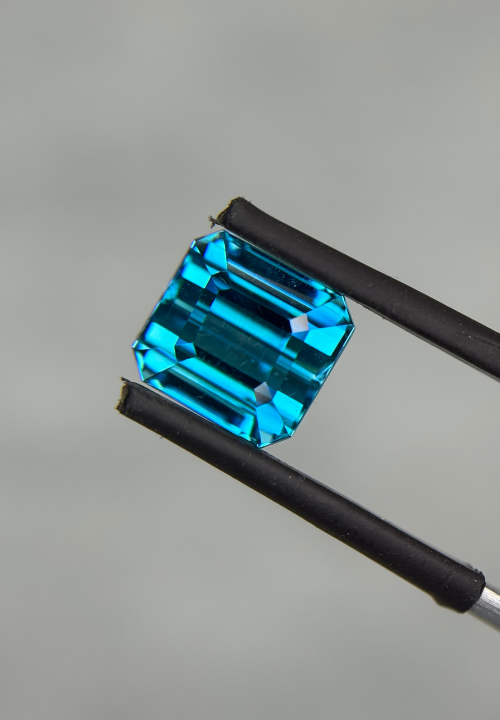
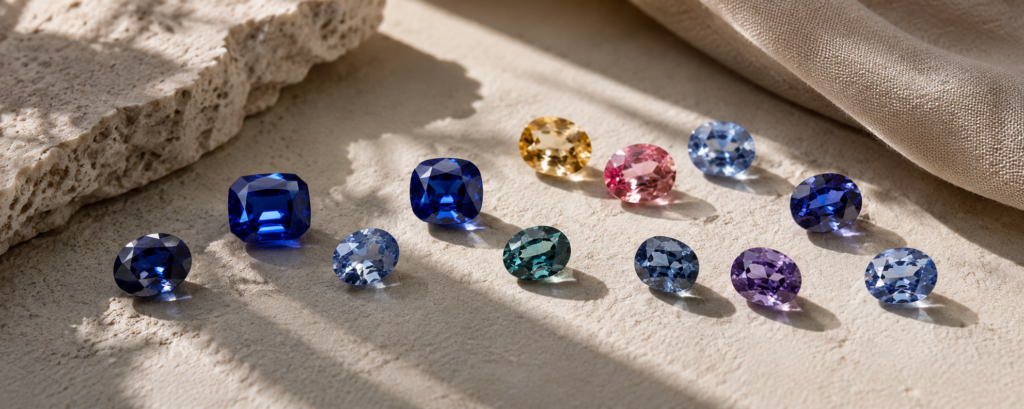
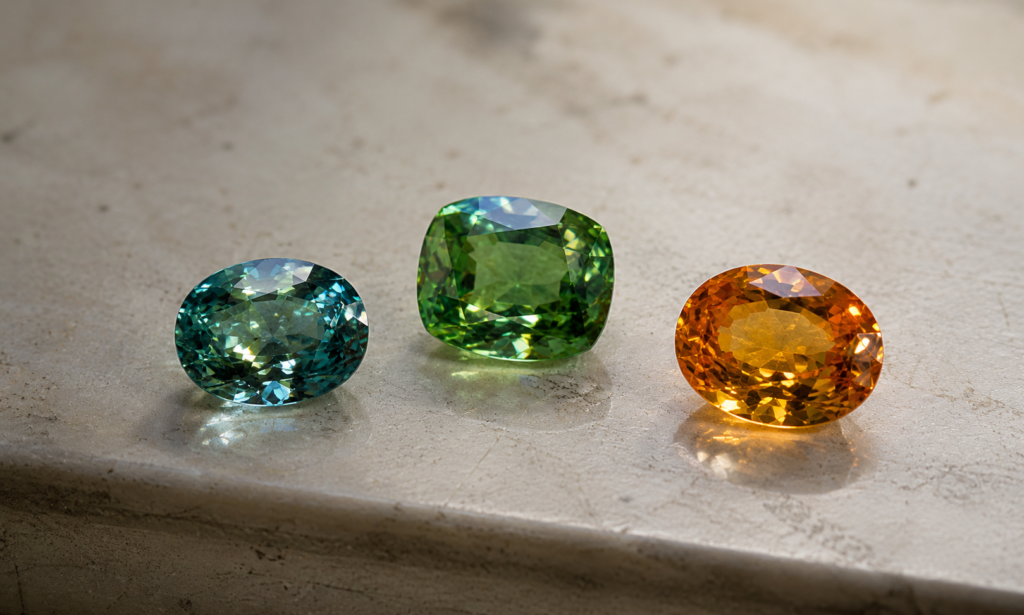
Our first question is simple: do we like the colour? Zircon exists far beyond its familiar blue identity, including green, yellow, orange, red, reddish brown, brown and colourless material. Blue may be especially popular, but popularity does not decide what deserves our attention.
Popularity can tell us what the market notices. It does not have to tell us what to notice.
We Look at the Colour Before the Colour Name
A label such as “Blue Zircon” identifies a family, not the entire stone. One blue may feel cool and open; another may lean greenish or appear more saturated. We pay attention to tone, modifiers and the overall feeling rather than asking every stone to fit one ideal.
A colour name identifies the family. It does not describe the entire personality of the stone.
We Want to See the Colour, Not Just the Sparkle
Zircon’s strong dispersion, luster and refractive properties give it remarkable optical potential. In coloured zircon, however, we still want to experience the body colour beneath the flashes. Fire can bring the stone to life without becoming the only thing we notice.
We love zircon’s fire. But in a coloured zircon, we still want to meet the colour underneath it.
Bright Does Not Always Mean Better
The brightest zircon is not automatically the one we prefer. A deep green, warm brown or orange zircon can communicate light very differently from colourless material. Brightness is one expression of zircon, not a universal measure of beauty.
Brightness is one expression of zircon. It is not the only expression worth seeing.
Clarity Matters When It Changes the Experience
Most faceted zircon is eye-clean, although some material can appear cloudy or smoky. We are not searching for microscopic perfection. What matters is whether an internal feature becomes visually dominant, significantly reduces transparency or distracts from the colour and light.
We do not need a zircon to be microscopically perfect. We want nothing inside it to become more important than the stone itself.
Cloudiness Is Different From Character
Softness or haze does not need to be rejected simply because it exists. In one zircon it may create atmosphere; in another it may make the colour muddy or suppress the light. We ask what the feature does to the gemstone.
Cut Matters Because Zircon Has So Much Light to Work With
Brilliant-style cutting is common because it can use zircon’s luster and fire effectively, but we do not judge cut only by textbook geometry. We look at whether colour remains visible, light moves through the face-up stone, and prominent windows or lifeless areas dominate.
We do not judge a zircon’s cut only by geometry. We judge what the geometry allows the stone to do.
Not Every Zircon Needs a Brilliant Cut
Step cuts, mixed cuts, elongated forms and unconventional shapes can give zircon different personalities. A cut does not have to maximise every flash. Sometimes a quieter facet pattern allows colour or form to become stronger.
A cut does not have to maximise every flash of light to make a zircon interesting.
Double Refraction Is Part of Its Character
Zircon is doubly refractive, so facet junctions can appear doubled in certain directions. We do not expect zircon to behave like a singly refractive gemstone. That busy internal facet appearance can simply be part of its identity.
We do not ask zircon to behave like a singly refractive gemstone. Its doubling belongs to its identity.
Treatment Is Information, Not an Automatic Rejection
Heat treatment is common in zircon, particularly in much blue material. Treatment alone does not decide whether we like a stone. What matters is understanding what is known and communicating it clearly.
Treatment does not automatically decide whether we like a zircon. Knowing what we are looking at does matter.
We Look at Zircon in More Than One Light
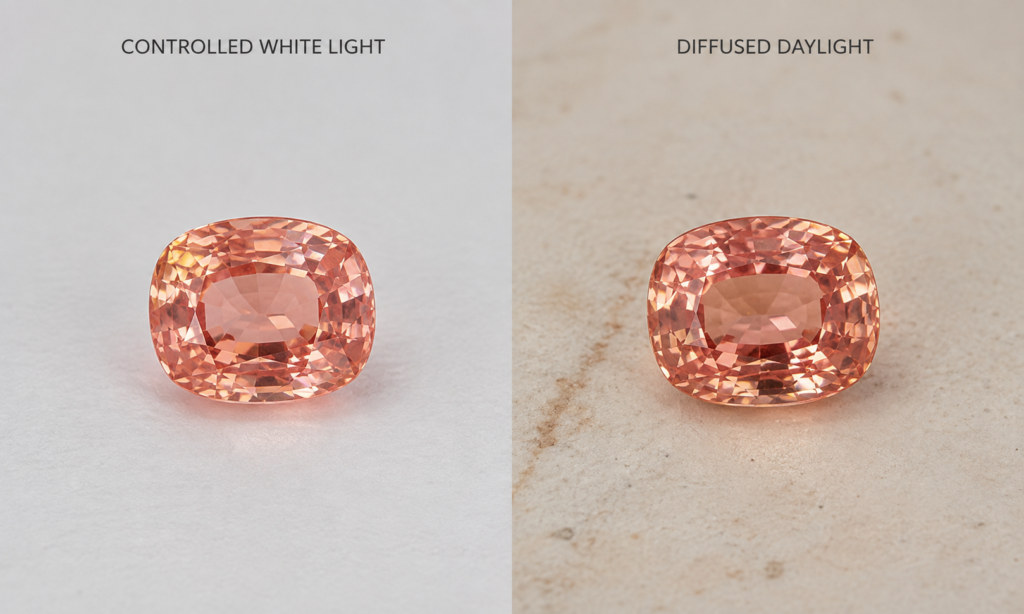
A gemstone does not live under one lamp. We like to see zircon in controlled white light and ordinary ambient or diffused daylight. We do not expect colour to look identical under every illumination; we want to understand how the stone responds.
We are not looking for a zircon that refuses to change. We want to understand how the zircon behaves when the light changes.
We Pay Attention to the Facets
Zircon is relatively brittle, and facet junctions can show abrasion or small chips. We look at the surface as well as the interior not for microscopic perfection, but for damage that affects face-up crispness or matters when the stone is set.
In zircon, the condition of the surface can matter almost as much as what is happening inside the stone.
We Think About How It Will Be Worn
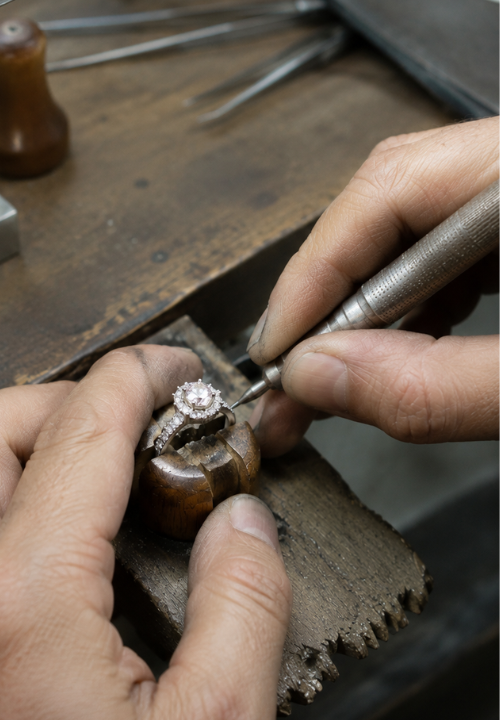
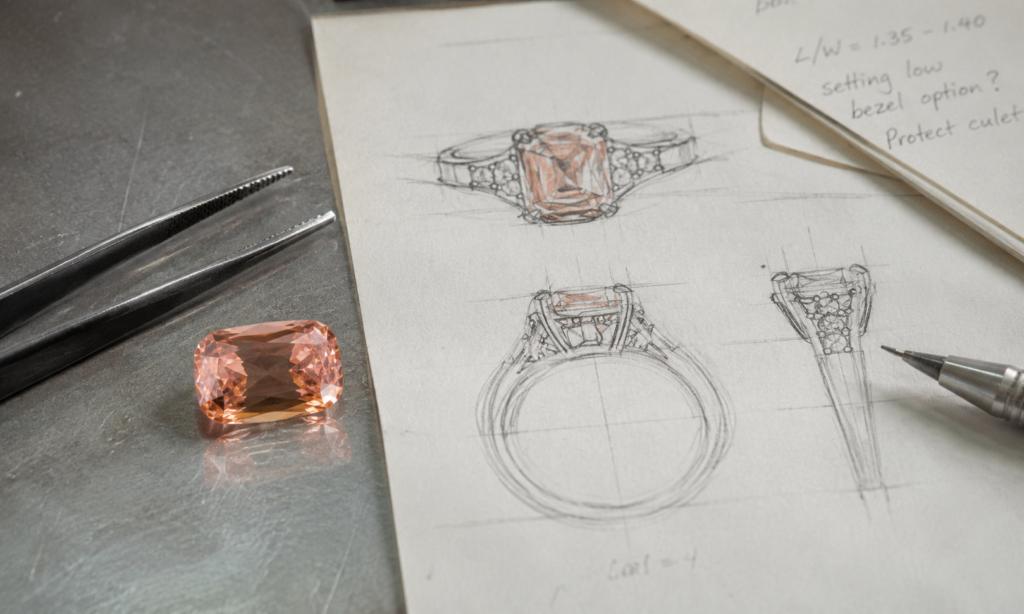
A zircon intended for a ring may lead to different setting decisions from one intended for earrings or a pendant. Shape, exposed points, size and expected wear can become part of the design conversation.
Choosing the zircon and choosing how it will be worn are sometimes part of the same decision.
We Read the Millimetres Alongside the Carats
Zircon has relatively high specific gravity, so it can weigh more than many gemstones of similar dimensions. We therefore consider face-up measurements, depth and proportions alongside carat weight.
With zircon, we read the millimetres alongside the carats.
Origin Adds Story, Not a Verdict
Zircon comes from several gem-producing regions. Cambodia has an important blue-zircon story, while Sri Lanka is notable in discussions of green and metamict zircon. Origin adds context, but it does not determine whether the finished gemstone appeals to us.
Origin can tell us where a zircon began. It does not decide whether we will love the finished gemstone.
Sometimes the Stone Gives Us the Design
An elongated cut, unusual proportion, deep green or warm cognac-like colour can become a starting point rather than a problem. Sometimes we can already imagine a piece when we first see the stone. With zircon, that instinct also includes thinking about protection.
Sometimes we choose a zircon not only because we like the gemstone, but because we can already see what it could become.
What Makes Us Say Yes?
There is no single checklist. We may respond to colour with identity, lively light, clarity that does not distract, a cut that works with the material, suitable surface condition and a form that suggests possibilities. None needs to be pushed to an abstract maximum.
We say yes when the zircon stops feeling like a list of qualities and begins to feel complete as a gemstone.
What We Are Really Looking For
We are not searching for the zircon with the most sparkle, the most electric blue, the greatest size or the most impressive label. We begin with colour. We watch what the light does. We consider cut, clarity, condition and character. In the end, we choose the zircon that feels complete as itself.