
Zircon has a way of making geological time feel almost tangible. Earth formed about 4.56 billion years ago, and some zircon crystals discovered in Western Australia have been dated to about 4.4 billion years. In human terms, both numbers are almost impossible to imagine. Geologically, however, those zircons formed remarkably close to the beginning of our planet.
Some zircon crystals formed when Earth itself was still young.
Not Every Zircon Is 4.4 Billion Years Old
The famous 4.4-billion-year age belongs to extraordinary ancient zircon grains, not to every zircon found in nature or set in jewelry. Zircon has formed during many different periods of Earth’s history. What makes the mineral remarkable is that some examples have survived from almost the earliest chapter we can investigate.
The 4.4-billion-year story belongs to extraordinary ancient zircon crystals—not to every zircon in jewelry.
The Story Begins in Western Australia
The Jack Hills region of Western Australia has yielded tiny detrital zircon grains older than four billion years. One landmark study reported a zircon age of about 4,404 million years. These are not large gem crystals waiting to be faceted. They are minute geological grains whose importance is vastly greater than their physical size.
One of Earth’s greatest geological archives can exist inside a grain almost too small to notice.
What Was Earth Like 4.4 Billion Years Ago?
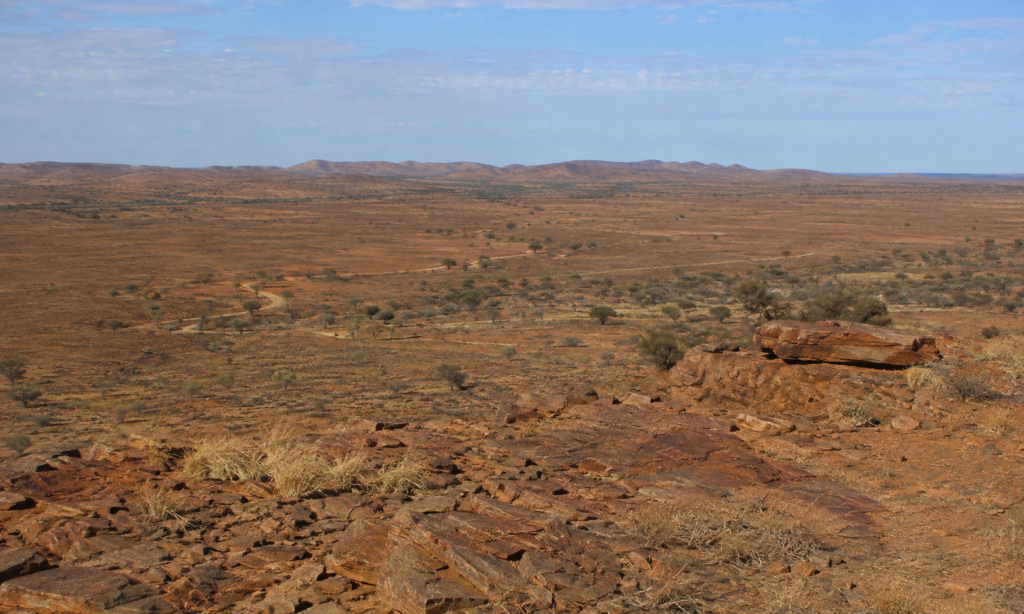
This period belongs to the Hadean Eon, an early chapter of Earth for which the surviving geological record is extremely limited. Much of the planet’s early crust was melted, altered, eroded or recycled by later geological processes. Ancient zircon grains are therefore unusually valuable witnesses to a world from which very little intact rock remains.
Much of early Earth disappeared. Zircon survived.
Why Did Zircon Survive?
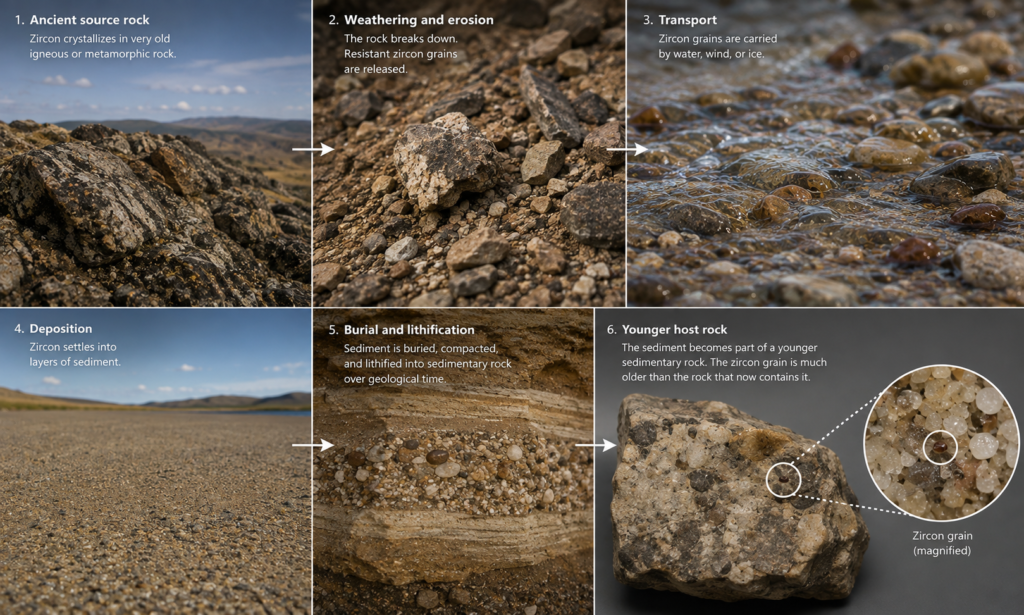
Zircon combines physical durability with strong chemical resistance. Individual crystals can endure weathering, erosion, transport, burial and later geological reworking. The original rock surrounding a zircon may disappear while the resistant zircon continues into a new environment.
The rock that once held a zircon can disappear while the zircon continues its journey.
A Zircon Can Be Older Than the Rock Holding It
The ancient Jack Hills zircons are detrital. They crystallized in older rocks, were released when those rocks weathered and eroded, travelled as sediment, and were eventually incorporated into younger deposits. A zircon grain can therefore be substantially older than the rock in which scientists later find it.
A zircon can outlive its first rock, travel elsewhere, and become part of a younger one.
How Do Scientists Know a Zircon Is So Old?
Zircon is especially useful for uranium–lead dating. When it crystallizes, its structure can incorporate uranium while strongly excluding ordinary lead. Over time, radioactive uranium isotopes decay into lead isotopes. By measuring these isotope systems, scientists can calculate when the zircon crystallized.
The same trace elements that slowly change zircon can also help scientists read its age.
Zircon Is More Than a Clock
Age is only part of what zircon can preserve. Chemical and isotopic information inside a crystal can offer clues about the material and environment from which it formed. This is why geologists often treat zircon as a tiny archive rather than simply a geological stopwatch.
Zircon does not simply survive time. It can preserve information from it.
Ancient Zircon Changed the Story of Early Earth
Research on Jack Hills zircons has found oxygen-isotope evidence consistent with interaction between early crustal material and liquid water. These findings helped challenge overly simple images of the Hadean as an entirely molten, hostile world and opened the possibility that differentiated crust and a hydrosphere existed surprisingly early.
A crystal smaller than a grain of sand helped change how scientists imagine the young Earth.
Zircon Is Still Teaching Us About Water
Scientists continue to ask new questions of these ancient grains. Recent research on Jack Hills zircons has presented evidence for meteoric fresh water interacting with emerged continental crust by around four billion years ago or earlier. The remarkable part is not only that the grains survived, but that analytical techniques continue to reveal new information from them.
Ancient zircon is not only a record we have already read. Scientists are still learning how to read more from it.
Why Zircon Works So Well as a Geological Archive
Zircon’s scientific importance comes from an unusual combination. It can survive geological reworking, incorporate elements useful for dating, and preserve chemical information about its formation. Durability allows the record to survive; chemistry allows scientists to read it.
Zircon survived because it is resilient. It became scientifically extraordinary because it also kept a record.
The Zircon in Jewelry and the Zircon in a Laboratory
The zircon studied by geologists and the zircon cut as a gemstone belong to the same mineral species: zirconium silicate, ZrSiO₄. Their individual ages, origins, structures and histories can be completely different, but they belong to the same mineral story.
The zircon in a jewel and the zircon in a geology laboratory belong to the same mineral story—even when their individual histories are very different.
Does an Older Zircon Make a Better Gemstone?
No. Geological age is scientifically fascinating, but it is not automatically a measure of gemstone beauty or quality. An ancient zircon is not necessarily more attractive, more suitable for jewelry or more valuable simply because it is older. The 4.4-billion-year story is about the significance of zircon as a mineral archive.
Geological age can make a zircon scientifically remarkable. It does not automatically make it a more beautiful gemstone.
A Different Way to Think About Precious
In jewelry, value is often discussed through beauty, rarity and price. Zircon offers another perspective: survival itself can be extraordinary. The mineral is famous for brilliance and fire, yet its deeper story reaches into geological time on a scale few objects we encounter can represent.
Zircon can be beautiful because of the way it handles light. It can be extraordinary because of the amount of time its mineral family has endured.
From the Hadean Earth to a Cut Gemstone
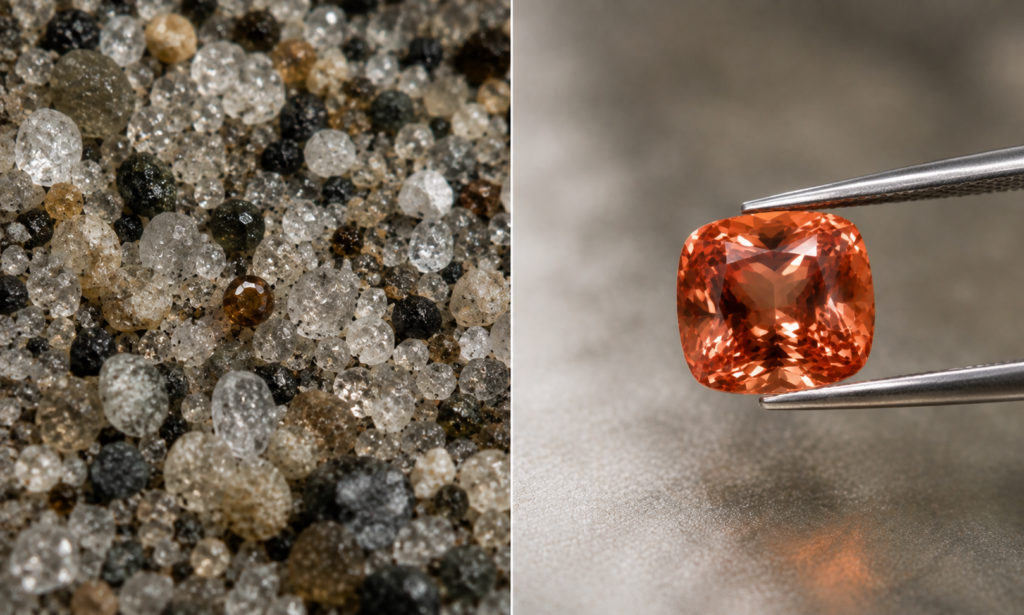
Ancient geological zircon grains and modern gem-quality zircon should never be confused as the same specimens. Yet placing them side by side conceptually reveals something remarkable: one mineral species can belong both to research into the earliest Earth and to the history of gemstones and jewelry.
One Mineral, Two Ways of Seeing Time
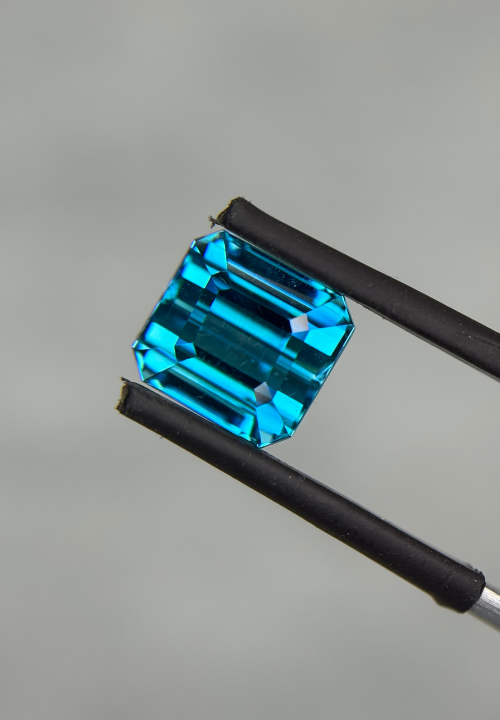
A geologist can look at zircon and see age, crust, water and planetary history. A jeweller can look at zircon and see colour, brilliance, fire and form. These perspectives do not compete. Together they reveal how unusual it is for one mineral to occupy both worlds.
To a geologist, zircon can be a record of time. To a jeweller, it can be a play of light. It is remarkable that the same mineral can be both.
A Small Crystal With an Enormous History
Some zircon grains have survived for roughly 4.4 billion years, enduring geological processes that erased much of the world in which they first formed. Today zircon continues to appear in laboratories, geological research, museum collections and jewelry. A crystal can be physically tiny and still carry an extraordinary relationship with time.
Zircon may be small enough to sit quietly in a piece of jewelry, yet its mineral story reaches back almost to the beginning of Earth itself.