
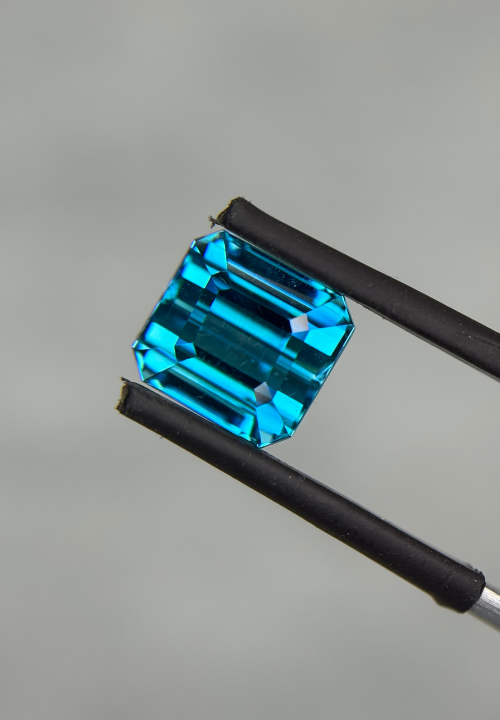
Few gemstones challenge the familiar image of garnet as quickly as tsavorite. Instead of deep wine red, it can appear fresh, transparent and intensely green—sometimes vivid enough that someone unfamiliar with the garnet family might never connect the two.
Few gemstones challenge the familiar image of garnet as quickly as tsavorite.
First, What Exactly Is Tsavorite?
Garnet is a mineral group, grossular is one species within that group, and tsavorite is the green gem variety of grossular. Grossular itself is not always green: its colour range extends from colourless and yellow through orange and reddish tones to strong green.
Every tsavorite is a green garnet, but not every green garnet is tsavorite.
The Green Comes From a Particular Chemistry
Tsavorite’s green is associated especially with trace vanadium and, in some material, chromium. These elements interact with light within the grossular crystal and help create the green we see. The colour is part of the crystal’s optical behaviour rather than something placed over its surface.
The green is not a coating placed over grossular. It is part of the way the crystal interacts with light.
Tsavorite Green Is Not One Green
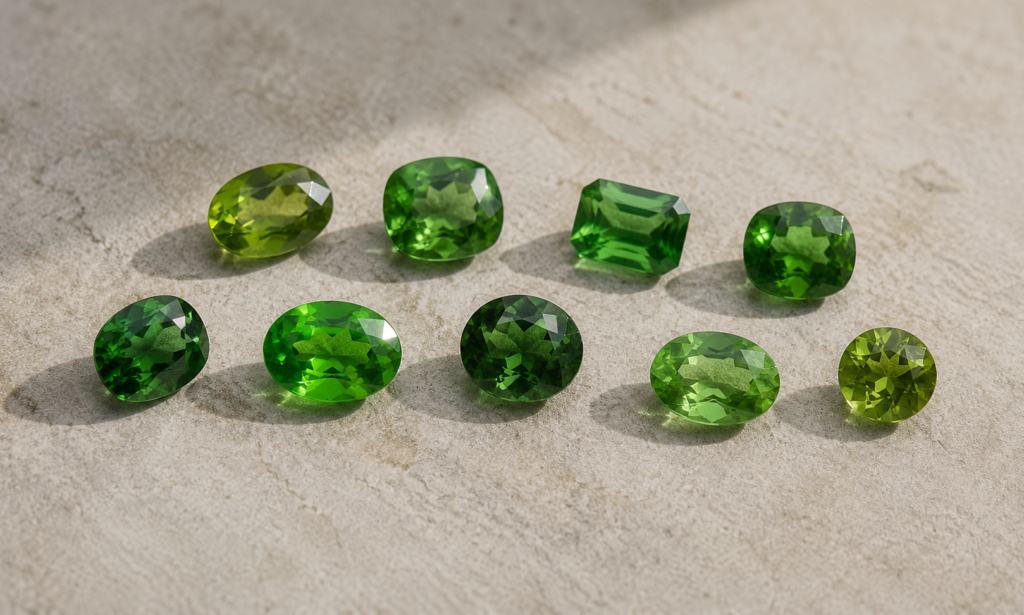
Tsavorite does not exist as one fixed green swatch. Individual stones can move through yellowish green, fresh medium greens, richer greens and deeper saturated appearances. East African deposits can also produce lighter mint-green grossular alongside more saturated material, reminding us that green grossular occupies a broad visual territory.
Tsavorite does not have to express green in exactly one way for its colour to have character.
Where Does Tsavorite Come From?
Tsavorite’s story is closely tied to East Africa, especially Kenya and Tanzania. Both have produced important material; their significance lies in the unusual regional geology that made this green grossular possible.
Tsavorite’s identity is closely tied to the geology of East Africa, not to a hierarchy between its sources.
The Landscape Behind the Green
Tsavorite occurs within complex metamorphic geology involving schist, gneiss, calc-silicate rocks, quartzite and marble. Ancient sediments were transformed by heat, pressure and tectonic activity, creating a geological environment far rougher than the finished gemstone suggests.
The vivid green begins in rocks shaped by an enormous geological history.
A Gemstone Born From Continental Collision
Research on East African tsavorite places its formation within metamorphic events connected with the Pan-African orogeny. Sedimentary rocks were subjected to substantial heat and pressure as continental crust was transformed. Tsavorite is therefore part of a geological story involving processes powerful enough to reshape large regions of the crust.
Tsavorite’s green emerged from rocks transformed under conditions powerful enough to reshape continents.
The Discovery of a Modern Gemstone
The geology is ancient, but tsavorite’s modern gemstone identity is remarkably young. Campbell Bridges played a central role in the discovery, development and recognition of East African green grossular, and gemological literature was documenting “tsavorite” by the 1970s. Its name connects the gemstone with Kenya’s Tsavo region.
The rocks are ancient. The name tsavorite is remarkably young.
From East Africa to the Jewelry World
Green grossular emerging from East African geology became a recognized gemstone identity in the international jewelry world. The name gave this green expression of grossular a clearer place in the trade, while the mineral story beneath that name remains the more fundamental one.
A geological discovery became a gemstone identity—and eventually a name recognized far beyond East Africa.
Why Large Tsavorite Is Less Common
Tsavorite is commonly encountered in smaller sizes, and fine larger stones are considerably less available. Some red garnets occur in substantial sizes more readily, showing that size has different geological meaning across branches of the family.
A large red garnet and a large tsavorite do not represent the same kind of geological occurrence.
Rough Shape Influences the Cut
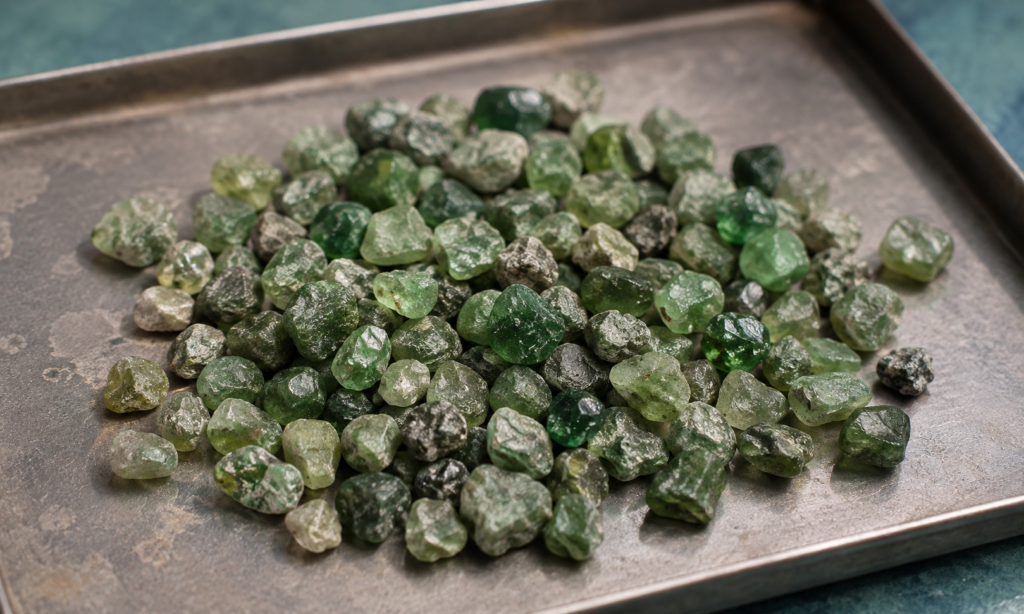
Fine tsavorite rough is valuable enough that cutters often consider how to preserve useful weight while revealing colour and light. The finished outline may respond to the original rough rather than forcing every stone into a predetermined calibrated form.
With tsavorite, the final shape can begin as a conversation with the rough.
Colour and Cut Work Together
Two tsavorites with similar body colour can feel different once faceted. Depth, proportions, orientation and light return influence whether the green appears open, bright, dense or dramatic. This is not a formula for the correct cut; it is part of how an individual crystal becomes a finished gemstone.
The colour belongs to the crystal. The cut determines how much of that colour we are able to experience.
What About Clarity?
Tsavorite can contain natural internal features, while other stones appear very transparent to the unaided eye. Clarity matters because it participates in the visual experience, not because every tsavorite needs microscopic perfection. Transparency, inclusions, colour and light work together.
Clarity is part of a tsavorite’s appearance, not a requirement for microscopic perfection.
Tsavorite and Demantoid: Two Different Greens
Tsavorite is green grossular; demantoid is green andradite. Andradite has higher refractive index and dispersion than grossular, giving demantoid a different relationship between green body colour and spectral fire. They can share the language of green without sharing the same mineral or optical identity.
They share the language of green, but they do not speak it in the same way.
Tsavorite Is Rarely About Treatment
Routine colour enhancement does not dominate the garnet market, and tsavorite is generally encountered without routine colour or clarity treatment. This should not be turned into an absolute claim that unusual treatment could never exist.
For tsavorite, the green we encounter is generally a story of the crystal itself rather than routine colour enhancement.
A Green Gemstone With Practical Durability
Garnets range roughly from 6.5 to 7.5 on the Mohs scale, depending on species, and tsavorite lies toward the harder side of the family. It can be used in many forms of jewelry with thoughtful setting and care. Its durability is part of tsavorite’s own material character.
Tsavorite does not need to be understood as an alternative to another green gemstone. Its durability is simply part of its own jewelry character.
Green Does Not Need to Mean Emerald
Tsavorite is sometimes described through comparisons with emerald because both can offer intense green. Yet they belong to different mineral families, form through different geological stories and have different optical and internal characters. Tsavorite becomes more interesting when its green is allowed to stand on its own.
Tsavorite does not need to look like emerald to justify its green.
What Makes Tsavorite Feel Like Tsavorite?
There is no single ideal expression every tsavorite must achieve. Green body colour, tone, saturation, transparency, cut, light return, natural internal features and size all contribute to personality. Some stones feel bright and open; others feel richer and denser.
Tsavorite is not one ideal shade of green. It is a relationship between colour, light and the individual crystal.
From Rough Stone to Fine Jewelry
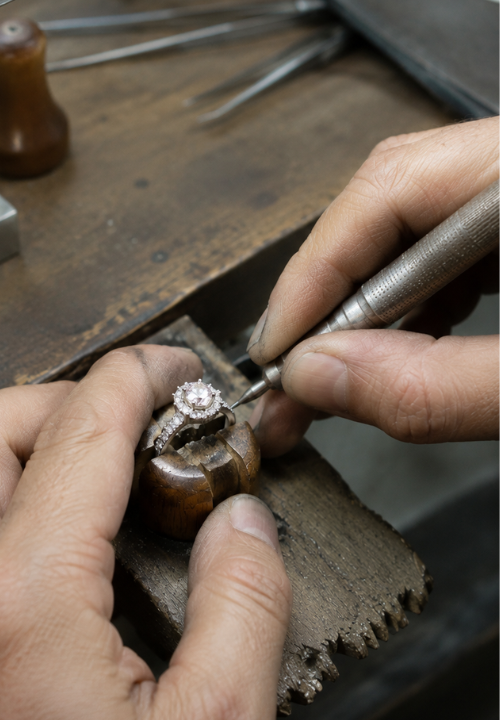
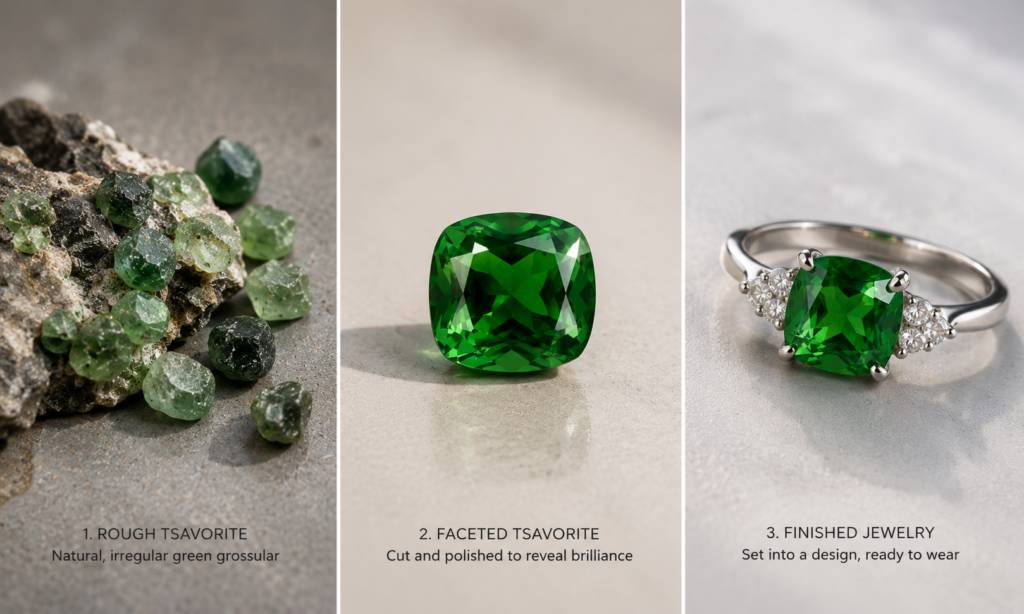
The journey from rough to jewelry can be revealing with tsavorite. A naturally irregular piece of green grossular is read by a cutter, transformed into a faceted stone, and eventually becomes the starting point for a design. The finished jewel may be refined, but its direction still begins with the material.
Between the rough and the finished jewel, the green remains the constant while almost everything around it changes.
One of Garnet’s Most Unexpected Expressions
Tsavorite is not important because it somehow escapes the identity of garnet. It reveals how broad that identity can be. From ancient East African metamorphic rocks to vivid faceted green, tsavorite shows one of the most distinctive possibilities within the grossular branch of the garnet family.
Tsavorite is not an exception to the garnet story. It is one of the clearest examples of how broad that story really is.