
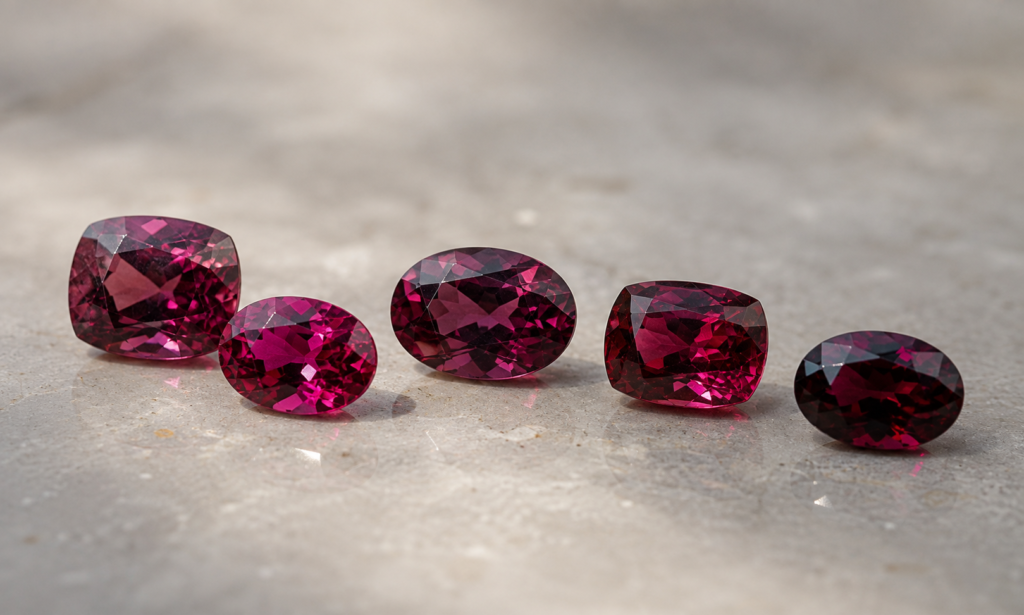
Rhodolite is easy to recognize as beautiful and surprisingly difficult to describe with one colour word. A stone may appear red, raspberry, rose or distinctly purple. That overlap is central to its identity.
Rhodolite lives between familiar colour names. Red can soften toward pink, deepen toward purple, or hold all three impressions at once.
First, What Exactly Is Rhodolite?
Rhodolite is not a separate garnet species. It is a varietal name commonly used for garnets within the pyrope–almandine compositional series, especially material with pinkish-red to purplish-red character.
Rhodolite is not a separate garnet species. Its identity emerges within the space between pyrope and almandine.
Why Can Two Garnet Species Meet?
Pyrope is magnesium-rich and almandine is iron-rich. Their compatible crystal structures allow magnesium and iron to substitute for one another, creating a continuous solid-solution series rather than a hard boundary.
Rhodolite exists because garnet chemistry is comfortable with the space between categories.
Rhodolite Is Not a Fixed Chemical Recipe
Historical descriptions sometimes gave approximate pyrope-to-almandine proportions, but natural rhodolite does not follow one universal recipe. The name describes a varietal identity within the pyrope–almandine world rather than a separate chemical end member.
The name describes a recognizable part of the pyrope–almandine world, not one exact chemical recipe.
A Name Inspired by the Rose
The name rhodolite comes from the Greek rhodon, meaning rose. Early North Carolina material was described with rose-red and violet-influenced colour language. The name began with an impression of colour, not a new mineral species.
Rhodolite was named not for a chemical boundary, but for the impression of a rose.
The North Carolina Chapter
Rhodolite’s historical story is closely connected with the Cowee Valley area of Macon County, North Carolina. As comparable garnets were recognized elsewhere, the name travelled beyond its original locality.
Rhodolite began as the name of a particular garnet appearance from one place. Its story eventually travelled far beyond North Carolina.
From Rose Red to Purple-Red
Rhodolite can occupy a broad visual space: pinkish red, rose, raspberry, purplish red, red-purple and deeper wine-like purple-red can all describe parts of its appearance. No single colour chip captures every stone.
Rhodolite does not sit at one point between red and purple. It moves through the space between them.
Where Do Pink and Purple Come From?
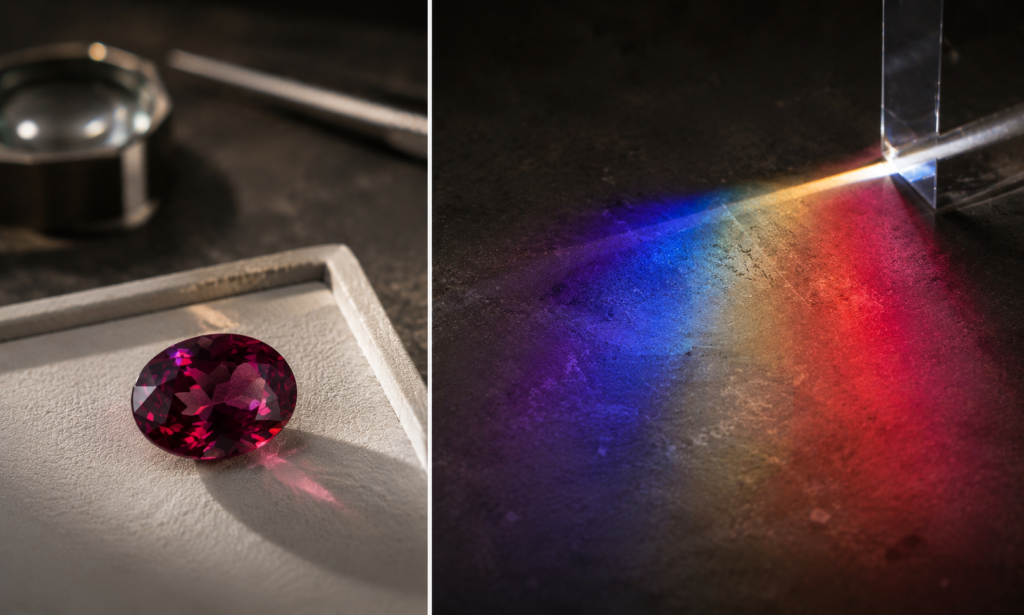
Rhodolite’s colour is not a simple pink pigment added to red. Composition and selective absorption shape which parts of white light reach our eyes. Iron-related absorption is important in pyrope–almandine garnets, while composition and tone influence the final balance.
Pink and purple are not painted onto red. They emerge from the way the garnet filters light.
When Red and Blue Survive Together
Studies of purple pyrope–almandine garnet show how absorption through parts of the green-to-yellow region can leave red and blue portions more prominent. Our eyes can experience that combination as purple.
In a purple rhodolite, the colour we see is partly the result of which parts of white light are allowed to remain.
Tone Changes the Personality
Lighter rhodolite can open toward rose and pink, medium tones may feel raspberry-like, and deeper material can move toward wine or plum. These are different moods rather than steps on a quality ladder.
A change in tone can move rhodolite from rose to raspberry to wine without changing the basic identity of the stone.
Pink and Purple Are Part of the Identity
The modifiers that pull rhodolite away from familiar red garnet are not necessarily distractions. Pink and purple can be precisely what gives an individual stone its personality.
In rhodolite, the colours that pull red toward pink and purple are not distractions from its identity. They are part of the identity.
East Africa Expanded the Story
Rhodolite later became important far beyond North Carolina. East African sources, including Tanzania and the Umba Valley region, helped establish it as a broadly recognized gemstone rather than a localized curiosity.
East Africa transformed rhodolite from a localized garnet story into a much broader gemstone identity.
Mozambique Added a Strong Purple Chapter
Purple pyrope–almandine garnets documented from Mozambique show how far this colour family can move toward purple. In some stones, purple can become the first impression we notice.
Some modern rhodolites allow purple to become more than a modifier—it can become the first colour we notice.
Origin Does Not Create One Rhodolite Colour
Localities add geological and historical context, but their colours overlap. North Carolina, Tanzania, Mozambique and other sources should not be reduced to fixed colour formulas.
Origin can explain where a rhodolite came from. Colour alone cannot reliably tell us where that was.
Nature Does Not Draw a Wall Around Rhodolite
Because pyrope–almandine chemistry is continuous, the language around rhodolite has practical boundaries rather than a perfect natural wall. Historical gemological discussion reflects questions about how broadly the name should be applied.
The boundary around rhodolite is useful for language, but nature itself is more continuous.
Not Every Pink or Purple Garnet Is Rhodolite
The garnet family contains other pink and purple material, including pyrope and mixed-composition garnets. Appearance can suggest rhodolite, but colour alone does not establish identity.
Colour can suggest rhodolite. Gemological identity requires more than colour alone.
Rhodolite Is Not the Same as Colour-Change Garnet
Rhodolite may look somewhat different as lighting changes, as any coloured gemstone can. That is not automatically true colour change, a more specific phenomenon involving a substantial perceived shift between different light sources.
Every gemstone responds to light. A true colour-change phenomenon is something more specific.
Clarity Can Let the Colour Stay Open
Rhodolite often occurs without obvious eye-visible inclusions, although natural stones vary. Transparency can give its layered red, pink and purple impressions more room to be seen, but microscopic perfection is not part of the definition.
Clarity can give rhodolite’s layered colour more room to be seen, but perfection is not its identity.
Cut Changes How the Colours Share the Stone
Facet arrangement, depth, proportions and extinction can change how red and purple appear face-up. Bright returns may reveal lively red or pink flashes, while darker areas can deepen the wine or purple impression.
Cut does not decide whether rhodolite is red or purple. It changes how those colours share the stone.
Rhodolite in Jewelry
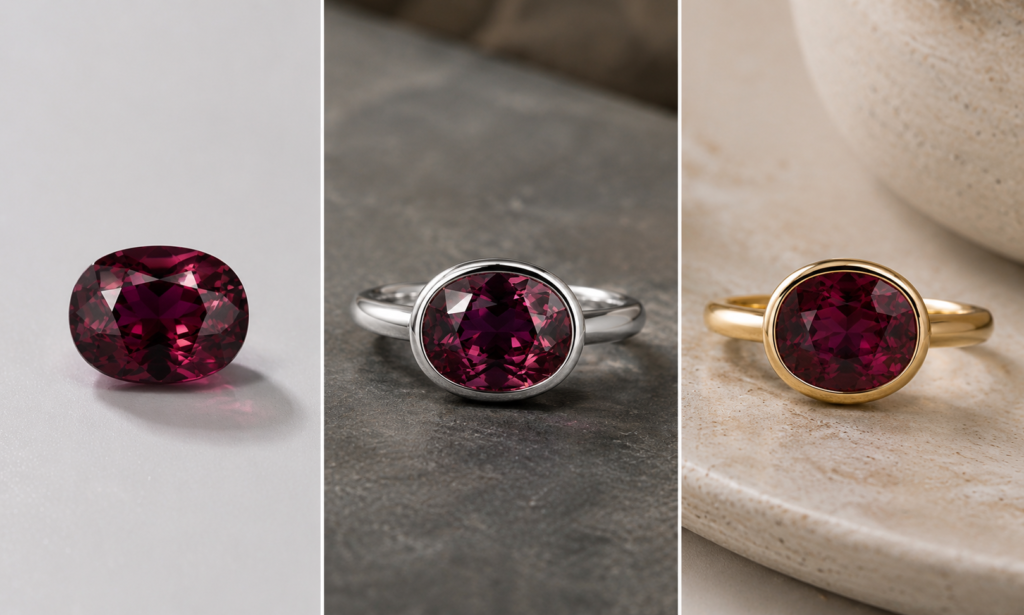
Metal, surrounding gemstones and background colours can influence which part of rhodolite’s palette catches our attention first. The gemstone itself does not need to change colour for our perception of it to shift.
The gemstone does not need to change colour for our experience of its colour to change.
Where Red, Pink and Purple Meet
One rhodolite may introduce itself as red and reveal raspberry flashes in movement. Another may appear purple first, while another feels predominantly rose. There is no required ratio of red, pink and purple.
Rhodolite is most interesting when its colours are allowed to overlap rather than being forced into separate boxes.
A Garnet That Lives Between Colours
Rhodolite is a fitting expression of the garnet family. Its chemistry occupies a continuum between pyrope and almandine, while its visual identity can occupy the meeting place between red, pink and purple. In both cases, continuity matters more than a hard boundary.
Rhodolite does not belong to red, pink or purple alone. Its character comes from the place where those colours stop behaving as separate categories.