
Mali garnet can be difficult to reduce to one colour. Some stones lean green, others yellow, olive or gold, and many sit naturally between them. That overlap is part of the material’s character.
Mali garnet often looks most like itself when green and yellow refuse to separate completely.
First, What Exactly Is Mali Garnet?
Mali garnet is not a separate species. Gem-quality material from Mali is commonly described as grossular–andradite garnet, occupying the compositional space between grossular, Ca₃Al₂(SiO₄)₃, and andradite, Ca₃Fe₂(SiO₄)₃.
Mali garnet is not a seventh major garnet species. It is a natural meeting point between grossular and andradite.
Why Can Grossular and Andradite Meet?
Both are calcium garnets. Aluminium dominates the relevant site in grossular while ferric iron dominates it in andradite, and substitution between them allows intermediate compositions to form.
The chemistry changes gradually, so the gemstone does not have to choose one end member or the other.
The Name Comes From a Place
The name refers to Mali in West Africa, where this material entered the modern gem trade. Research in the mid-1990s documented gem-quality grossular–andradite from Mali in commercial quantities.
Mali gave this garnet its trade identity because it was the place where an unusual composition became a gem material in meaningful quantity.
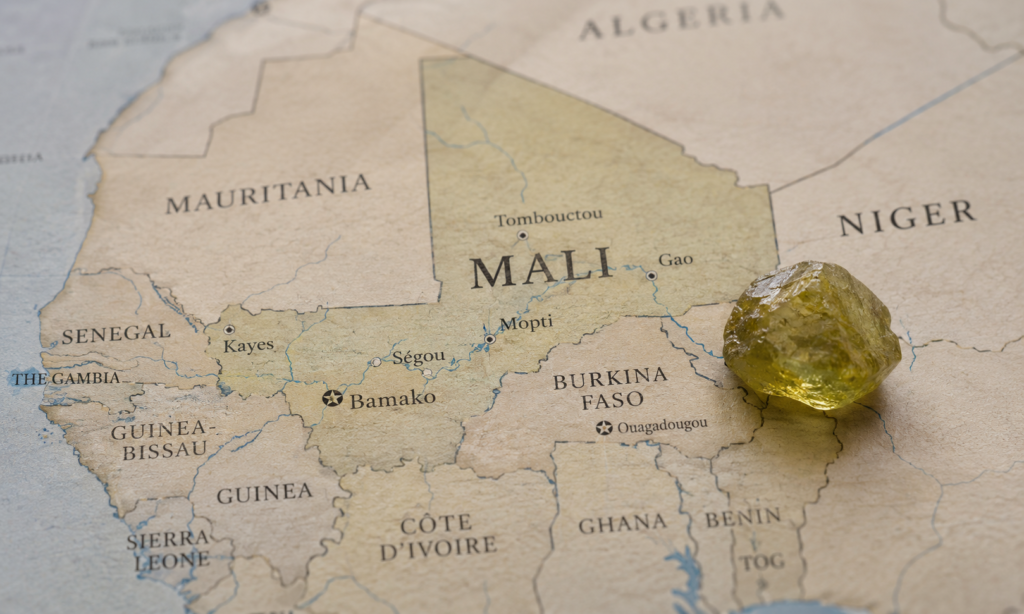
A Modern Gemological Discovery
Material appearing in the European trade in 1994 included transparent facetable garnets ranging through yellow, green and brown. Their properties resembled grossular without fitting it completely, prompting closer study.
Mali garnet entered the gem trade first as a colour mystery and only then as a mineralogical story.
Iron Is Central to the Colour Story
Ferric iron is important to the andradite component and to the colour of Mali grossular–andradite, creating a close relationship between composition and its yellow-to-green appearances.
In Mali garnet, iron helps connect mineral composition directly with the colour we see.
Mali Garnet Is Not One Green
Documented material includes yellow-green, greenish yellow, green and brownish appearances, while intense green also occurs. Its identity extends far beyond one vivid-green image.
The most characteristic Mali garnet may sit between green and yellow rather than choosing either colour completely.
Where Green Becomes Yellow
In one stone green may lead while yellow adds warmth; in another, yellow becomes the first impression with green underneath. Small shifts can change the entire mood.
A small shift in the balance between green and yellow can change the entire mood of the stone.
Where Yellow Becomes Gold
As yellow becomes warmer or deeper, Mali garnet can move toward golden, honey-like, olive-gold and yellow-brown impressions. Brownish warmth can give the stone a more earthy character.
Gold in Mali garnet is not a separate colour category. It can emerge naturally as yellow becomes warmer and deeper.
Intense Green Is Only One Expression
Strong green Mali garnet can be striking, but it represents only part of the range. Golden, yellow-green and olive expressions reveal other sides of the same mineralogical story.
An intense green Mali garnet can be striking, but it does not define what every Mali garnet needs to become.
Between Grossular and Andradite—Optically Too
The intermediate identity appears in measurable properties as well as chemistry. Studies found refractive indices generally above typical grossular and below andradite.
Mali garnet sits between grossular and andradite not only in chemistry, but also in measurable optical behaviour.
Why Can Mali Garnet Look So Bright?
Andradite has higher refractive index and dispersion than grossular. An andradite component can contribute to lively brilliance and sometimes noticeable dispersion without making Mali garnet demantoid.
Its brightness hints at the andradite side of its identity without turning Mali garnet into demantoid.
Colour and Light Share the Stone
Lighter yellow-green material may feel open and bright, while deeper green, golden or brownish tones can feel denser and warmer. Body colour, tone and light return work together.
In Mali garnet, the balance between colour and light can be as important as the colour name itself.
What the Rough Can Hide
Early studies described some rough with dull or brownish exterior surfaces concealing transparent yellowish-green or green material inside. The contrast can make the transformation especially dramatic.
In some Mali garnet rough, a quiet brown surface can hide a transparent green or yellow-green interior.
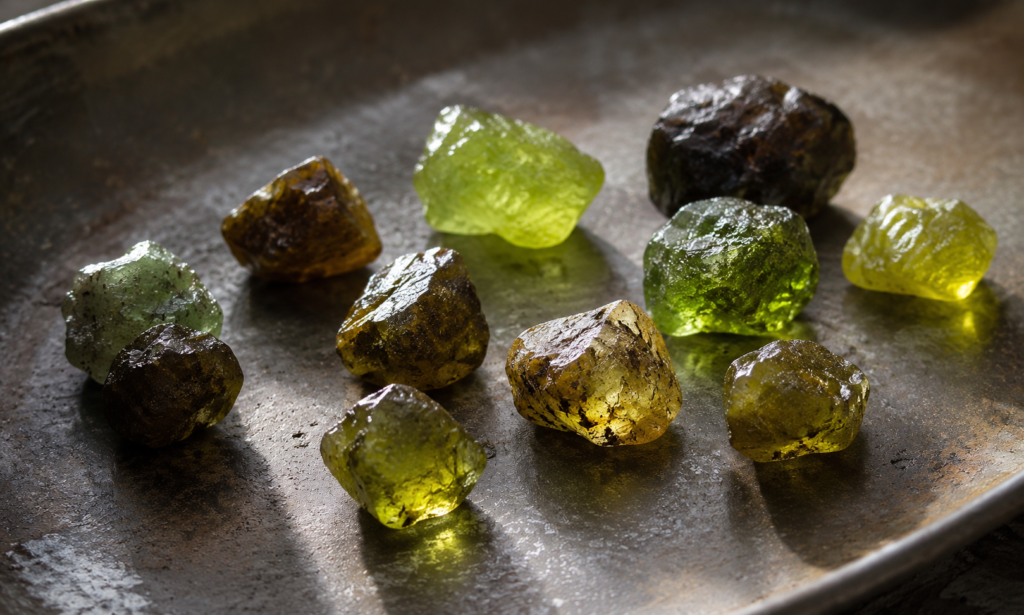
Formed Where Rocks Were Changed
The original Mali deposits were described in a contact-metamorphic setting, where heat and chemical interaction associated with igneous activity altered surrounding rocks and created conditions for calcium-rich garnets.
Mali garnet is a product of rocks changed by heat, chemistry and contact.
Why the Geology Fits the Chemistry
Grossular and andradite both require calcium, while their balance reflects aluminium and iron. A metamorphic environment bringing these ingredients together provides a logical context for intermediate compositions.
The same geological environment can supply the ingredients for both sides of Mali garnet’s identity.
Mali Garnet and Tsavorite Tell Different Green Stories
Tsavorite is green grossular whose colour is associated especially with vanadium and sometimes chromium. Mali garnet is grossular–andradite, with ferric iron central to its chemistry and colour.
They may share the word green, but tsavorite and Mali garnet arrive there through different chemistry.
Mali Garnet Is Not Demantoid Either
Demantoid is the green variety of andradite. Mali garnet occupies intermediate grossular–andradite chemistry, so an andradite influence does not make it demantoid.
Mali garnet can borrow something of andradite’s optical character without becoming demantoid.
Between Green and Gold
Yellow-green, greenish yellow, olive and gold can overlap when describing Mali garnet. Lighting and tone can shift which impression reaches us first, making rigid boundaries unhelpful.
The closer green moves toward yellow, the less useful a single colour word becomes.
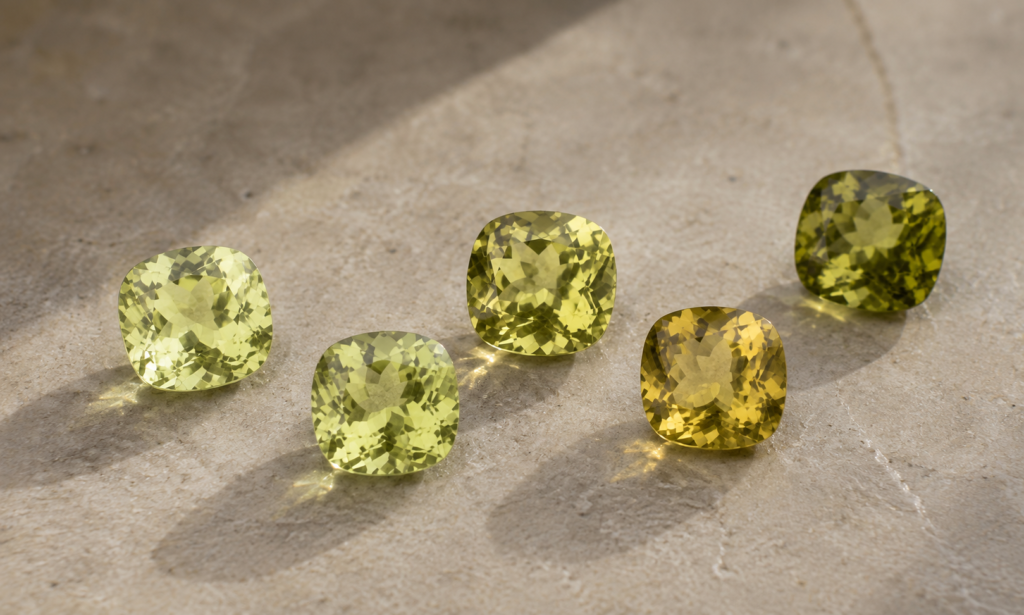
Cut Changes How the Warmth Appears
Proportions, facet arrangement, depth and extinction influence whether yellow feels open, green appears deeper, or golden tones become luminous or dense.
Cut does not decide whether Mali garnet is green, yellow or gold. It changes how those colours move through the stone.
Treatment Is Not the Main Story
Routine enhancement is not the defining narrative around Mali garnet. Its characteristic palette is fundamentally connected with natural grossular–andradite composition.
The colour story of Mali garnet begins with its natural composition rather than routine enhancement.
“Mali” Is Not a Quality Grade
The name carries origin and historical context, not a guarantee of colour, clarity or beauty. Material from Mali itself spans a broad range.
“Mali” tells us where the gemstone story began. It does not tell us how beautiful every individual stone must be.
A Garnet That Refuses a Single Category
Mali garnet sits between grossular and andradite, while its colour can sit between green and yellow, cool and warm, bright and earthy. These overlaps are the character of the material.
Mali garnet is most interesting not when it reaches one end of its spectrum, but when we can feel the relationship between both sides.
From Rough to Jewelry
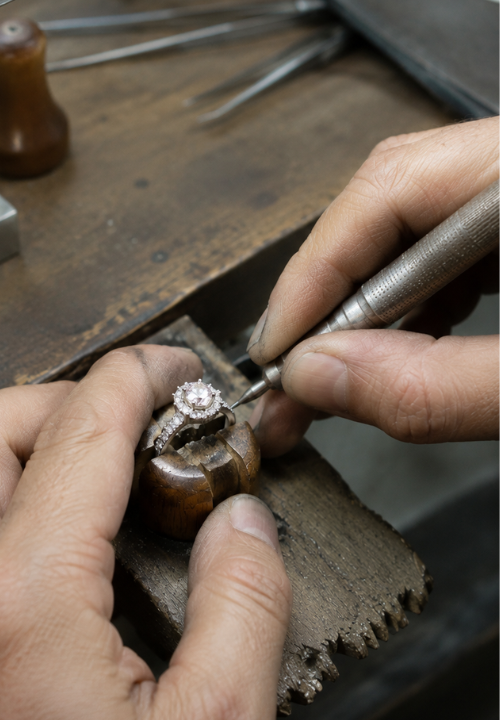
The journey from earthy rough to a polished yellow-green or golden gemstone can be dramatic. Cutting reveals transparency and light return; jewelry gives the colour a new context.
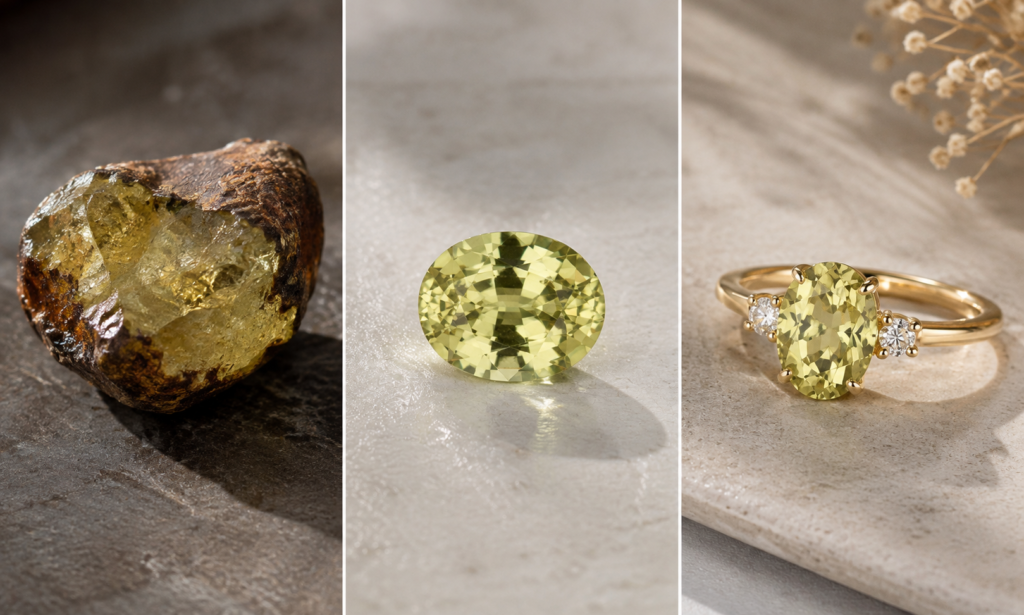
Where Green, Yellow and Gold Come Together
Mali garnet is more than another green garnet. Its chemistry occupies a meeting place, and its colours echo that idea through green, yellow, olive and gold. The spaces between categories are precisely where its identity becomes clearest.
Mali garnet does not need to become greener, yellower or more golden to find its identity. Its identity is the place where those colours meet.