
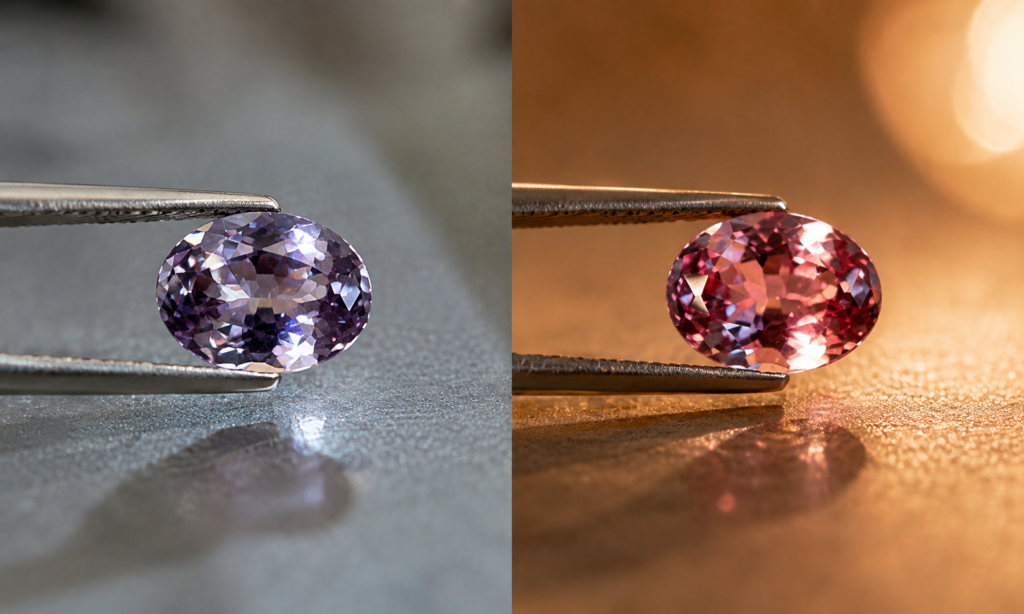
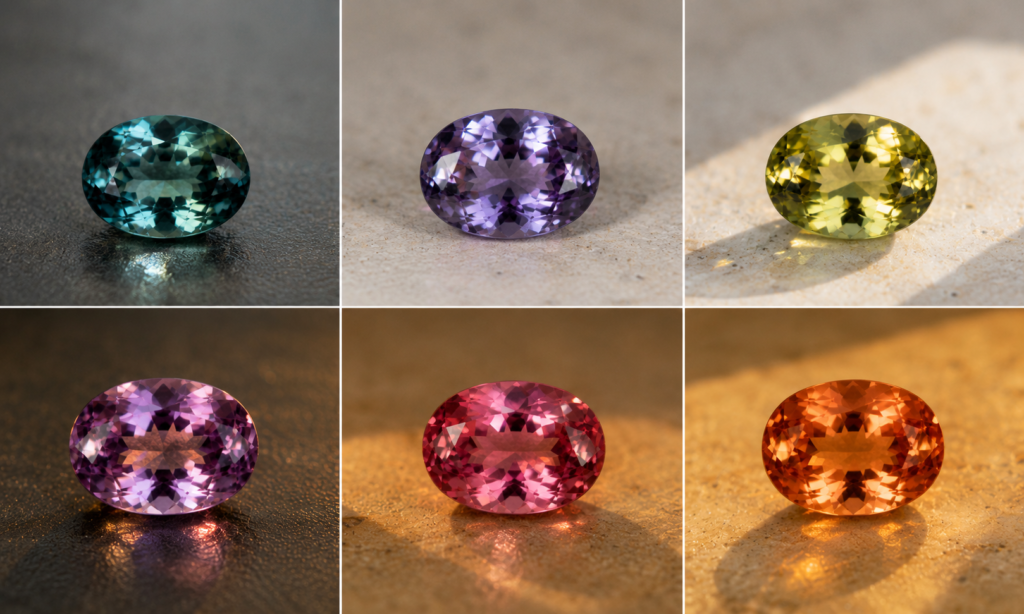
A colour-change garnet can seem to carry two different moods in the same stone. Under one light it may appear blue-green, green, yellow-green or purple; under another it may move toward purple, pink, orange or red. The gemstone has not changed its chemistry. What has changed is the light available for us to see.
The gemstone stays the same. What changes is the light available for it to show us.
What Exactly Is Colour-Change Garnet?
Colour-change garnet is not one separate garnet species or one fixed variety. The name describes an optical behaviour: a significant change in perceived body colour under different light sources. Many important examples belong to the pyrope–spessartine compositional series, although colour change is not limited exclusively to that chemistry.
Natural colour-change garnets can also contain almandine, grossular and other components in varying proportions. There is no universal recipe that every colour-change garnet must follow.
The Chemistry Behind the Change
Vanadium is especially important in many pyrope–spessartine colour-change garnets, while chromium, iron, manganese and the overall garnet composition can also influence the final appearance. The relationship is more complex than assigning one element to one colour.
Even vanadium does not follow a simple rule in which more always produces a stronger change. Research on blue-green pyrope–spessartine has shown that increasing vanadium can alter the transmission pattern enough to reduce the red window that helps create a dramatic change.
The element that helps create colour change can, in a different concentration, also reduce it.
Why Does the Colour Change?
Different light sources do not contain the same balance of wavelengths. Daylight has one spectral distribution, while warm incandescent light has another. At the same time, a garnet selectively absorbs some parts of incoming light and transmits or returns others.
In some colour-change pyrope–spessartine garnets, absorption creates useful transmission regions toward blue or blue-green and toward red. A cooler daylight-like source can make one region visually dominant, while a warm incandescent source can favor another. Our eyes then experience the same stone as a different colour.
Colour change happens in the conversation between the gemstone and the light around it.
Colour Change Does Not Mean One Pair of Colours
There is no single colour pair that defines the phenomenon. Material documented from Madagascar has shown blue-green to purple change. Tanzanian garnets have been reported changing from purple or pinkish purple under cooler light toward intense pink under warm incandescent light. Other documented pyrope–spessartine material reportedly from Sri Lanka has moved from yellow-green toward orange.
These examples reveal that colour-change garnet is better understood as a family of light-dependent experiences than as a gemstone that must always move from green to red.
The Discovery of Blue Garnet
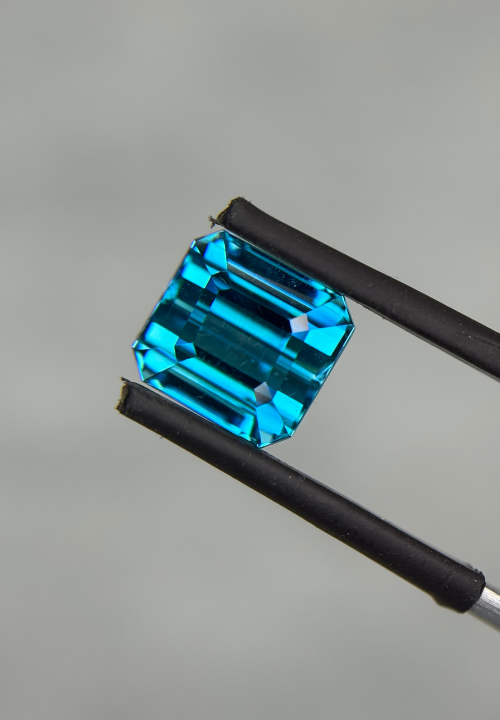
For generations, garnet was often described as occurring in every colour except blue. Blue-green colour-change material discovered near Bekily in Madagascar in the late 1990s challenged that familiar statement. Gemological studies identified the stones as pyrope–spessartine garnets whose appearance could move from blue-green in daylight toward purple under incandescent light.
The discovery mattered beyond one unusual colour. It expanded the visible possibilities of the entire garnet family and showed how strongly composition and illumination can reshape what we think a garnet is supposed to look like.
Not Every Change Looks Equally Dramatic
Colour-change strength exists on a continuum. Some stones present two clearly different colours, while others show a subtler shift. Cut, tone, composition, stone depth and the distance light travels through the material can all influence the experience.
Larger or deeper stones can sometimes produce a stronger visual effect because light travels through more material, but size alone does not determine the result. A smaller stone with a different composition or cut may behave very differently. This is why colour change is better understood as an interaction of variables rather than a simple grading formula.
Light Is Part of the Gemstone Experience
Terms such as “daylight” and “indoor light” are convenient, but the actual light source matters. Window daylight, cool LED, warm LED, fluorescent and incandescent illumination can have different spectral characteristics, so the same garnet may not look identical in every room.
Photography adds another layer. Automatic white balance, exposure adjustment, HDR and colour processing can strengthen or weaken the apparent change. A useful comparison therefore keeps the stone, camera position, orientation and background consistent while changing the controlled light source and identifying it clearly.
Colour-Change Garnet Is More Diverse Than Pyrope–Spessartine
Pyrope–spessartine is central to the modern colour-change garnet story, but it should not become a universal definition. Gemological literature has documented unusual colour-change behaviour in other garnet compositions as well, including rare grossular-rich material.
The phenomenon therefore tells us something broader about the garnet group: different combinations of chemistry can sometimes create similar light-dependent behaviour through different absorption patterns.
Two Colours, One Gemstone
A colour-change garnet raises an interesting question: which appearance is its real colour? The more useful answer is that both belong to the stone. Blue-green under one illumination is not more authentic than purple under another, and pink does not become false simply because the same gemstone looked purple earlier.
A colour-change garnet does not have one true colour and one false colour. Both belong to the same stone.
This is one of the clearest examples of why gemstone colour cannot be separated completely from viewing conditions. Mineral chemistry creates the possibilities, but light participates in what we actually experience.
Designing With Two Different Moods
Colour-change garnet adds an unusual dimension to jewelry because a design may live with more than one colour personality. Metal, surrounding stones and the environment can interact differently with each appearance, so the piece is not experienced from a single colour swatch.
There is no requirement that a particular colour change belongs with a particular metal. The more interesting idea is that the design can acknowledge both sides of the gemstone rather than trying to make one of them the permanent identity.
One Gemstone, Two Different Moods
Colour-change garnet is memorable because the transformation can feel almost theatrical, yet the mechanism is grounded in mineral chemistry, selective absorption, illumination and human vision. The phenomenon reminds us that gemstone colour is not something the stone displays entirely on its own.
Colour is not something a gemstone shows alone. Light is always part of the picture.
The Same Stone, Seen Differently
A colour-change garnet remains one gemstone throughout the day. What changes is the light around it—and with that change, another side of the same stone becomes visible. Neither appearance needs to replace the other. Together, they form the complete experience of a gemstone whose colour was never meant to stay inside one fixed box.