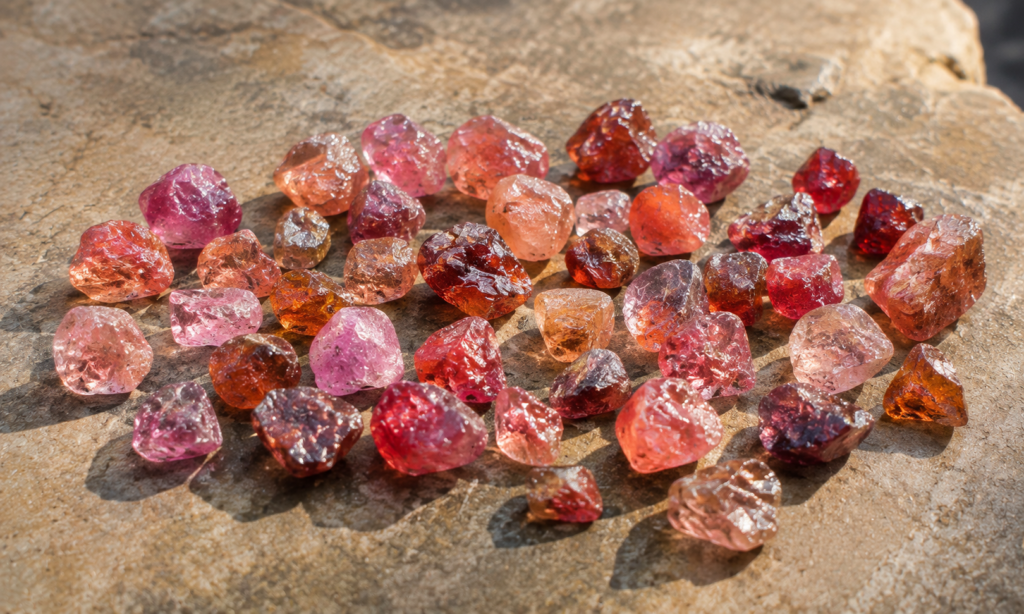
Malaya garnet has an unusual place in the garnet family. Its colours can move through pink, peach, pinkish orange, yellowish orange, reddish orange and red, while its chemistry often occupies territory between familiar garnet species rather than sitting neatly at one end member. Its modern identity grew from precisely this difficulty: it did not fit comfortably into the categories the gem trade already knew.
Malaya garnet became interesting precisely because it did not fit neatly into the names already waiting for it.
First, What Exactly Is Malaya Garnet?
Malaya also encountered as Malaia—is not a separate garnet species. It is a varietal or trade name used for garnets commonly associated with intermediate pyrope–spessartine compositions. Natural stones can also contain almandine and grossular components in varying amounts.
Gemological literature has not defined Malaya by one precise compositional boundary. That matters because the name describes a recognizable part of the garnet story without pretending that every stone follows exactly the same chemical recipe.
A Name Born from Not Quite Belonging
The name Malaya has long been associated in gem-trade literature with the idea of an “outcast” or material that sat outside familiar categories. The exact linguistic history is more complicated than the simplified story sometimes repeated in the trade, so the name is better treated as part of Malaya’s historical identity than as a perfectly literal translation.
What is clear is that these garnets did not fit comfortably into the established commercial names used for other material. Over time, the difficulty of placing them became the reason a separate name was useful.
What once made Malaya difficult to classify eventually became part of what made it recognizable.
The Umba Region and the Beginning of the Story
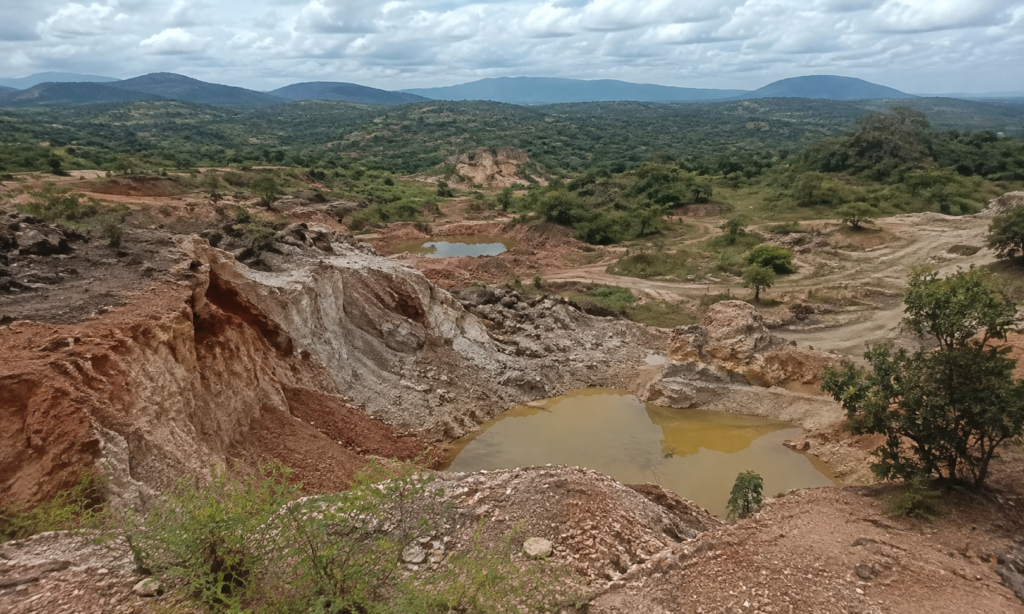
The modern commercial story of Malaya is closely connected with East Africa, particularly the Umba region around northern Tanzania and southern Kenya. Material from this area entered the gem trade during the later twentieth century and became central to early descriptions of Malaya garnet.
Umba is important here as history, not as a quality grade. It is the region where the identity of these unusual intermediate garnets became especially visible to the international gem trade.
Between Pyrope and Spessartine
Much of Malaya’s mineralogical character lies between pyrope and spessartine. Pyrope is the magnesium-rich garnet end member, while spessartine is manganese-rich. Malaya stones commonly contain substantial components of both, with additional almandine or grossular possible.
This does not mean Malaya is simply half pyrope and half spessartine. Natural compositions vary, and published studies show a meaningful range. Malaya is therefore a particularly useful example of solid solution: nature can move continuously between mineral end members even when our names prefer clear boundaries.
A Colour That Lives Between Colours
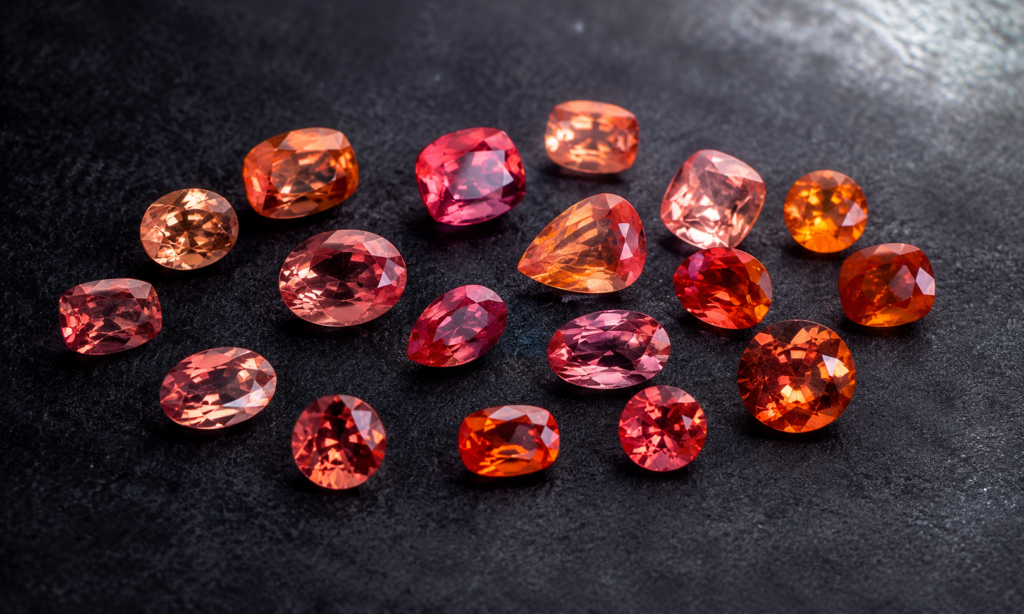
Malaya is equally difficult to reduce to one colour. Documented material ranges through pink, pinkish orange, yellowish orange, orange, reddish orange and red. In everyday visual language, some stones may reasonably be described as peach, salmon, warm pink or pink-orange, although these are descriptive terms rather than formal gemological colour categories.
This in-between quality is part of the attraction. A stone may not read simply as pink or simply as orange; the character can come from the way those impressions meet within the same body colour.
Malaya is often most characteristic when its colour seems to belong to more than one place at once.
Madagascar Expanded the Story
The Malaya story later expanded beyond its East African beginnings. In the late 1990s, Malaya-type garnets from the Bekily area of southern Madagascar entered the market and were studied gemologically. Published material included predominantly pink to pinkish-orange stones as well as orange and red examples.
Their compositions again occupied intermediate pyrope–spessartine territory, with variable additional garnet components. Differences between documented Madagascar and earlier East African material reinforced an important point: Malaya was not one fixed recipe tied permanently to one locality.
Malaya Does Not Always Look Like the Malaya We Imagine
Modern imagery can make Malaya seem almost synonymous with delicate peach or pastel pink-orange. Those colours can certainly be part of its identity, but the documented range is broader. Some stones are lighter and softer in appearance; others move toward saturated orange, reddish orange or deeper red.
There is therefore little value in forcing every Malaya garnet toward one visual ideal. Its history and mineralogy both point in the opposite direction: variation is part of the category.
Where Familiar Garnet Names Begin to Overlap
Malaya can visually approach other garnets. A pink or reddish stone may remind us of rhodolite, while warmer orange material can move toward colours associated with spessartine. Appearance alone does not redraw the mineral chemistry underneath.
This overlap is not a weakness in the name. It reflects the larger reality of garnet solid solutions. Human categories are useful for communication, but the boundaries between natural compositions can be much more gradual than the labels suggest.
The Category Became an Identity
Over the years, several names have been applied to garnets in this general territory, but Malaya or Malaia became the most widely recognized international trade term. What began as material that was awkward to place gradually acquired an identity of its own.
That history makes Malaya especially revealing. The name does not erase the complexity of its chemistry or colours; it gives us a practical way to talk about a group whose most interesting quality may be that it exists between simpler categories.
Malaya began as a problem of classification and became a reminder that nature does not have to respect the categories we create for it.
The Beauty of Not Fitting Perfectly
Malaya garnet does not need one exact colour, one exact composition or one visual personality to make sense. Its story is held together by an intermediate mineralogical territory, a broad warm palette and a history shaped by the difficulty of fitting natural material into established names.
Malaya garnet was once difficult to place because it sat between familiar names, familiar colours and familiar compositions. Today, that same in-between character is exactly what makes its story so compelling. It is not a garnet that failed to fit a category. It is a reminder that the category was always smaller than nature itself.