
Opal can seem less like a gemstone with a fixed colour and more like a surface on which colour is constantly appearing. Blue may emerge beside green, orange or red; tilt the stone and part of that picture can disappear while another colour takes its place. This play-of-colour is created by the interaction between light and opal’s internal structure.
In opal, colour is not simply something the gemstone has. It is something the gemstone does with light.
First, What Exactly Is Opal?
Opal is hydrated silica, commonly represented as SiO₂·nH₂O. Unlike minerals with an orderly crystal lattice, opal lacks a conventional crystalline structure and is described as a mineraloid. Water is also part of its structure. Its Mohs hardness is approximately 5 to 6.5.
The feature behind precious opal’s most recognizable appearance lies at a much smaller scale: tiny silica spheres that can become arranged with enough regularity to interact with visible light.
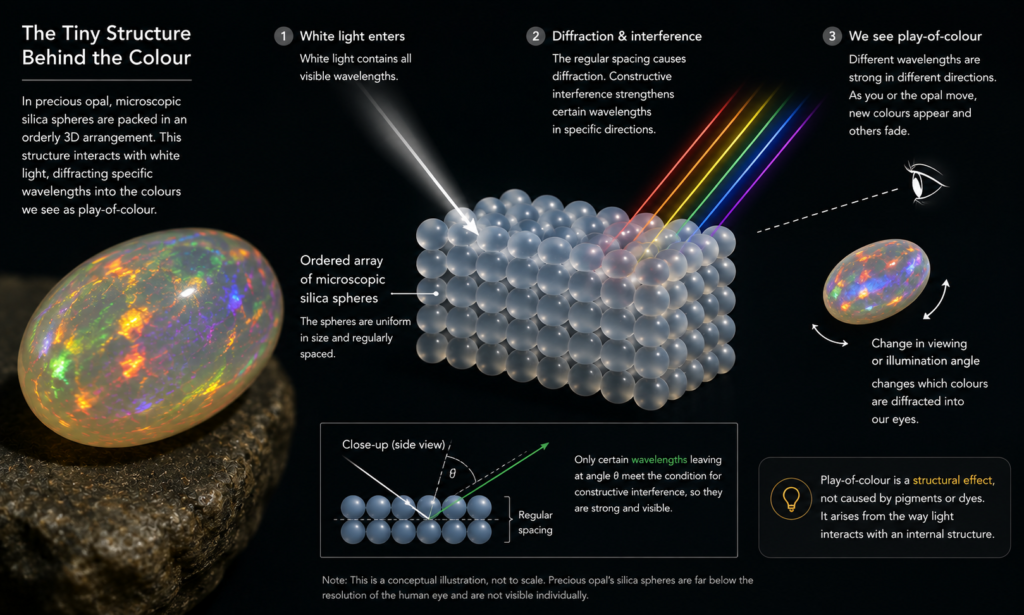
The Tiny Structure Behind the Colour
Inside precious opal, microscopic silica spheres can be packed in an orderly three-dimensional arrangement. When white light enters this structure, regular spacing interacts with the light through diffraction and interference, separating parts of the visible spectrum.
The colours are therefore not simply rainbow pigments trapped inside the stone. They emerge because the physical structure changes the way light reaches our eyes.
The rainbow inside precious opal is created not by pigment, but by structure.
Why Different Opals Show Different Colours
The size and spacing of silica spheres influence which wavelengths of visible light are diffracted. Smaller spacing can favour shorter wavelengths toward violet and blue, while larger spacing can allow longer wavelengths such as orange and red to appear.
This helps explain why one precious opal may be dominated by blue and green while another shows orange or red. Its spectral flashes are intimately connected with microscopic structure.
Why the Colours Move
Play-of-colour changes because the relationship between internal structure, light source and viewing angle changes as the stone moves. A small tilt can alter which wavelengths are directed toward the eye.
A patch can change, disappear or be replaced by another impression from a different angle. This dynamic behaviour is one reason a single still photograph cannot communicate every visual moment of an opal.
To really see an opal, we have to let either the gemstone or the light move.
Precious Opal and Common Opal
Not every opal displays play-of-colour. Material that does is known as precious opal. Its silica spheres have enough regularity in size and arrangement to produce the optical phenomenon.
Common opal, sometimes called potch, generally lacks play-of-colour because its internal arrangement does not create the same orderly diffraction structure. That does not make it visually empty: common opal can have attractive pink, blue, green, yellow and other body colours, with translucent or opaque appearances of their own.
Body Colour Changes the Stage
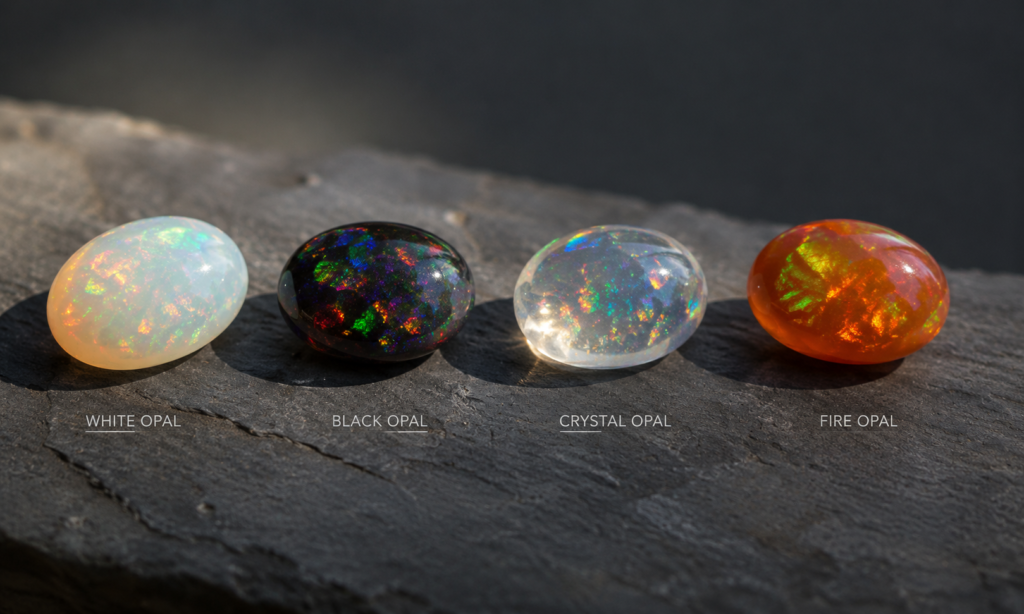
Opal has another colour element beyond play-of-colour: its underlying body colour. White opal provides a light background, black opal a dark one, crystal opal can be transparent to semitransparent, while fire opal is associated with yellow, orange or red body colour.
These backgrounds change how play-of-colour is experienced. A dark body can create strong contrast, a pale body can make the effect feel softer, and transparent material can make colour appear suspended within the stone. Body colour is the stage; play-of-colour is the performance.
Pattern Gives the Colour a Shape
The colours of precious opal also appear in different patterns. Some stones show tiny scattered points, others larger patches, mosaic-like areas, flames or broad moving fields. Trade vocabulary includes names such as pinfire, harlequin and flame among many others.
The important idea is not to memorize every pattern name. Two opals can contain similar colours but arrange them in completely different ways. In opal, colour has an architecture as well as a palette.
Why Opal Rarely Looks Exactly the Same Twice
An opal’s appearance is built from many variables at once: body colour, transparency, play-of-colour, dominant spectral colours, pattern, brightness, orientation and cut. Change one and the overall impression can change substantially.
This is why individual opals can feel remarkably distinct even when they share the same broad colour family. Their individuality grows naturally from the complexity of the structures and patterns responsible for what we see.
Two opals can share the same colours and still feel like completely different gemstones.
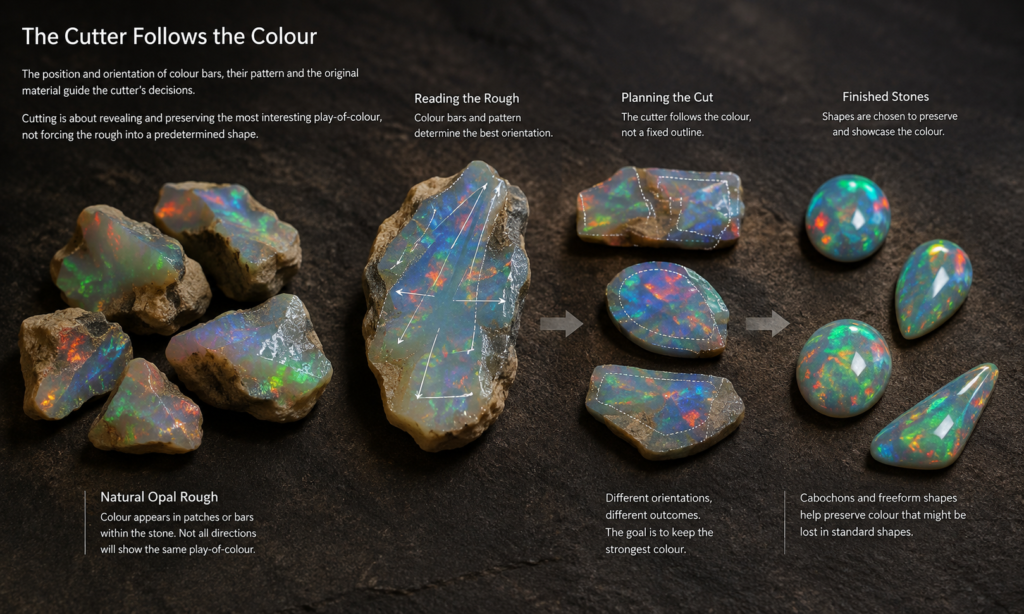
The Cutter Follows the Colour
With fine precious opal, cutting can become an exercise in revealing and preserving interesting colour-bearing areas of the rough. The position and orientation of a colour bar, its pattern and the original material can influence the final outline.
An opal therefore does not always need to become a perfectly calibrated oval or round. Cabochons and freeform shapes can preserve areas of play-of-colour that might otherwise be lost if rough were forced into predetermined geometry.
Opal Is a Gemstone to Experience, Not Freeze in One Image
Opal is particularly difficult to understand from a single photographic frame because play-of-colour is dynamic. A photograph can show body colour, pattern and colours visible at one angle, but it cannot contain every appearance the stone produces as it moves.
Multiple viewing angles and short videos can therefore be especially informative when experiencing opal remotely. The useful question is not only “What colour is it?” but also “What does the colour do when the stone moves?”
A Gemstone That Needs Light to Complete the Picture
An opal can hold blue, green, orange, red and violet across a single surface, yet its identity is not simply the sum of those colours. What makes precious opal extraordinary is the relationship between its internal structure, surrounding light and the angle from which we see it.
Move the stone and the picture changes. In that sense, opal is not only a gemstone of colour. It is a gemstone whose colour comes alive through light.