
A gemstone laboratory report can look technical at first. It becomes much easier to understand when each field is treated as an answer to a particular question about the gemstone.
A laboratory report becomes much easier to read once we stop seeing it as a page of technical terms and start seeing it as a series of answers.
Start With the Report Number
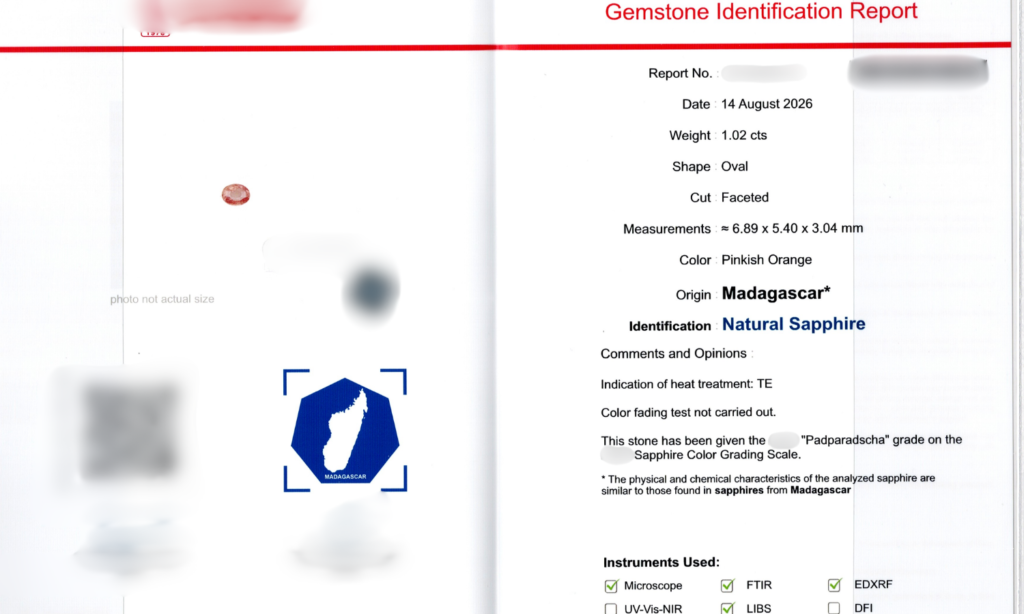
Begin with the document itself. A laboratory report normally carries a unique report number and date, and established laboratories provide their own ways to verify report information. Verification helps establish that the report record corresponds with information held by the issuing laboratory rather than relying only on the appearance of a printed document.
Make Sure the Report Describes the Stone in Front of You
Next, connect the document to the physical gemstone. Depending on the laboratory and report type, fields can include carat weight, measurements, shape, cutting style and a photograph. These details are not a judgement of beauty; they describe the object examined by the laboratory. Measurement conventions and precision can vary between laboratories.
Species and Variety: What Is the Gemstone?
Gemstone names often sit within a larger mineral identity. Sapphire is a variety of corundum, while emerald is a variety of beryl. Some reports make this relationship explicit through Species and Variety fields; others express it differently. Species identifies the underlying mineral, while variety is often the more familiar gemstone designation.
The familiar gemstone name may be the variety. The report often tells us the mineral identity underneath it as well.
Read the Full Identification Wording
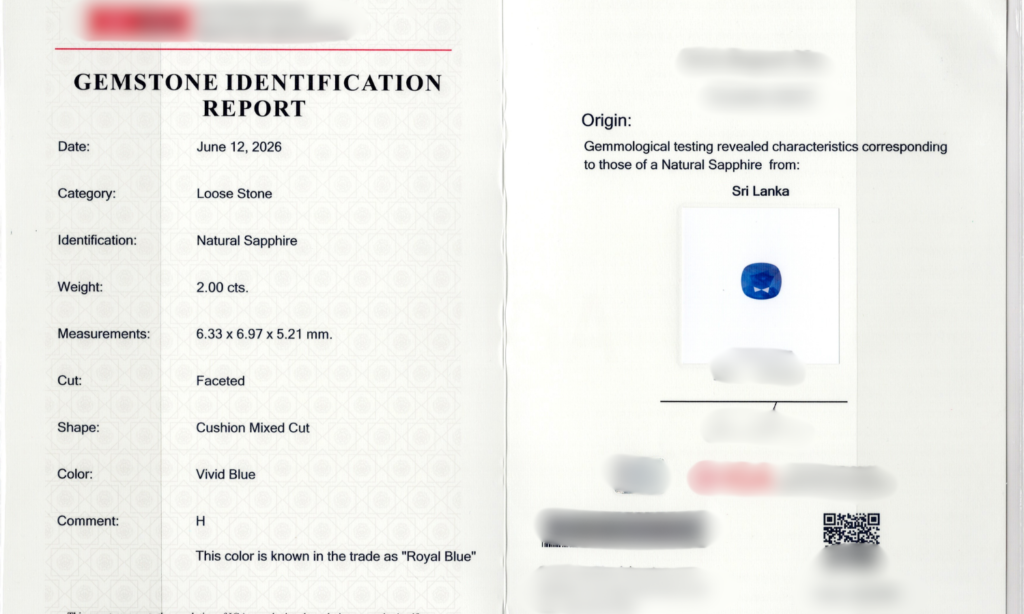
Do not stop at a familiar word such as Sapphire, Ruby or Emerald. One central function of laboratory testing is identification, and reports can distinguish natural material from laboratory-grown material where applicable. Reading the complete identification statement gives more information than searching the page for the gemstone name alone.
Colour Is a Description, Not Necessarily a Grade
A report may include colour wording such as blue, green or pinkish red, with the level of detail depending on the laboratory and report type. These descriptions should not automatically be interpreted as universal beauty or quality grades. Colour terminology can differ between laboratories, so read it in the context of the laboratory that issued it.
Treatment: Read the Exact Wording Carefully
Treatment information is worth reading word by word. Depending on the gemstone and laboratory, a report may disclose detectable evidence of heating, clarity enhancement, dyeing, impregnation or other treatments. Sapphire reports may distinguish indications of heating from no indications of heating, while emerald reports can describe clarity enhancement and, in some systems, its extent or filler.
The phrasing matters because laboratory conclusions reflect what testing supports. A statement such as “no indications of heating” should be preserved as written rather than rewritten into a stronger historical claim.
In a laboratory report, the exact wording matters. “No indications of” is not the same sentence as “never.”
Geographic Origin: Read It as an Expert Opinion
Some report types provide a geographic-origin opinion where that service is available. Laboratories evaluate combinations of gemological properties, microscopic characteristics, chemical data and spectroscopy, comparing observations with reference material and databases. Because natural deposits can overlap in their characteristics, origin is an expert opinion based on the available evidence.
Sometimes the evidence does not support a sufficiently confident conclusion and the origin can be reported as inconclusive. That reflects the evidence available in that gemstone rather than turning the examination into a failed test.
Do Not Skip the Comments
Comments, remarks or additional-information sections can contain details that do not fit neatly into the main fields. Depending on the laboratory and report type, they may expand on treatment observations, terminology, special characteristics or other findings. Read these notes as part of the report rather than optional fine print.
Different Laboratories Speak Slightly Different Languages
GIA, GRS, SSEF, Gübelin, AIGS and other laboratories do not all use identical layouts or terminology. Measurement presentation, treatment descriptions, origin wording, comments and specialized colour terminology can differ. Use the definitions and conventions of the laboratory that issued the report rather than assuming every laboratory uses the same framework.
A laboratory report should be read in the language of the laboratory that issued it.
Read the Report in a Simple Order
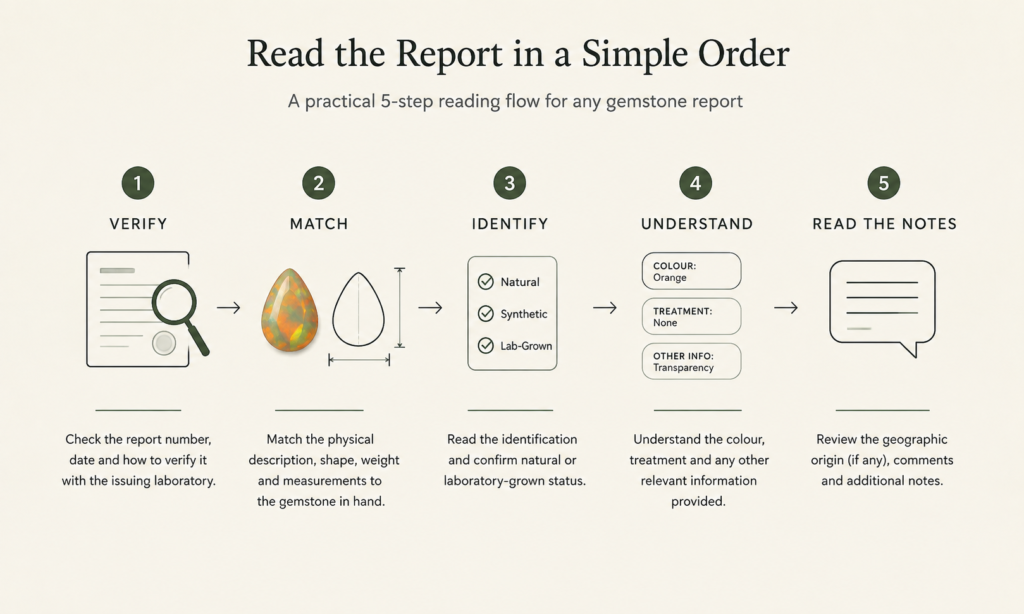
A useful sequence is to verify the document, match its physical description to the gemstone, read the identification and natural or laboratory-grown status, understand colour and treatment information, then move to any geographic-origin opinion, comments or remarks. This is not a quality-ranking sequence. It is simply a way to move through the document without letting one prominent term distract from the rest.
Read the Words That Are Actually There
A gemstone laboratory report does not need to feel intimidating. Start with the document itself, connect it to the stone, understand the identification, and then read treatment, origin and comments in the laboratory’s own words.
The most useful habit is simple: do not add meaning that is not written there. A treatment statement should not silently become a stronger statement, and a geographic origin should not become a judgement of beauty. A report is most useful when we allow it to say exactly what it says.