
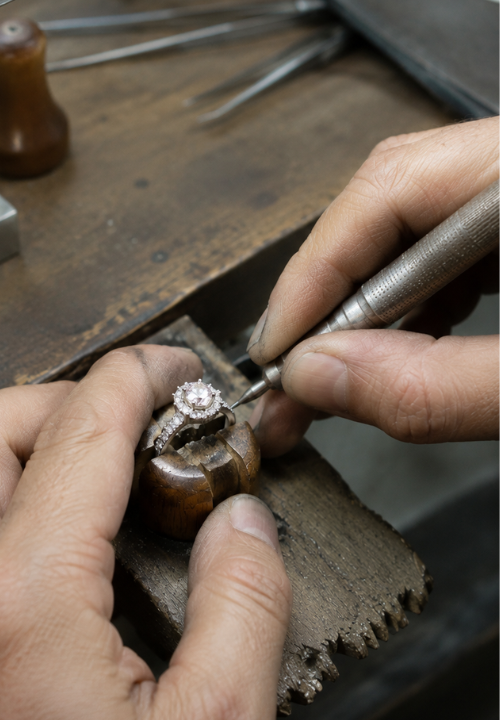
At first glance, a ring can seem simple: a gemstone held above a band of metal. Look more closely, however, and the design begins to separate into a series of structures—the head, prongs, gallery, bridge, shoulders and shank. Each has a practical role, but each also changes the way the ring looks and feels.
A ring is not one shape. It is a collection of small structures that become one design.
Start With the Three Main Parts
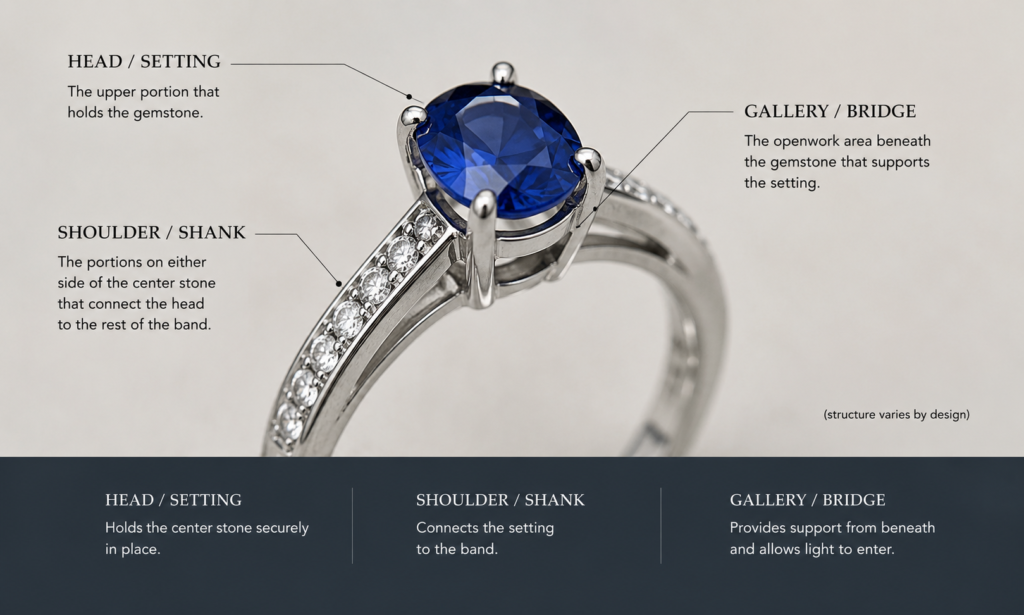
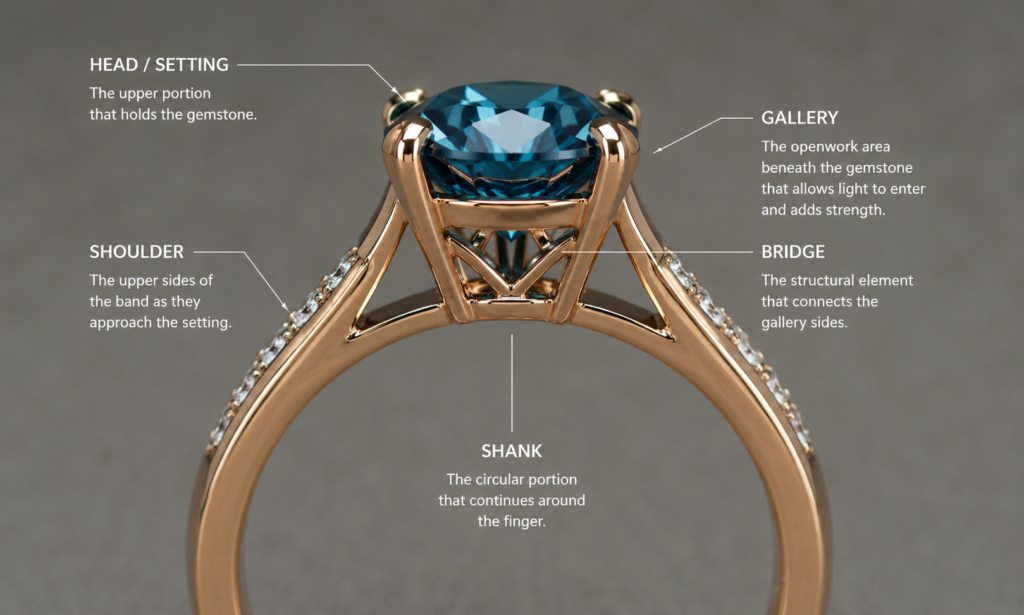
A useful way to understand ring anatomy is to begin with three broad areas. The head is the upper portion that holds the gemstone. The shoulders are the upper sides of the band as they approach the setting. The shank is the circular portion that continues around the finger.
From these three areas, the design becomes more detailed. Prongs may rise from the head, a gallery can form beneath the gemstone, a bridge can connect the structure near the finger, and a sizing area may be left at the bottom of the shank.
The Head: Where the Gemstone Meets the Ring
The head is the upper structure that holds the primary gemstone. Depending on the design, it may use prongs, a bezel, a basket-like construction or another setting architecture.
Its form influences how high the gemstone sits, how open the sides appear, how much metal surrounds the stone and how the ring looks in profile. The same gemstone can therefore feel light and open in one head, or more enclosed and architectural in another.
The gemstone may be the focal point, but the head determines how that gemstone enters the architecture of the ring.
Prongs: Small Details That Change the Outline
Prongs are small metal supports that rise around a gemstone and secure it at selected points along its edge. Their number, placement and shape affect both the structure of the setting and the visual outline around the stone.
Round, claw, double and V-shaped prongs can create different impressions even around the same gemstone. Pointed shapes such as princess, pear and marquise cuts also bring additional attention to vulnerable corners or tips, which the setting may be designed to protect.
Prongs are small, but they sit exactly where metal and gemstone become one object.
The Gallery: The Architecture Beneath the Stone
The gallery occupies the area beneath the gemstone and upper setting. It is often much less visible from the top, yet it can become one of the most expressive parts of a ring when viewed from the side.
A gallery may be open and minimal, crossed with supporting elements, decorated with a motif or built as a more enclosed structure. Its form contributes to support, openness and the side silhouette of the ring. This is why two rings that appear similar from above can reveal very different personalities in profile.
The Bridge: The Structure Closest to the Finger
The bridge sits beneath the main setting, connecting or supporting the structure near the finger line. Its exact form varies considerably between designs, so it is better understood as part of the architecture below the gemstone rather than as one fixed shape.
This area can influence the space beneath the center stone, the side profile and how another ring may sit beside it. What looks like empty space from a distance can therefore be an intentionally resolved structural part of the design.
The Shoulders: Where the Ring Begins to Rise
The shoulders are the portions of the shank that approach the head. They create the transition between the circular band and the architecture holding the gemstone.
Shoulders may remain straight, taper toward the stone, divide into a split shank, carry smaller gemstones or rise upward. In a cathedral-style ring, arches of metal rise from the shank toward the center setting, making this transition especially visible.
The shoulder is therefore more than a connection. Its shape can make the center feel more elevated, integrated, delicate or substantial.
The Shank: More Than the Band Around the Finger
The shank is the part of the ring that encircles the finger. Although it is often casually called the band, its width, thickness, taper and profile contribute strongly to the visual weight and physical presence of the whole ring.
A shank may be plain, stone-set, engraved, textured, split or gradually narrowed toward the center. Even when the head and gemstone remain unchanged, altering the shank can make the ring feel lighter, stronger, quieter or more architectural.
Side Stones and Accent Stones Have Different Roles
Not every gemstone in a ring plays the same visual role. The primary or center stone usually acts as the focal point. Side stones flank it and can extend or frame the central composition, while smaller accent stones may add rhythm, texture or light along the shank or other parts of the setting.
Thinking about these stones as different parts of the composition helps explain why adding more gemstones is not simply a matter of adding more sparkle. Their scale, position and relationship to the center change the hierarchy of the design.
The Bottom of the Ring Matters Too
The lower part of the shank is often quieter than the top, but it can serve an important practical purpose. A relatively plain section at the bottom may act as a sizing area, allowing a jeweller to add or remove metal when adjusting the ring size.
Continuous pavé, engraving or patterns around the entire circumference can make future resizing more complex. A visually simple area at the base of a ring may therefore be an intentional design decision rather than an unfinished one.
Even the quietest part of a ring can be there for a reason.
Height Changes More Than Appearance
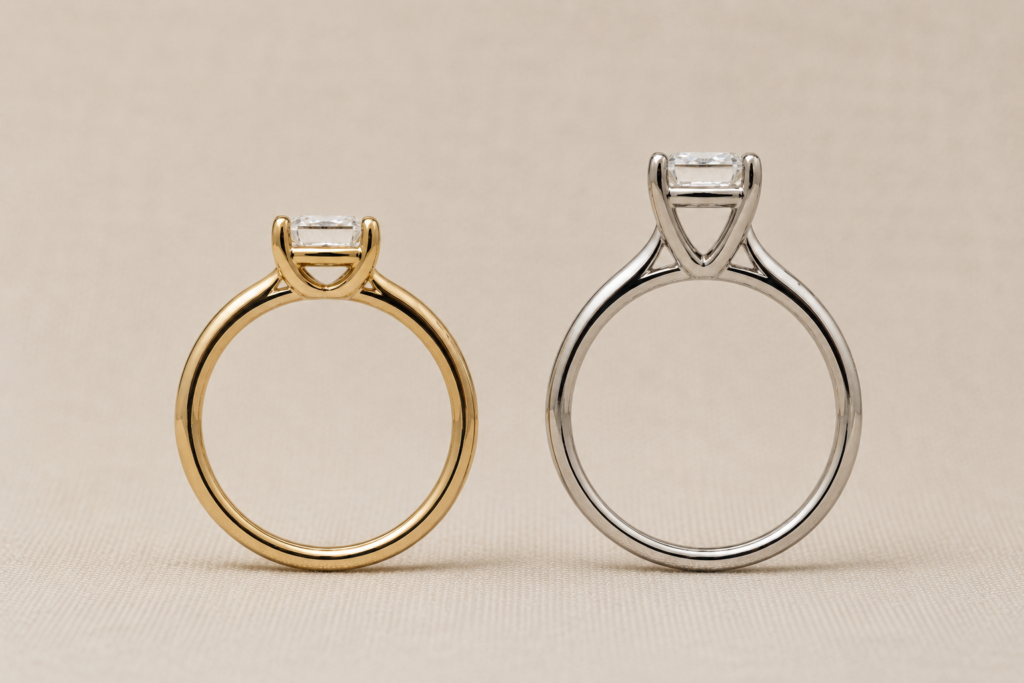
Ring height is created by several parts working together: the head, gallery, bridge and shoulders. A lower profile brings the gemstone closer to the finger, while a higher profile creates more vertical presence and a different side silhouette.
Height can also influence the space beneath the setting, how another band sits beside the ring and how exposed the upper structure feels during wear. Neither high nor low is inherently better; they are different relationships between appearance and function.
Anatomy Becomes Design When the Parts Work Together
A ring is rarely successful because one isolated component is beautiful. The prongs need to make sense with the gemstone, the head with the gallery, the shoulders with the shank, and the overall structure with the scale and character of the stone.
The gemstone itself also matters. Different shapes and materials can introduce different structural considerations, particularly around exposed points, edges or gemstones that benefit from greater protection.
The character of a ring does not come from one beautiful detail. It comes from the relationship between all of them.
Learning to See the Whole Ring
Understanding ring anatomy gives us a language for seeing design more clearly. We begin to notice where the gemstone sits, what holds it, how the gallery opens beneath it, how the shoulders transition into the setting and how the shank carries the design around the finger.
The goal, however, is not simply to memorize every term. In a resolved ring, these individual components eventually stop feeling separate. Proportion, structure and detail begin to work together, and what remains is the character of the ring as a whole.