
A tourmaline can begin in pink and finish in green. Another may move from blue into green, yellow into green, or colourless into pink. At first glance, the result can look almost like two gemstones placed together.
But a true bi-colour tourmaline can be one continuous crystal. The change in colour is part of its growth history.
Two colours do not mean two gemstones. Sometimes they mean two chapters of the same crystal.
What Exactly Is Bi-Colour Tourmaline?
Bi-colour tourmaline describes tourmaline that displays two clearly distinguishable colour zones within the same gemstone. The broader term parti-colour or parti-coloured tourmaline can be used for material showing more than one colour.
Pink and green is one of the best-known combinations, but it is only one possibility.
Bi-colour describes what we see: two distinct colours sharing one gemstone.
How Can One Crystal Become Two Colours?
Tourmaline grows from a geological environment whose chemistry does not necessarily remain constant. During one stage of growth, the surrounding fluid or melt may supply a particular combination of elements. Later, that environment can change.
The crystal continues growing, but the chemistry entering the newer growth can differ. Because chemistry influences tourmaline colour, a new zone can develop a visibly different appearance.
The crystal keeps growing. The environment changes. The colour changes with it.
The Boundary Is a Moment in Geological Time
The line between pink and green is more than a decorative pattern. It can mark a change between stages of crystal growth.
Some boundaries appear relatively sharp; others blend more gradually. Natural tourmaline zoning can take many forms, from straightforward bands to considerably more complex growth patterns.
The line between two colours can be the visible boundary between two stages of crystal growth.
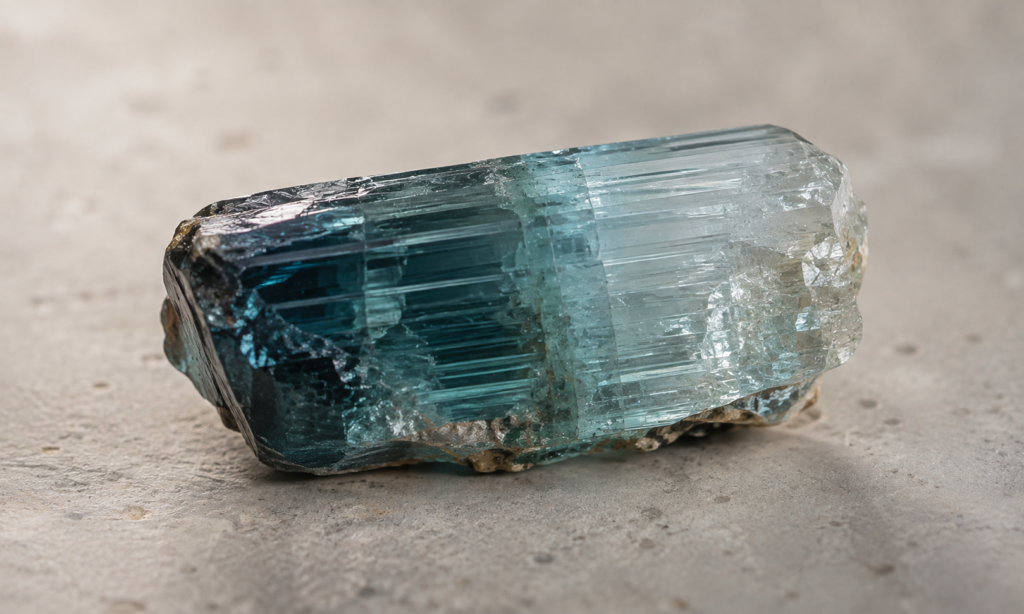
Bi-Colour Does Not Have to Mean Pink and Green
Pink and green may be the iconic combination, but tourmaline has no fixed bi-colour palette. Natural material can combine pink with colourless, green with yellow, blue with green and many other arrangements.
Tourmaline species such as liddicoatite can show especially complex zoning involving pink, red, orange, yellowish green, bluish green, blue, brown and colourless areas.
Pink and green may be iconic, but bi-colour tourmaline has no fixed palette.
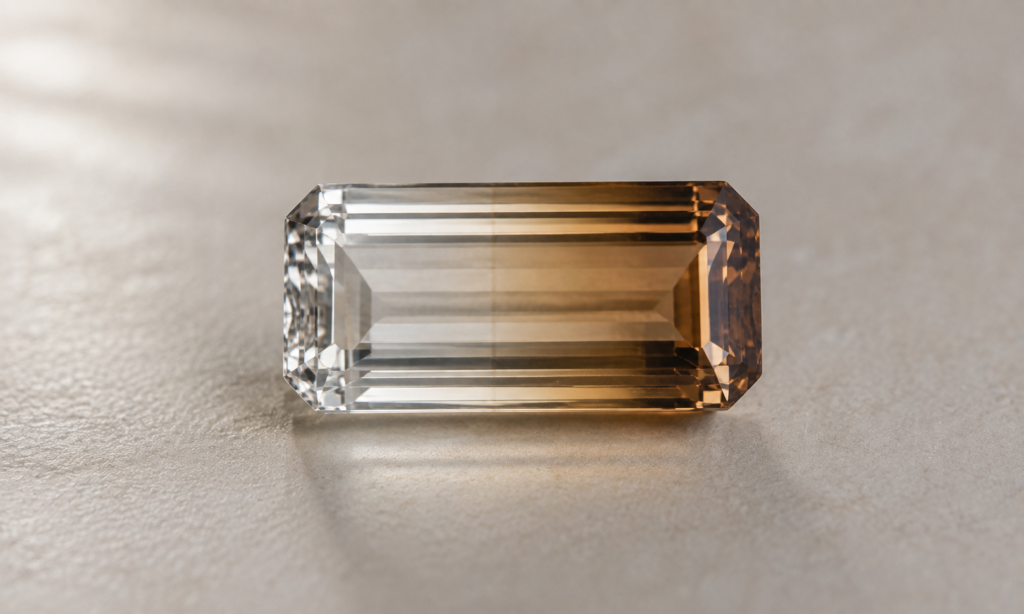
Bi-Colour and Watermelon Tourmaline Are Not Quite the Same Thing
The terms are related but describe different visual ideas. A classic bi-colour crystal may change colour along its length—for example, from pink at one end to green at the other.
Watermelon tourmaline typically refers to zoning arranged more like layers, with a pink or reddish inner area surrounded by green outer growth when the crystal is viewed or sliced across the appropriate direction.
Watermelon is therefore a distinctive form of multicolour zoning, while not every bi-colour tourmaline is watermelon.
Bi-colour divides the gemstone by colour. Watermelon surrounds one colour with another.
The Cutter Has an Unusual Decision to Make
With many gemstones, a cutter may try to minimise distracting colour zoning. Bi-colour tourmaline can reverse that objective. The zoning may be the very feature worth preserving.
The cutter must decide where the boundary should sit in the finished stone, how much space each colour receives, which orientation presents the colours successfully and how much rough can reasonably be preserved.
With bi-colour tourmaline, the cutter is not trying to create the pattern. The pattern is already there. The task is to reveal it.
Why Are Rectangles So Common?
Tourmaline commonly grows as elongated prismatic crystals. When two colour zones also extend along that long crystal, an elongated finished shape can preserve both the natural proportions and the colour story efficiently.
That helps explain the frequency of long rectangles, step cuts, elongated cushions and related shapes in bi-colour tourmaline. They are not mandatory; they are often practical responses to the rough.
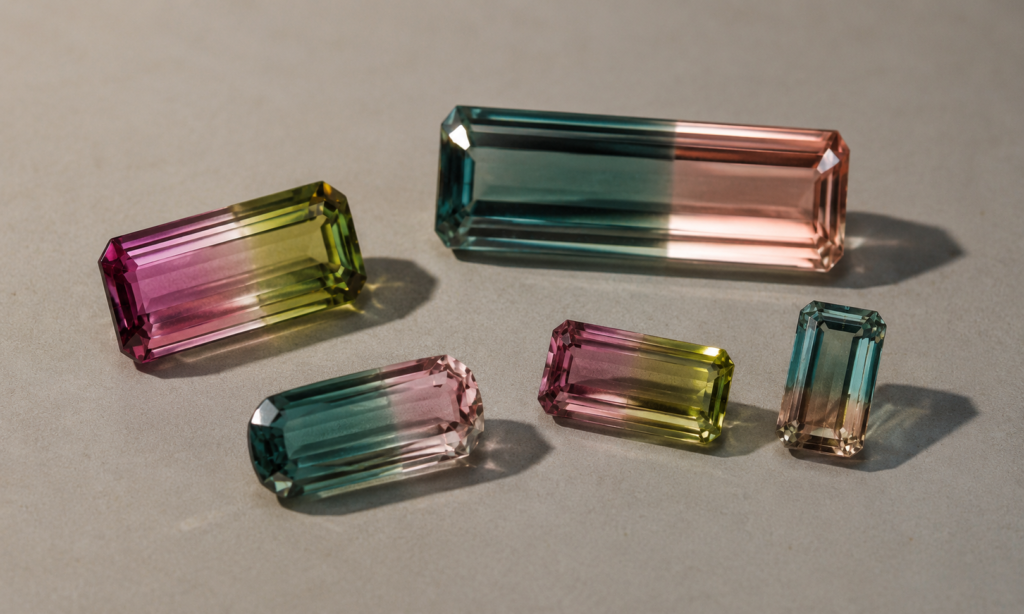
A Perfect 50/50 Split Is Not Required
Nature does not measure the two colours before growing the crystal. One zone may occupy 30 percent and the other 70 percent. The transition may sit away from the centre or follow a slightly irregular line.
A balanced half-and-half split can be beautiful, but it is not a universal standard. What matters visually is how the colours, boundary and cut work together.
Symmetry can be beautiful. So can imbalance when the crystal makes it feel intentional.
Sharp Boundary or Soft Transition?
A sharp junction can feel graphic, architectural and bold. A softer transition can feel more organic, fluid or painterly.
Neither character is automatically superior. Natural tourmaline can produce both sharp and diffuse colour boundaries, and each can create a different kind of finished gemstone.
The boundary changes the character of the gemstone, not simply its quality.
Colour Balance Matters More Than Colour Names
Two stones described as “pink and green” can look completely different. One may have a saturated green beside a delicate pink; another may reverse the visual weight. Tone, saturation, the area occupied by each colour and the way the cut presents the transition all affect the final composition.
The colour names tell us what is present. They do not tell us whether those colours work beautifully together.
“Pink and green” describes the ingredients. It does not describe the finished composition.
Pleochroism Adds Another Layer
Tourmaline commonly shows pleochroism, so colour and intensity can change with viewing direction. A cutter working with bi-colour rough is therefore managing two systems at once: the visible colour zoning and the directional behaviour of each part of the crystal.
The final face-up appearance depends not only on where the colour boundary lies, but also on how the crystal is oriented and faceted.
Bi-Colour Tourmaline Gives Jewellery Designers Something Unusual
With a single-colour gemstone, the designer often creates the visual composition around the stone. Bi-colour tourmaline can arrive with a composition already inside it.
The direction of the colour split can influence whether a stone is set horizontally or vertically. An off-centre transition can inspire asymmetry. Metal, side stones and the surrounding form can either quietly support the two colours or deliberately respond to them.
With bi-colour tourmaline, jewellery design can begin inside the gemstone itself.
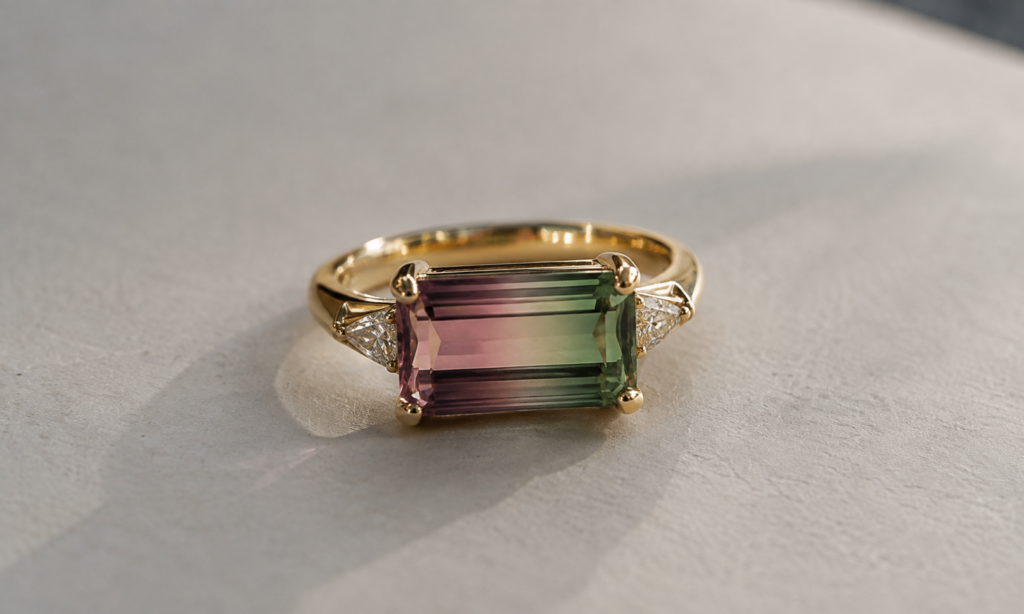
One Crystal, Two Moments
When we look at a bi-colour tourmaline, we may simply see pink beside green. The crystal records something more: one environment, a period of growth, a change in chemistry, and another period of growth that continued within the same crystal.
The cutter did not invent those two colours. The cutter chose how clearly we would be allowed to see the transition that nature had already made.
A bi-colour tourmaline carries two colours because one crystal lived through more than one chemical moment. The beauty is that we can still see the change.