


Few gemstone origins have become as closely linked with a gem as Colombia has with emerald. The phrase Colombian emerald carries centuries of history, celebrated stones, distinctive geology and a reputation that reaches far beyond the mines themselves.
Yet Colombia was not the first place where humans knew emerald, and it is certainly not the only source capable of producing exceptional stones. Its fame came from something more complicated.
Colombia did not introduce the world to emerald. It changed what the world believed an emerald could look like.
Emerald Existed Long Before Colombia Became Famous
Emerald was known in the ancient world long before Colombian material reached Europe. Egyptian deposits supplied emerald for centuries, and the gemstone had already acquired associations with wealth, beauty and power.
The turning point came when Colombian emeralds entered wider international trade in the sixteenth century. Large crystals and strongly saturated green material introduced a level of emerald that astonished markets familiar with other historical sources.
Colombia did not create the desire for emerald. It dramatically expanded the possibilities people associated with the gemstone.
Colombia Knew Emerald Before the Spanish Arrived
It is misleading to say that the Spanish simply “discovered” emerald in Colombia. Indigenous peoples in the region were already mining, using and trading emerald before European conquest.
Communities in what is now Boyacá had an established relationship with the stone, and Colombian emeralds circulated through pre-Columbian trade networks.
The Spanish encountered an emerald culture and mining tradition that already existed.
When Colombian Emerald Entered the Wider World
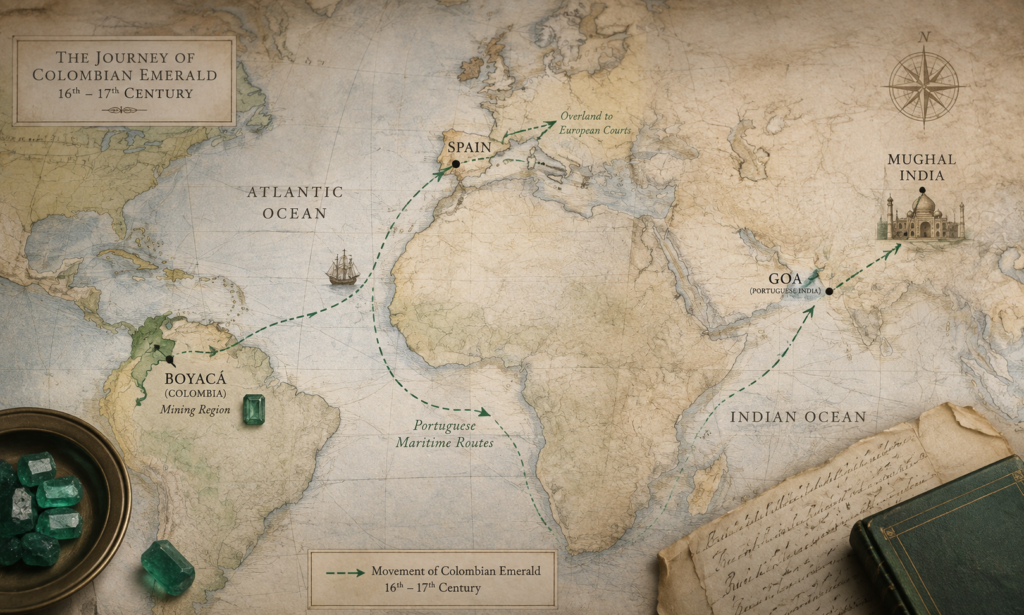
Spanish contact with emerald-producing areas in the sixteenth century transformed the scale and direction of the trade. Emeralds from the region that became Nueva Granada began moving toward Spain and other European markets.
From there, trade networks carried Colombian emeralds much farther. Through Portuguese and other commercial routes, important stones reached India and the courts of the Mughal Empire.
Colombian emerald did not become famous inside Colombia. It became famous along the trade routes that carried it out of the Andes.
The Mughal Connection Expanded the Legend
Mughal India became one of the great destinations for Colombian emerald. Large stones entered royal treasuries and were carved, engraved and incorporated into jewellery and ceremonial objects.
This movement mattered culturally. Colombian emerald was no longer simply a gemstone from a remote South American source. It became part of elite jewellery traditions across continents.
History Alone Would Not Have Been Enough
A long story cannot sustain a gemstone reputation by itself. Colombian deposits also demonstrated repeatedly that emerald could reach extraordinary levels of colour, transparency and size.
That does not mean every Colombian emerald is exceptional. The deposits have always produced a broad range of material. The important point is that remarkable examples appeared often enough, and visibly enough, to influence how generations of buyers imagined fine emerald.
Colombia became famous because it repeatedly demonstrated that emerald could reach an extraordinary level of colour, transparency and size.
What Does Colombian Emerald Actually Look Like?
There is no single exact colour that every Colombian emerald must display. Stones from Colombia can vary in hue, tone, saturation, transparency and clarity, and material from individual mining areas also covers a range.
Fine Colombian emerald is often associated in the trade with vivid, strongly saturated green and, in some examples, a relatively pure or gently warm green appearance. But those tendencies are not a diagnostic colour formula.
Origin can influence character. It does not prescribe one exact colour.
Why Is “Colombian Colour” Talked About So Much?
Some exceptional Colombian material displays the combination of colour and transparency that generations of dealers and collectors have found especially compelling. Repeated exposure to those stones helped create a recognisable market ideal.
But emeralds from Zambia, Afghanistan, Brazil, Ethiopia and other sources can overlap visually with Colombian material. Appearance alone cannot reliably establish geographic origin.
A Colombian-looking emerald is not necessarily Colombian.
Colombia’s Geology Is Unusual Even for Emerald
Many emerald deposits around the world are associated with interactions involving beryllium-bearing pegmatitic or hydrothermal material and chromium-bearing metamorphic rocks. Important Colombian deposits tell a different geological story.
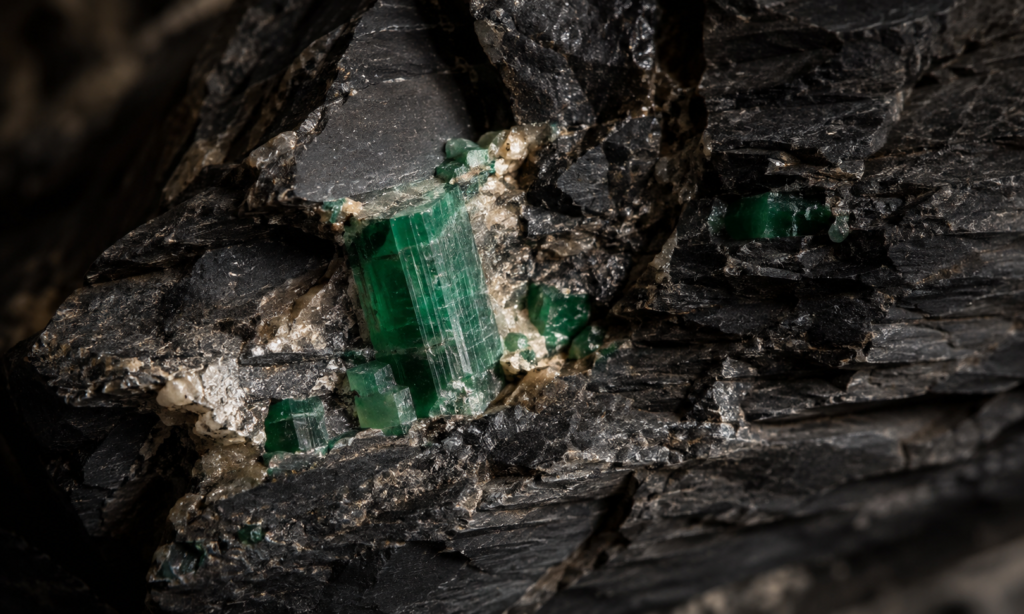
Colombian emeralds occur in sedimentary environments dominated by organic-rich black shales. Hydrothermal fluids moved through fractures and reacted with these rocks, creating the conditions necessary for emerald crystallisation.
This hydrothermal-sedimentary setting is one of the features that makes Colombian emerald geology particularly distinctive.
Green from Black Shale
One of the most striking contrasts in the Colombian story is visual: vivid green emerald crystals emerging from dark sedimentary rock and pale veins.
Highly saline hydrothermal fluids circulated through fractured black shale. These fluids helped mobilise and transport the chemical ingredients involved in emerald formation, and emerald crystallised when conditions became suitable in veins and fractures.
Some of Colombia’s most famous green crystals owe their existence to ancient salty fluids moving through dark sedimentary rock.
The Famous Three-Phase Inclusion
Under magnification, Colombian emerald became famous for distinctive multiphase fluid inclusions. A classic example may contain liquid, a gas bubble and a solid phase within a small cavity.
These microscopic scenes reflect the fluid-rich geological history of the stone and became important clues in gemological study.
But modern gemology has added an important correction: similar multiphase inclusions can occur in emeralds from other geographic sources. A classic clue is useful evidence, not an automatic origin determination.
A classic clue is not the same as a final answer.
Muzo Is Famous — But Colombia Is Not Just Muzo
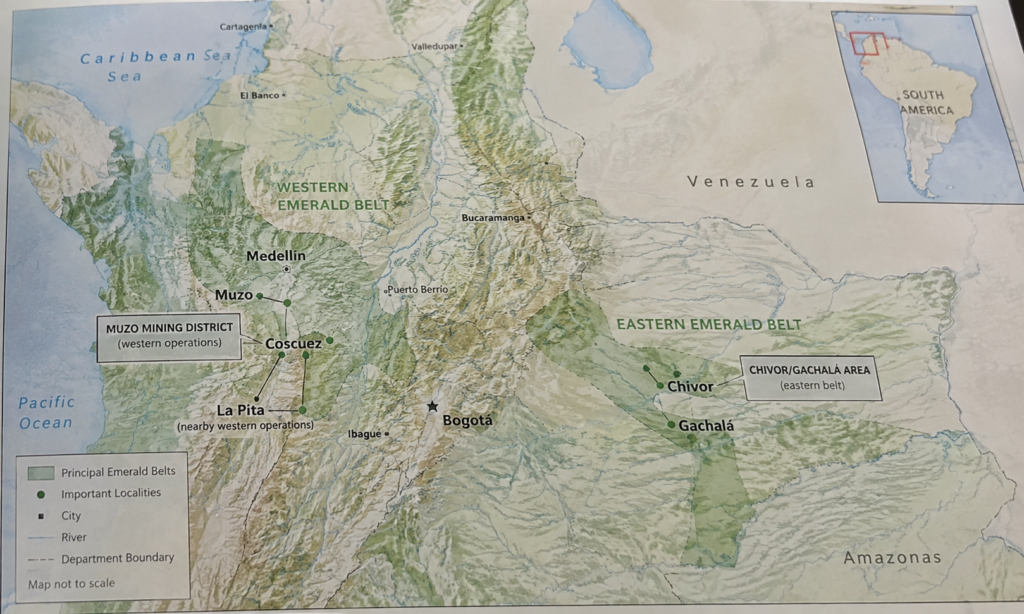
Muzo is probably the Colombian emerald locality most familiar to the international trade, and its name has become strongly associated with fine material. But Colombian emerald is much broader than Muzo.
Important deposits occur along emerald belts in Colombia’s Eastern Cordillera. The western belt includes mining areas such as Muzo and Coscuez, while the eastern belt includes Chivor and other deposits.
Colombian emerald is an origin. Muzo is a locality within that origin.
Muzo and Chivor Built Different Parts of the Legend
Muzo became deeply associated with the commercial reputation of fine Colombian emerald. Chivor carries another powerful part of the story: indigenous mining, early Spanish exploitation, long periods of abandonment and later rediscovery.
The histories of these mining districts contain adventure, changing ownership, difficult terrain and repeated attempts to recover valuable green crystals from the Andes.
They contribute to the legend in different ways without creating a simple hierarchy in which one mine must always produce a better emerald than another.
Exceptional Stones Made Their Origin Famous Too
Over centuries, Colombian emeralds entered royal collections, important jewellery and museum holdings. Exceptional stones carried their provenance with them.
When remarkable gems from one origin repeatedly become culturally visible, the reputation of the place grows alongside the reputation of the stones.
Exceptional stones do more than become famous themselves. They make their origin famous with them.
Then Reputation Began to Reinforce Itself
The relationship eventually became circular. Exceptional stones built Colombia’s reputation; that reputation increased demand for Colombian origin; demand contributed to premiums for fine material; and origin itself became something buyers increasingly wanted laboratories to investigate.
As other major emerald sources became important to the international market, geographic-origin determination gained even greater commercial significance.
Reputation therefore became part of the market, but it began with generations of actual gemstones.
Does Colombian Origin Automatically Make an Emerald Better?
No. Colombia produces a range of emerald qualities, just as other origins do. A Colombian stone can be exceptional, commercial, pale, heavily included or poorly cut. Emeralds from other countries can also be extraordinary.
Colour, transparency, clarity character, cut, treatment, size and overall appearance still belong to the individual gemstone. Origin adds information; it cannot substitute for those qualities.
Origin can add context and rarity. It cannot replace the gemstone itself.
Why Can Colombian Origin Carry a Premium?
Centuries of reputation, historic production of exceptional stones, collector preference, market demand and the cultural association between Colombia and fine emerald can all contribute to an origin premium.
That premium is not fixed, and origin does not transform an ordinary stone into an exceptional one. Its commercial importance tends to become more meaningful when the emerald itself already has qualities the market strongly values.
Origin tends to matter most when there is already something exceptional worth attaching the origin to.
Can You Tell a Colombian Emerald Just by Looking at It?
Not reliably. Experienced observers may describe a stone as having a “Colombian look,” but visual resemblance is not the same as geographic proof.
Modern origin determination considers microscopic inclusions together with spectroscopy, trace-element chemistry and comparison against extensive reference collections. Characteristics can overlap between sources, and some stones can remain difficult to classify conclusively.
When origin materially affects the description or price of an emerald, a respected laboratory report becomes especially important.
The Complicated Side of the Legend
The history of Colombian emerald is not entirely romantic. Indigenous mining traditions were followed by colonial conquest, coercive labour and exploitation. Later periods of the emerald industry also experienced conflict and violence.
Acknowledging that history does not diminish the beauty of the gemstone. It prevents the story from becoming a fantasy in which royal collections and extraordinary crystals are remembered while the people and difficult realities surrounding their extraction disappear.
The legend of Colombian emerald is beautiful, but its history is not entirely romantic.
What “Colombian Emerald” Really Tells You
At its most precise, Colombian is a statement about geographic origin. It does not by itself tell you the exact colour, clarity, degree of treatment, beauty, value or specific mine.
A laboratory conclusion of Colombia also should not automatically be translated into Muzo unless the evidence and reporting specifically support that locality.
“Colombian” tells you where the emerald formed. The rest of the stone still has to speak for itself.
Why Colombia Is Still Famous Today
Colombia’s reputation survives because several stories reinforce one another: unusual geology, centuries of mining, historic trade, celebrated localities, exceptional stones, royal and cultural associations, continuing market demand and the rarity of truly fine material.
That reputation is neither a pure marketing invention nor a guarantee of quality. It is a historical reputation built around the repeated appearance of remarkable emeralds from one part of the Andes.
A Reputation Built One Emerald at a Time
Colombia did not become synonymous with emerald because the market decided one day that the name should carry prestige. The association accumulated over centuries.
Emeralds were mined and traded by indigenous communities, encountered and exploited by Spanish colonisers, carried across the Atlantic, circulated through European trade and travelled onward into Mughal India. Later generations continued to encounter remarkable stones from Muzo, Chivor, Coscuez and other Colombian deposits.
Each exceptional emerald added another layer to the reputation until the name of the country became one of the most powerful origin names in the gemstone world.
Colombia became famous not because every emerald from its mountains is exceptional, but because exceptional emeralds from those mountains have shaped the world’s idea of emerald for centuries.