
Demantoid is green, but light rarely allows it to remain only green. As the stone moves, flashes of spectral colour can appear across its green body colour, giving it one of the most distinctive optical personalities in the garnet family.
Demantoid is green—but light rarely allows it to remain only green.
First, What Is Demantoid?
Garnet is a mineral group, andradite is one species within it, and demantoid is the green to yellowish-green gem variety of andradite. This separates it from tsavorite, which is green grossular. Both are green garnets, but they belong to different branches of the family.
Every demantoid is green andradite, but green garnet itself belongs to more than one branch of the garnet family.
Why Is It Called “Demantoid”?
The name demantoid refers to its diamond-like optical appearance, especially its high refractive index and strong dispersion. The historical comparison describes what observers noticed about its light behaviour; it does not make demantoid a diamond substitute.
The name demantoid was born from light, not from an attempt to make garnet pretend to be diamond.
What Exactly Is Fire?
White light contains many wavelengths. When a gemstone disperses that light, different wavelengths separate slightly and become visible as spectral colours. These coloured flashes are called fire. This differs from brilliance, which describes light return without necessarily separating it into spectral colours.
Brightness returns light. Fire separates it into colour.
Demantoid Has Exceptional Dispersion
Andradite has unusually strong dispersion for a garnet. Demantoid’s dispersion is about 0.057, compared with roughly 0.028 for tsavorite, helping explain why spectral flashes can become so important to its appearance. These numbers describe different optical behaviour, not a hierarchy between the two green garnets.
Demantoid’s fire is not an effect added to the gemstone. It comes from the optical properties of andradite itself.
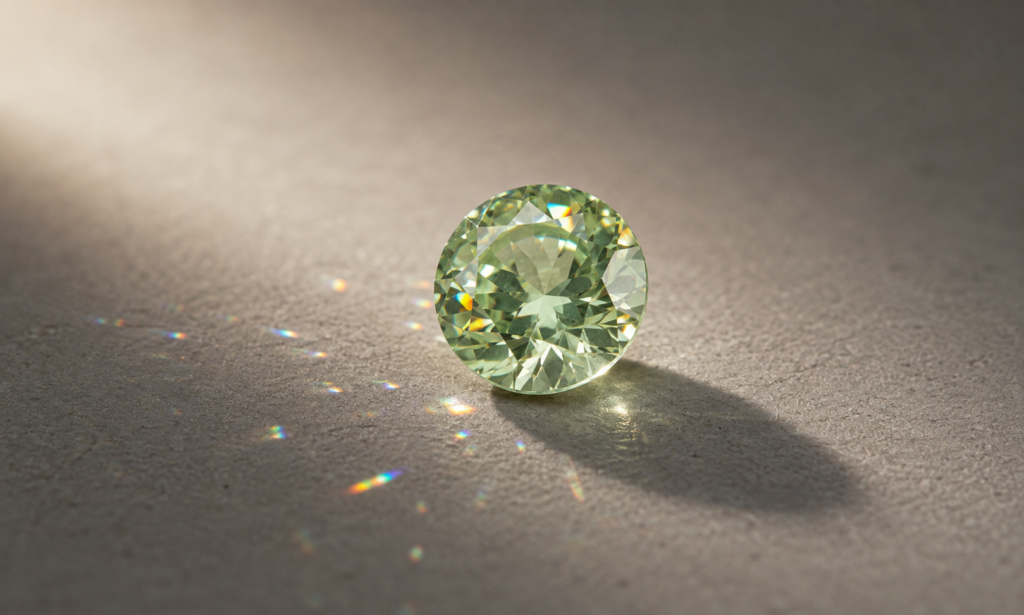
Green and Fire Can Compete for Attention
Demantoid contains an unusual visual tension. Stronger body colour can make green dominant, while lighter material can sometimes leave more visual space for spectral fire to appear. Neither expression is automatically the correct one.
In demantoid, colour and fire do not always ask for the same thing.
There Is More Than One Demantoid Green
Demantoid can range through yellowish green, golden green, fresh green and richer green, with other modifiers appearing in some material. Different deposits can occupy different parts of this range, but colour should not become a rigid origin rule or a single ideal.
Demantoid does not have one green personality. Yellow, depth and brightness can shift its character dramatically.
A Lighter Demantoid Can Reveal Another Side
Lighter demantoid can be especially revealing because body colour does not dominate every return of light. In some material, including examples documented from Namibia, lighter colour combined with strong dispersion can make fire particularly noticeable.
A lighter green does not simply mean less colour. It can give the fire more room to appear.
Cut Gives the Fire Somewhere to Appear
Exceptional optical properties create potential, but cut influences how we experience them. Proportions, facet arrangement, polish and movement affect brightness, scintillation and visible dispersion. A cutter is therefore working with green and light at the same time.
The crystal creates the potential for fire. The cut decides how that potential reaches the eye.
Demantoid Began in the Russian Urals
Demantoid’s modern history began in Russia’s Ural Mountains in the nineteenth century. It became closely associated with Russian jewelry and the imperial era, giving this green garnet a historical identity quite different from the more recently recognized story of tsavorite.
Before demantoid became an international gemstone, its story belonged to the Ural Mountains.
Demantoid in Russian Jewelry History
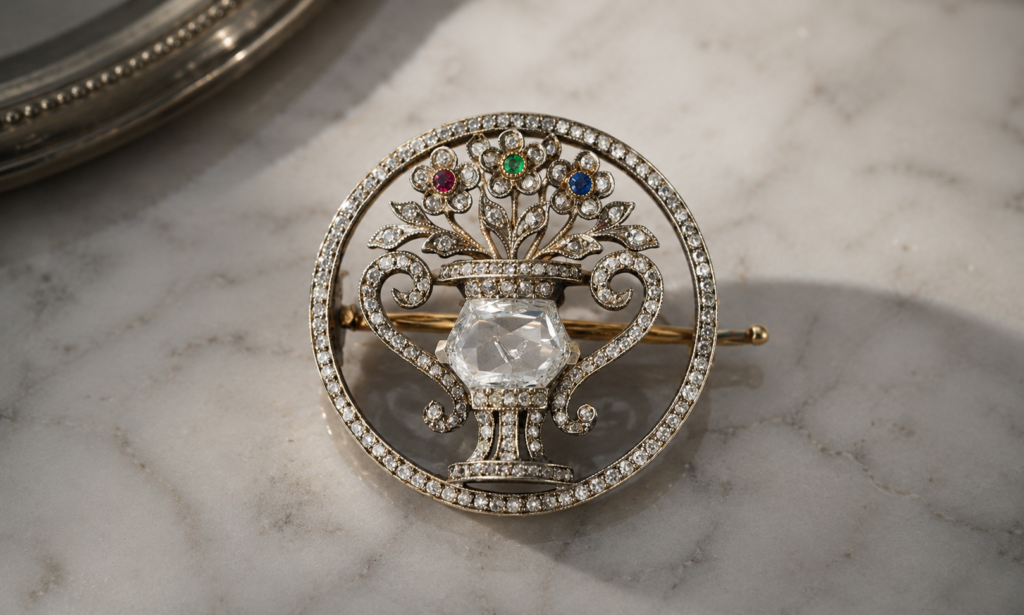
Demantoid became admired in late nineteenth- and early twentieth-century Russian jewelry and is associated with makers including Fabergé. This remains an important chapter in its identity, but documented objects require careful attribution and provenance when used as historical evidence.
Russia Is No Longer the Only Source
Russia dominated the early demantoid story, but important deposits were later identified elsewhere. Demantoid has been documented from Namibia, Madagascar, Iran and Italy, among other localities. The mineral is therefore not Russian by definition.
Demantoid is a mineral identity. Russia is one important chapter of its origin story, not its definition.
Different Origins, Different Geological Stories
Demantoid can form in different geological settings. Some deposits are associated with serpentinite and ultramafic rocks, while others occur in skarn-related environments involving intrusions, fluids and carbonate-rich rocks. The same green andradite identity can emerge from different geological processes.
The same green andradite can emerge from very different geological stories.
The Famous Horsetail Inclusion
Some demantoids contain radiating fibrous inclusions traditionally called horsetails. They are famously associated with Russian material, but not every Russian demantoid contains one, and similar features have been reported from other origins including Iran and Italy. A horsetail is interesting context, not a simple passport for origin.
The horsetail is famous, but it is not a passport.
Origin Can Influence Character Without Defining Beauty
Different sources can show tendencies in colour, inclusions and geological context, but these do not create a universal beauty ranking. Russian, Namibian and Madagascan material can each express demantoid differently. Origin adds information; it does not replace looking at the individual stone.
Origin can explain part of a demantoid’s story. It cannot replace looking at the stone itself.
Why Large Demantoid Is Unusual
Demantoid is commonly found in relatively small sizes, and fine larger stones are much less common. Substantial examples can therefore be notable from a geological and availability perspective, without implying that a larger stone must be more beautiful than a smaller, lively one.
With demantoid, size can become remarkable simply because nature usually gives us less of it.
Treatment Is More Nuanced Than “Untreated Garnet”
Routine treatment does not define demantoid as it does some gemstone categories, but treatment should not be described in absolutes. Heat treatment has been reported for some Russian material, including attempts to shift yellowish-green colour toward stronger green. Disclosure is more useful than assuming either that all demantoid is treated or treatment never occurs.
Understanding treatment is more useful than assuming either that every demantoid is treated or that treatment never occurs.
Demantoid and Tsavorite Are Not Competitors
Tsavorite is grossular; demantoid is andradite. Tsavorite offers its own relationship between green, transparency and brilliance, while demantoid’s exceptionally strong dispersion can make spectral fire particularly visible. Neither needs the other to establish its identity.
Tsavorite and demantoid do not compete for the title of the better green garnet. They reveal two different possibilities within the same family.
The Character Is in the Balance
One demantoid may be remembered first for rich green, another for spectral flashes, and another for a warmer yellow-green character. There is no single balance every stone must achieve. Colour, fire, cut and movement combine differently in each gem.
The most interesting demantoid is not necessarily the greenest or the most fiery. It is the stone in which colour and light create a character of their own.
Demantoid in Jewelry
Because demantoid commonly occurs in smaller sizes, it has appeared as accent stones, clusters and smaller focal gems, while exceptional larger stones can become centres in their own right. Small size need not mean quiet appearance: scintillation and dispersion can make a modest demantoid remarkably lively in motion.
When Green Meets Fire
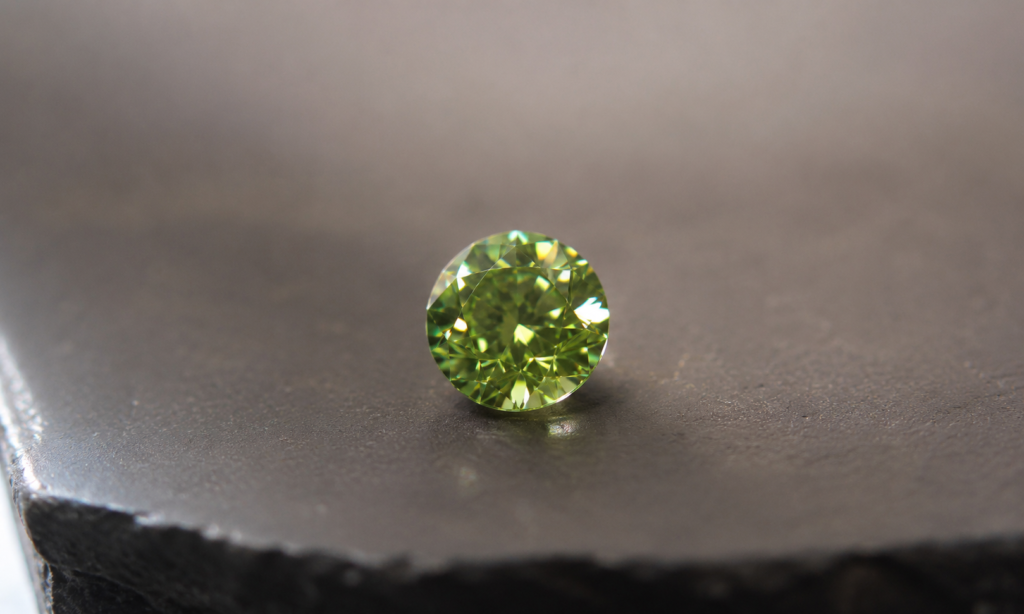
Demantoid is not simply a green garnet that happens to sparkle. It is andradite in which green body colour, high refractive index and exceptional dispersion meet. Its character emerges from the conversation between those properties rather than from requiring either colour or fire to dominate.
Demantoid becomes most itself when we stop asking whether the green or the fire should dominate—and simply watch what happens when they meet.