


For many gemstones, eye-clean has become a reassuring shortcut. If no inclusion can be seen without magnification, the stone can feel safer, finer or more desirable. Carry that expectation directly into emerald, however, and it can become misleading.
Natural emeralds commonly contain inclusions visible to the unaided eye, while fine eye-clean examples are unusually rare. Clarity still matters, but emerald asks us to look at it in a more nuanced way.
Perhaps the better question is not “Can I see an inclusion?” but “What happens to the emerald when I can?”
What Does “Eye-Clean” Actually Mean?
In the gemstone trade, eye-clean is a practical description for a stone in which inclusions are not readily visible to the unaided eye under reasonable viewing conditions. It is useful language, not a universal scientific boundary.
Viewing distance, lighting, gemstone size, inclusion position and contrast, and the observer’s eyesight can influence what is noticed. Magnification changes the question again entirely.
Eye-clean is a useful description, not a universal scientific boundary.
Emerald Plays by Different Clarity Expectations
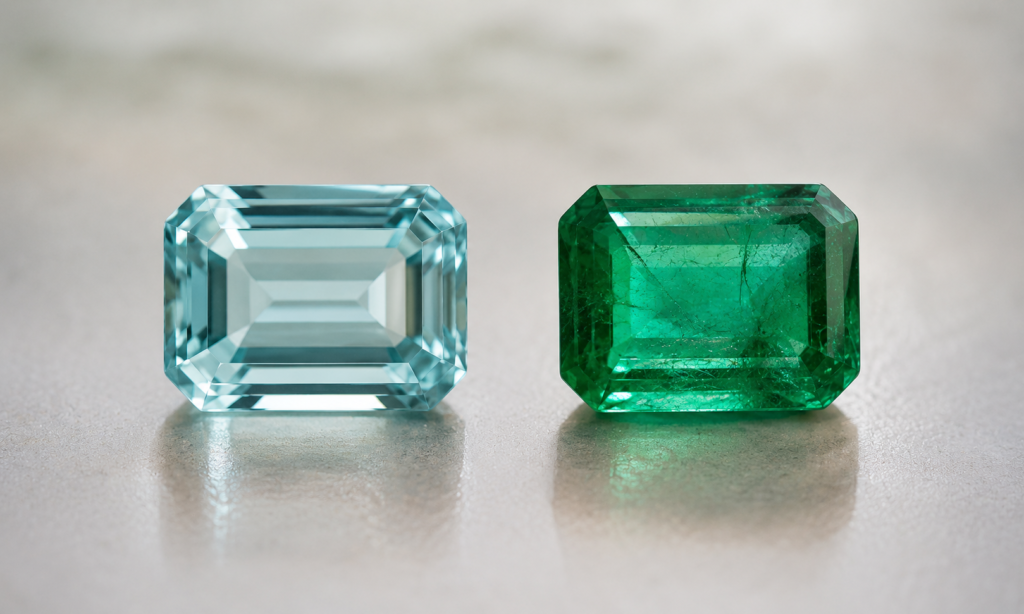
Clarity expectations depend on the gemstone. Aquamarine and emerald are both varieties of beryl, yet faceted aquamarine is commonly expected to be eye-clean while eye-visible inclusions are widely accepted in emerald.
That difference reflects how these materials occur and what is realistically encountered in the market. Applying the same clarity expectation to every gemstone can hide more than it reveals.
Clarity cannot be judged without understanding the gemstone being judged.
So, Does an Emerald Need to Be Eye-Clean?
No. An emerald can be visibly included and still be exceptionally beautiful. Eye-visible inclusions are accepted even in higher-quality emeralds because they are such a common feature of natural emerald.
The important qualification is that inclusions can still matter greatly. When they reduce transparency, dominate the face-up appearance or interfere strongly with colour and brightness, their effect becomes much more significant.
Eye-visible inclusions can be completely compatible with a beautiful emerald. Their effect matters more than their mere visibility.
Visible Is Not the Same as Distracting
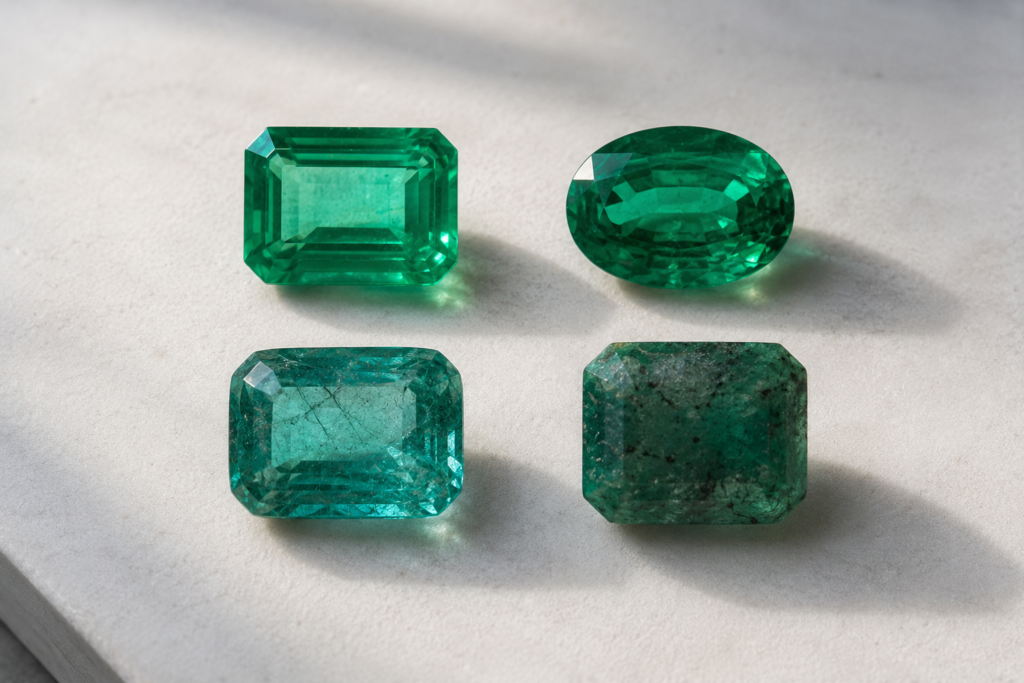
Imagine two emeralds. In the first, fine jardin is visible, yet the eye still encounters green colour, brightness and shape before exploring the interior. In the second, there may be fewer inclusions overall, but one dark, high-contrast crystal directly beneath the table immediately catches the eye.
The second can feel more visually interrupted even though it appears to contain less. Counting inclusions rarely tells the whole story; position, contrast, size, nature and interaction with the rest of the stone matter.
An inclusion can be visible without becoming the centre of the emerald.
Transparency May Matter More Than the Word “Clean”
Clarity and transparency are closely connected, but they are not identical. An emerald can contain obvious jardin and still allow light through in a way that feels open, bright and lively.
Another emerald may show no single dramatic inclusion, yet numerous fine internal features can combine to create a cloudy or sleepy appearance.
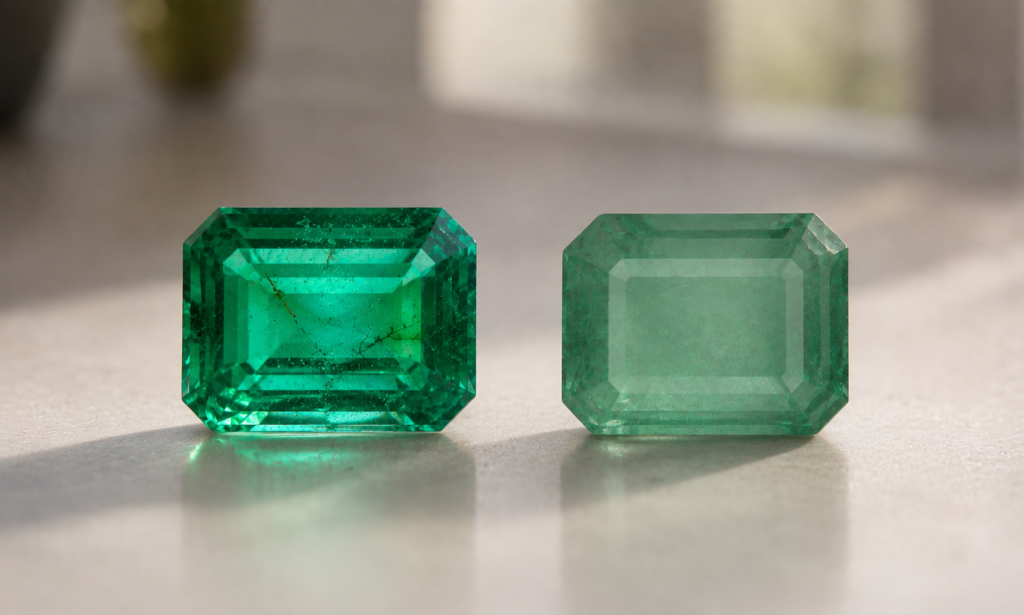
A stone can be included and transparent at the same time.
Where the Inclusion Sits Changes Everything
A feature beneath the centre of the table can attract more attention than a similar feature near the edge. A dark crystal can have more visual contrast than a pale or transparent feature. A strongly reflective fissure can announce itself differently from soft, fine jardin.
So “this emerald is not eye-clean” is only the beginning. More useful questions are: Where is the inclusion? What visual effect does it create? And how much does your eye care?
What If I Can See the Jardin?
Seeing jardin does not mean you have to pretend it is invisible in order to appreciate the emerald. In many stones, the internal landscape and colour can coexist.
That does not mean more inclusions are automatically more beautiful. There is a point at which internal features begin to overwhelm transparency, brightness or colour, and that balance differs from stone to stone.
Character begins when the internal features coexist with the stone. It ends when they overwhelm it.
When Visible Inclusions Do Become a Problem
Accepting inclusions as part of emerald does not mean ignoring their effects. An inclusion deserves closer attention when it substantially reduces transparency, creates a strongly distracting dark or whitish area, produces conspicuous reflections, or when a fissure raises a question about physical condition.
Beauty and durability are different questions. A feature can be visually unobtrusive yet structurally important, while another can be visually distracting without presenting the same durability concern.
Accepting inclusions is not the same as ignoring them.
Then Why Are Eye-Clean Emeralds So Expensive?
Because they are rare. Natural emeralds combining attractive colour, high transparency, good size and cut with no eye-visible inclusions are difficult to find. At the fine end of the market, that rarity can carry a substantial premium.
The premium is meaningful, but it should not become a universal definition of beauty. An eye-clean emerald can be rare without automatically being the emerald whose colour or character someone loves most.
Rarity explains why eye-clean emeralds command a premium. It does not mean beauty begins only when inclusions disappear.
Eye-Clean and Beautiful Are Two Different Questions
“Is it eye-clean?” asks whether inclusions are readily visible without magnification under normal viewing conditions. “Is it beautiful?” asks something broader: colour, transparency, brightness, cut, internal character, balance and personal response.
An emerald can be eye-clean and beautiful; eye-clean yet less compelling to a particular observer; visibly included and beautiful; or so included that its internal features overwhelm the rest of the stone.
Macro Photography Makes “Eye-Clean” Even More Confusing
A gemstone that appears eye-clean in normal viewing can reveal tiny crystals, fissures, fluid inclusions and growth features in a macro photograph. That is not a contradiction.
Macro photography asks what becomes visible when we enlarge the interior. Eye-clean asks what is readily visible to the unaided eye under normal viewing conditions.
A macro photograph tells you what is there. Eye-clean tells you whether you normally see it without magnification.
A More Useful Way to Look at an Emerald
Experience. Look from a normal viewing distance. What reaches you first—colour, brightness, shape or an inclusion?
Observe. Move the stone through the light. Notice whether an inclusion flashes, reflects strongly or repeatedly pulls attention away. Consider whether the stone still feels transparent and open.
Inspect. Then move closer or use magnification. Learn what is inside and pay particular attention to fissures or other features that may matter to durability.
This creates a useful sequence: Experience → Observe → Inspect. It prevents magnification from becoming the only way we learn to see a gemstone.
Perhaps “Eye-Comfortable” Is the Better Idea
“Eye-comfortable” is not a gemological grade or established laboratory term. As an editorial idea, however, it can be useful.
Instead of asking only whether an inclusion is visible, ask whether it interferes with your experience of the emerald. You may see the inclusion clearly while still feeling that colour, transparency and overall balance remain dominant.
“Eye-comfortable” is not a gemological grade. It is simply a useful way to think about whether an inclusion interferes with your experience of the stone.
Beauty Does Not Begin at Eye-Clean
Eye-clean emeralds can be exceptionally rare and valuable. Clarity affects value. Transparency matters. Some inclusions genuinely interfere with beauty, and some fissures deserve careful attention because of durability.
None of that requires us to turn eye-clean into the dividing line between a beautiful emerald and an unbeautiful one.
Emerald is a gemstone in which the internal world is often visible. Learning to distinguish visibility from distraction, and clarity from transparency, gives us a more complete way to appreciate it.
An emerald does not become beautiful the moment its inclusions disappear. Sometimes beauty is already there—with the inclusions still inside it.