
Tourmaline comes from many parts of the world, and origin can add history, geological context and provenance to a gemstone. But does a Brazilian, Afghan, Mozambican or Tanzanian name tell us which stone is better? For most tourmaline, not by itself.
There is, however, an important exception. In parts of the Paraíba market, documented geographic origin can become part of value itself.
For most tourmaline, origin is context. For a few important categories, origin can become part of the market identity.
Tourmaline Comes From Many Different Parts of the World
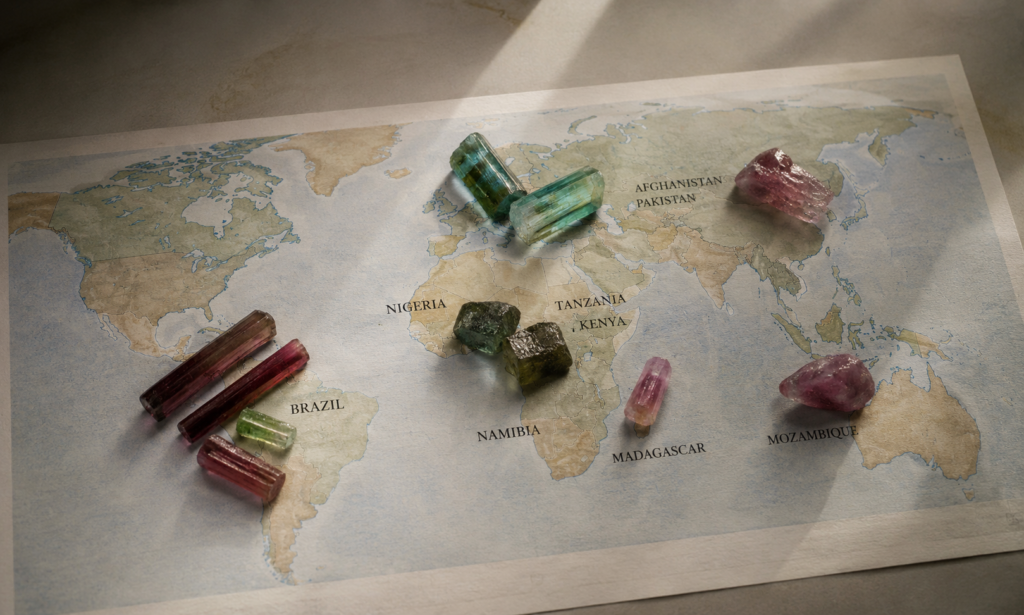
Important tourmaline-producing regions include Brazil, Mozambique, Nigeria, Namibia, Tanzania, Kenya, Madagascar, Afghanistan and Pakistan, among others. Each deposit has its own geology and production history, yet every source can produce a range of colours, clarity and quality.
A mine tells us where a crystal formed. It does not grade the crystal that came out of it.
Why Do Certain Colours Become Associated With Certain Origins?
Repeated production creates reputations. Afghanistan and Pakistan are often associated with attractive blue-green, mint and pink material; Brazil has produced rubellite, green tourmaline, Paraíba and many other colours; East Africa is important to chrome tourmaline and several other varieties; Mozambique has become especially important to copper-bearing Paraíba-type material.
These associations describe what markets have repeatedly seen. They are not rules that every gemstone from those places must follow.
Origins can develop colour reputations. Individual gemstones do not have to obey them.
Can You Tell Tourmaline Origin From Colour?
Colour may suggest associations, but it should not be treated as a passport. A mint stone is not automatically Afghan, a rubellite is not automatically Brazilian, and a blue-green stone is not automatically Mozambican.
Paraíba provides an especially useful example: copper-bearing material from Brazil, Nigeria and Mozambique can overlap strongly enough in appearance and conventional gemological properties that geographic origin cannot be established reliably by colour alone.
Colour may remind us of a place. It is not a passport.
Why Can Different Countries Produce Similar Tourmaline?
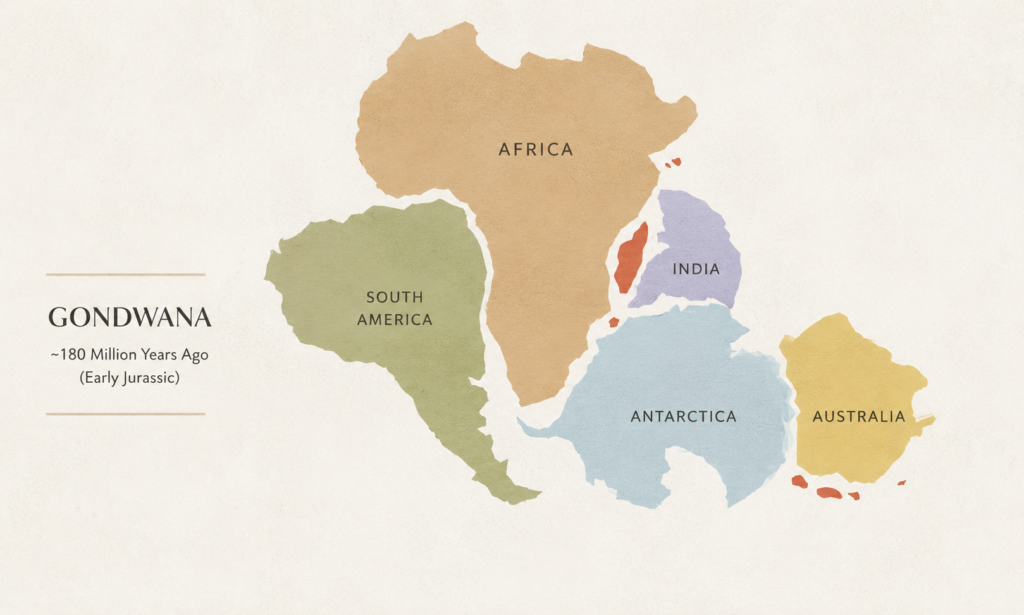
Modern national borders are extremely young compared with the rocks that host gemstones. The geological history connecting South America and Africa reaches back to ancient continental assemblies and the later breakup of Gondwana. Deposits now separated by oceans can therefore share parts of a much older geological story.
That does not mean every tourmaline deposit formed through one identical process. It means gemstone geology follows rocks, tectonics and deep time rather than modern political boundaries.
Gemstones are older than countries. Their geology follows continents, not modern borders.
Does Origin Affect the Appearance of Tourmaline?
It can influence tendencies. Different deposits provide different host rocks, trace elements and growth environments, so one source may repeatedly produce certain colour characters more often than another.
The important word is often. A deposit can still produce broad variation, and an origin reputation cannot predict the appearance of every individual crystal.
Origin can influence what a deposit tends to produce. It cannot predict every gemstone the deposit will produce.
The Important Exception: Paraíba
Paraíba changes the conversation because geographic origin can carry significant market meaning. Copper-bearing tourmaline was first brought to international attention from Paraíba, Brazil, in the late 1980s. Related copper-bearing material was later discovered in Nigeria and Mozambique.
Modern Paraíba terminology is not restricted to Brazilian stones, but the market can still place a premium on documented Brazilian origin.
Paraíba shows the moment when origin stops being only a story and begins to influence the market itself.
Why Does Brazilian Paraíba Carry an Origin Premium?
The premium should not be simplified into a claim that every Brazilian Paraíba is more beautiful than every African one. Brazil carries the history of the original discovery, limited production, collector reputation and strong demand for documented provenance.
Fine Brazilian material can be exceptional, but the colour ranges of Brazilian, Nigerian and Mozambican copper-bearing tourmalines overlap. Origin premium and visual quality are therefore related market considerations, not the same thing.
An origin premium reflects history, rarity and market preference. It is not proof that one individual gemstone must look better than another.
Two Paraíba Tourmalines Can Look Similar but Carry Different Values
Two stones of similar size, colour, clarity and cutting may still be valued differently when one has independently documented Brazilian origin and the other comes from Mozambique. In this situation, provenance itself becomes collectible information.
Two gemstones can look remarkably similar while the market values the stories behind them differently.
Can a Laboratory Really Determine Tourmaline Origin?
For Paraíba tourmaline, specialist laboratories can use quantitative trace-element analysis and extensive reference collections to investigate geographic origin. Elements such as copper, zinc, gallium, strontium, tin and lead can help build chemical patterns that are compared with known material from Brazil, Nigeria and Mozambique.
Origin determination is not educated guessing from colour. It is comparison against a scientific reference database.
Even Laboratories Sometimes Say “Inconclusive”
Natural deposits overlap, and not every stone fits neatly into a reference field. A laboratory may therefore be unable to reach a confident geographic conclusion and report an inconclusive result. That does not automatically indicate a problem with the gemstone; it means the evidence is not strong enough to turn uncertainty into a country name.
A careful laboratory would rather say “inconclusive” than turn uncertainty into a country name.
What About Rubellite, Indicolite and Other Tourmalines?
For rubellite, indicolite, green tourmaline, bi-colour, watermelon and many other tourmalines, country should usually not replace examination of the actual gemstone. Colour, tone, brightness, clarity, cut and colour zoning can matter more directly to what you experience.
For most tourmaline, the gemstone should earn your attention before the country does.
Does a Famous Origin Guarantee Better Quality?
No. Famous deposits produce ranges of quality just as less famous deposits do. A prestigious place name cannot correct weak colour, excessive darkness, poor cutting or an appearance that simply does not appeal to you.
A famous origin can add context. It cannot repair weak colour, poor cutting or a gemstone you simply do not love.
When Is Origin Worth Paying Attention To?
Origin becomes especially relevant when it materially changes market value, when provenance matters to a collector, when the mining history is personally meaningful, or when a seller is asking you to pay an origin premium.
If that premium depends on a specific country, independent laboratory documentation becomes much more important than a verbal assumption based on appearance.
Origin matters most when it changes what the gemstone means to you—or what the market is asking you to pay for it.
How Should You Choose Between Two Tourmalines From Different Origins?
Begin with the gemstones themselves. Which colour do you prefer? Which remains brighter? Which cut works better? Which zoning or individual character interests you more? How do they behave in the lighting in which you will actually see them?
Then ask where each stone came from, whether that origin is documented and whether you are being asked to pay extra because of it.
Choose the gemstone first. Understand the origin second. Pay for provenance only when provenance actually matters.
A Place Is Part of the Story, Not the Whole Story
Every tourmaline began somewhere. The geology of that place supplied the environment and chemistry from which the crystal grew, so origin is genuinely part of its history.
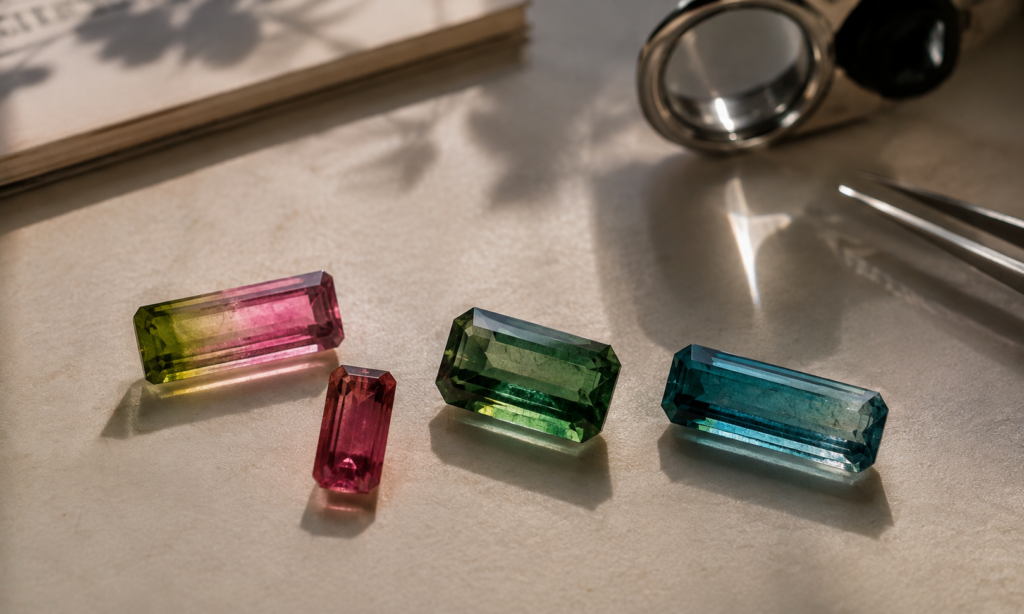
Once the crystal exists, however, its individual colour, clarity, brightness, cutting and character determine much of what we actually experience. Only in particular markets, such as documented Paraíba provenance, does the place name itself become a major part of commercial value.
Origin tells us where a tourmaline began. The gemstone itself tells us what it became.