
Many gemstone cuts are named for their outline or facet arrangement. Oval, pear, cushion and brilliant can belong to many materials. The emerald cut is different: the gemstone’s name became inseparable from the architecture of the cut itself.
Today we speak naturally of an emerald-cut diamond or aquamarine. The more interesting question is why this particular architecture became so closely associated with emerald.
The emerald cut is not simply a rectangle chosen for elegance. Its architecture answers several problems presented by the emerald itself.
What Actually Is an Emerald Cut?
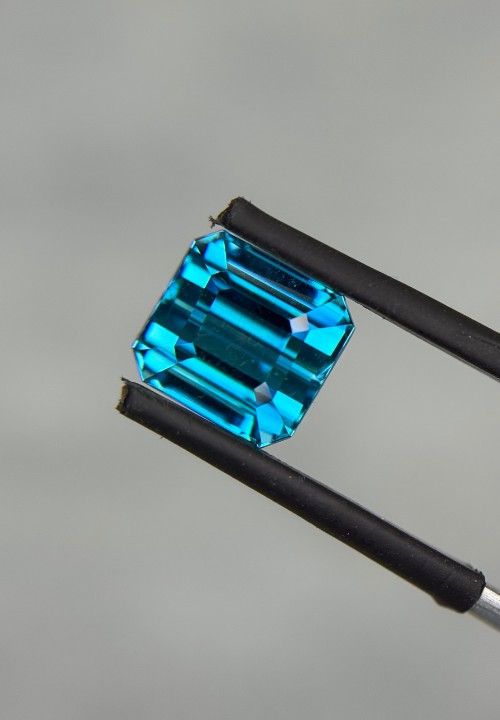
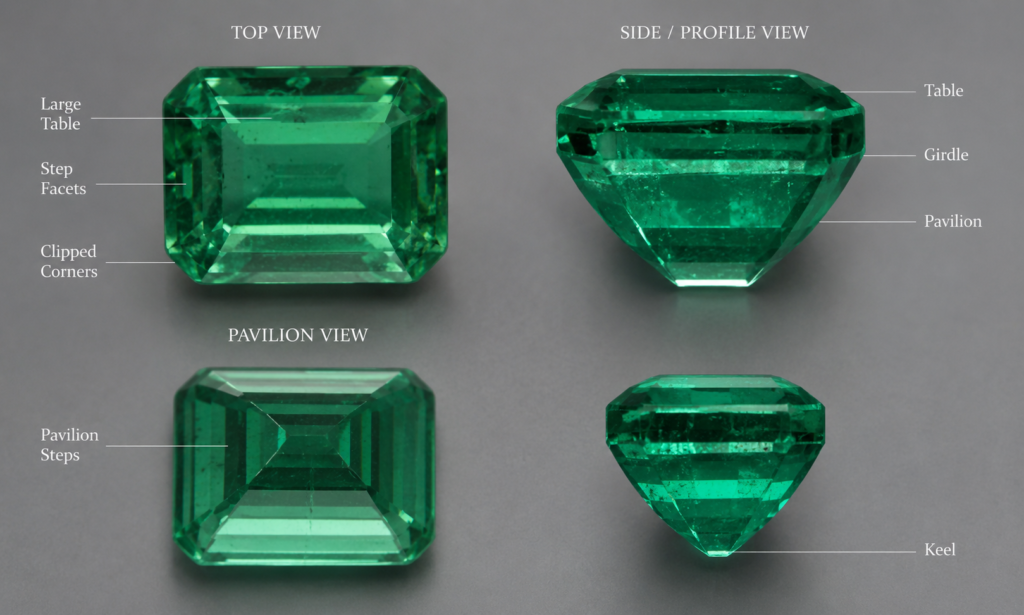
A classic emerald cut has an elongated rectangular outline with clipped corners, a relatively large open table and rows of broad step facets. The clipped corners turn the rectangle into an eight-sided outline.
Step facets create broader flashes and long planes of light and dark rather than the rapid fragmented scintillation associated with many brilliant-style arrangements.
A brilliant cut breaks light into activity. An emerald cut opens the stone into planes.
The Story Begins with the Rough Crystal
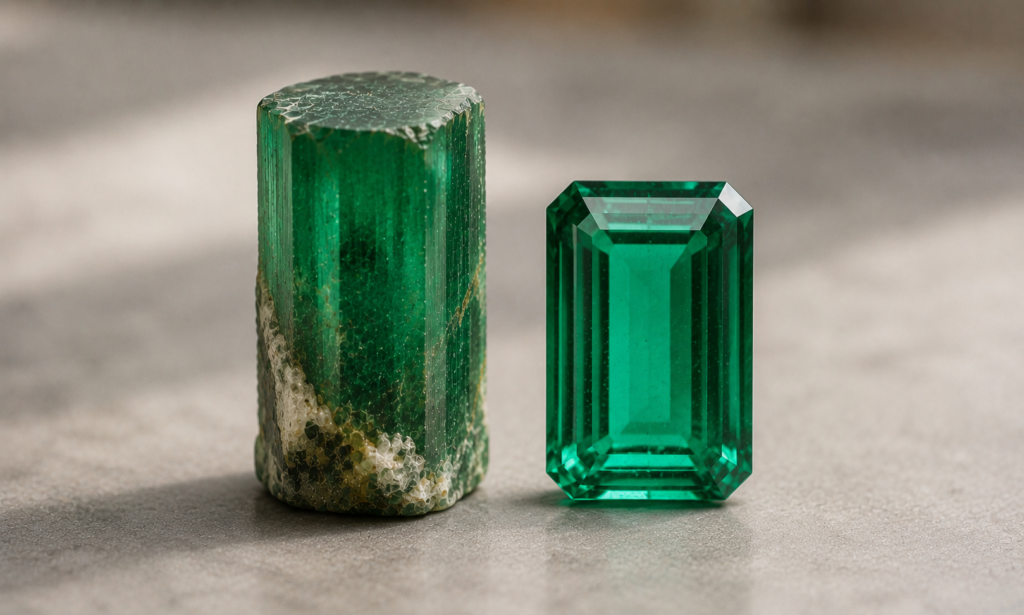
Natural emerald commonly grows as a hexagonal prismatic crystal. That original geometry matters because every finished gemstone begins with a finite piece of rough, not an empty design page.
An elongated rectangular outline can often make practical sense for prismatic emerald rough. Forcing the same crystal into a round outline could require removing valuable material around its perimeter.
The final rectangle often begins with the shape nature already gave the cutter.
Cutting Emerald Is a Negotiation with Weight
Coloured-stone cutting balances competing goals: preserve weight, improve colour, manage fissures, choose orientation and create proportions that perform well optically. With valuable emerald rough, unnecessary weight loss can have a substantial effect on value.
How much of this crystal can be preserved without compromising the finished stone?
Then Come the Fissures
Emerald commonly contains fissures and other internal features. Their location can influence how the rough is planned. A cutter may consider whether a fissure should be removed, whether it approaches the girdle, how it interacts with a corner, and whether changing orientation could produce a safer or more attractive result.
An emerald is not cut around an ideal diagram. The diagram has to negotiate with the emerald.
Why Are the Corners Cut Off?
Instead of retaining four sharp 90-degree corners, the classic outline truncates them. Sharp corners are vulnerable points, especially in a gemstone that commonly contains fissures and requires thoughtful handling during cutting, setting and wear.
The clipped corners are not merely decoration. They remove four vulnerable points from the outline.
The Cut Gives the Setter Somewhere Safer to Hold the Stone
A setter must secure the emerald while controlling pressure. Faceted corners provide comparatively safer areas for prong placement than four exposed sharp rectangular points. A stylistic signature therefore also carries a functional purpose.
But the Emerald Cut Does Something Unexpected: It Shows More
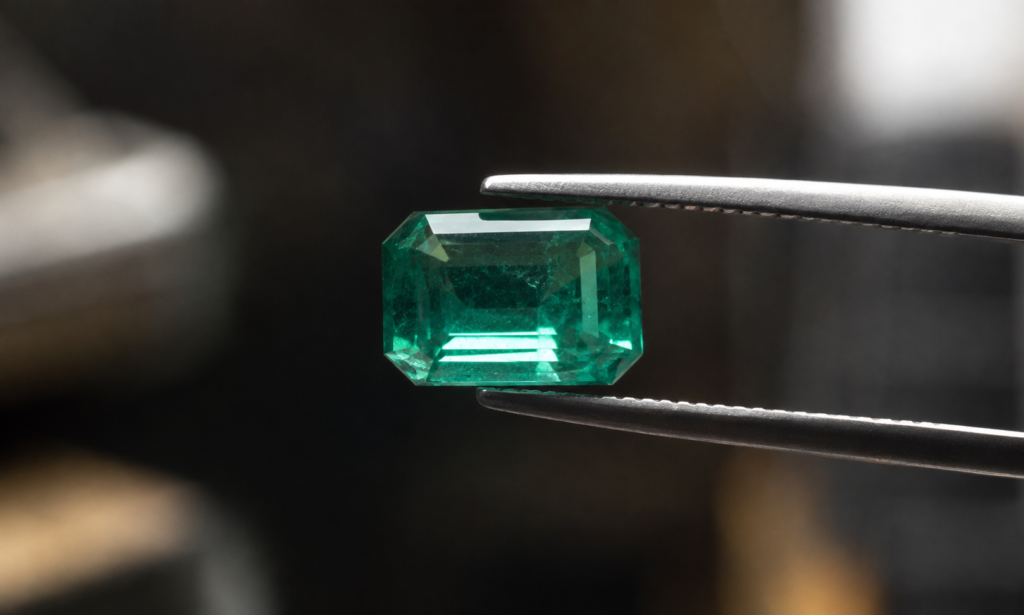
There is an apparent contradiction in pairing emerald with a large open step cut. Emerald is commonly included, yet step-cut architecture does relatively little to camouflage the interior. Its large table and broad facets create open areas through which the eye can look into the gemstone.
The cut became associated with an included gemstone, yet it does not hide the gemstone’s interior. It opens it.
Why Open an Included Stone?
Because emerald is not valued for scintillation alone. Colour is central to the experience. Broad step facets and an open table can give green colour, transparency and depth room to be perceived across larger areas while the jardin may remain visible.
Instead of hiding the emerald behind sparkle, the cut gives colour room to exist.
Step Facets Create a Different Kind of Light
As an emerald cut moves, its parallel facet rows can appear to open and close in sequence. Broad reflections alternate between lighter and darker planes, producing a sense of depth rather than a continuous field of small flashes. It is a different visual language, not a superior one.
Cut Can Make the Green Look Different
The outline may be classic, but proportions need not be identical. Table size, pavilion depth and facet arrangement can influence apparent tone and saturation. Lighter and darker rough may therefore call for different solutions.
The outline may be classic. The proportions still belong to the individual emerald.
Orientation Matters Because Emerald Has More Than One Green
Emerald is dichroic, so its crystal structure can show different colour appearances in different crystallographic directions. The cutter therefore chooses not only a shape but also the direction from which the finished gemstone will be viewed, balancing face-up colour with weight and clarity.
Before the cutter decides how the emerald will look, they must decide which direction of the crystal we will be looking into.
Sometimes Every Facet Can Remove More Than Weight
Some emerald rough can show uneven colour distribution. Removing material may therefore change not only weight but also the apparent colour of the finished stone. This adds another variable alongside fissures, orientation and proportions.
Every facet removes material. In emerald, it may also remove colour.
Does an Emerald Have to Be Emerald Cut?
No. Emeralds are also cut as ovals, cushions, pears, rounds, cabochons and fancy shapes. A different outline may preserve weight, avoid a problematic fissure, suit colour distribution or reveal a special internal pattern.
The emerald cut is a solution, not a rule.
And the Emerald Cut Does Not Belong Only to Emerald
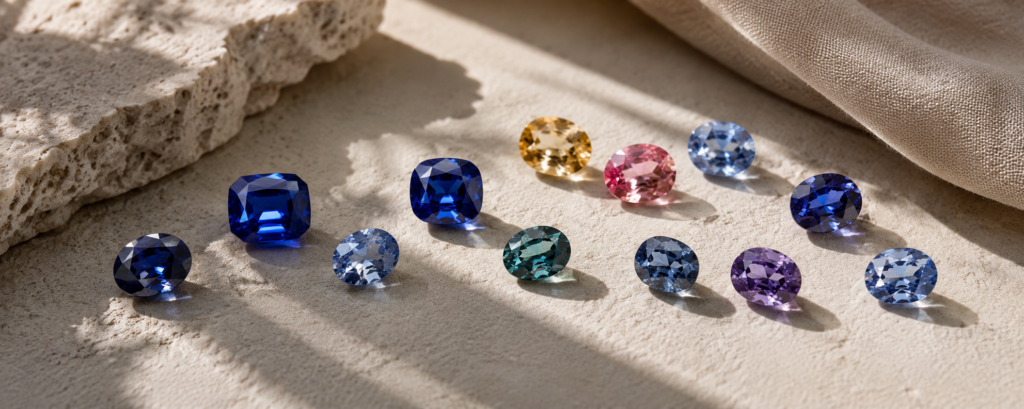
The architecture works with many transparent gemstones. Diamonds, aquamarines, tourmalines, sapphires and other materials can all be fashioned in emerald-cut form. The cutting language moved beyond the gemstone that gave it its name.
The Same Cut Can Mean Something Different on Diamond
An emerald-cut diamond also has a large table and broad step facets, but diamond buyers often become especially attentive to clarity because the open architecture can make inclusions easier to see. On emerald, visible jardin is much more expected.
Same cut. Different gemstone. Different expectation.
What Does a Well-Cut Emerald Cut Look Like?
Does the Colour Feel Alive?
The proportions should support the emerald’s colour rather than making it unnecessarily dark, washed out or closed.
Is There a Large Dead Window?
If pavilion proportions are too shallow for the material, light can pass through rather than returning effectively to the eye, creating an obvious window through which the background can be seen.
Do the Steps Feel Balanced?
As the emerald moves, the broad facets should create a coherent rhythm of reflections rather than leaving the stone visually lifeless.
Do the Proportions Make Sense for This Stone?
Colour, rough shape, fissures, orientation and weight retention differ from emerald to emerald. The successful cut resolves those variables convincingly for the particular crystal.
A good emerald cut is not the one that follows one perfect diagram. It is the one that makes sense for the emerald it came from.
The Cut Is a Record of Decisions
The elongated outline can relate to prismatic rough and weight retention. Clipped corners remove vulnerable points and assist setting. The open table reveals colour and interior. Step facets create broad planes of light. Depth and facet proportions influence apparent colour. Orientation responds to dichroism. The final outline negotiates with fissures and the limits of the rough.
A finished emerald cut is therefore more than a shape. It can be read as a record of decisions made between cutter and crystal.
A Cut That Learned from the Stone
The emerald cut is not the only beautiful way to cut emerald, nor automatically the best choice for every rough. Its lasting association with emerald comes from how its architecture works with several characteristics at once: prismatic crystal habit, valuable rough, common fissures, vulnerable corners, colour, dichroism and the practical realities of setting.
What began as a practical relationship between material and cutting architecture became an aesthetic recognised around the world—even when the stone inside the outline is no longer an emerald.
The emerald cut did not become timeless by ignoring the nature of emerald. It became timeless by learning how to work with it.