
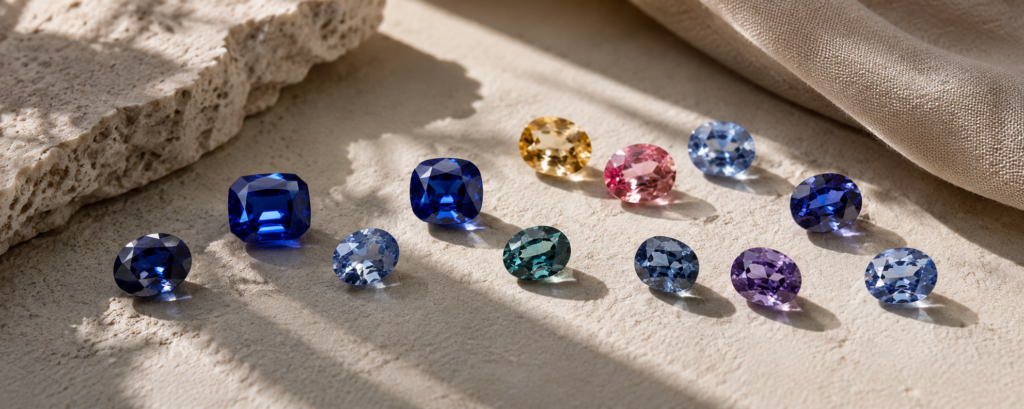
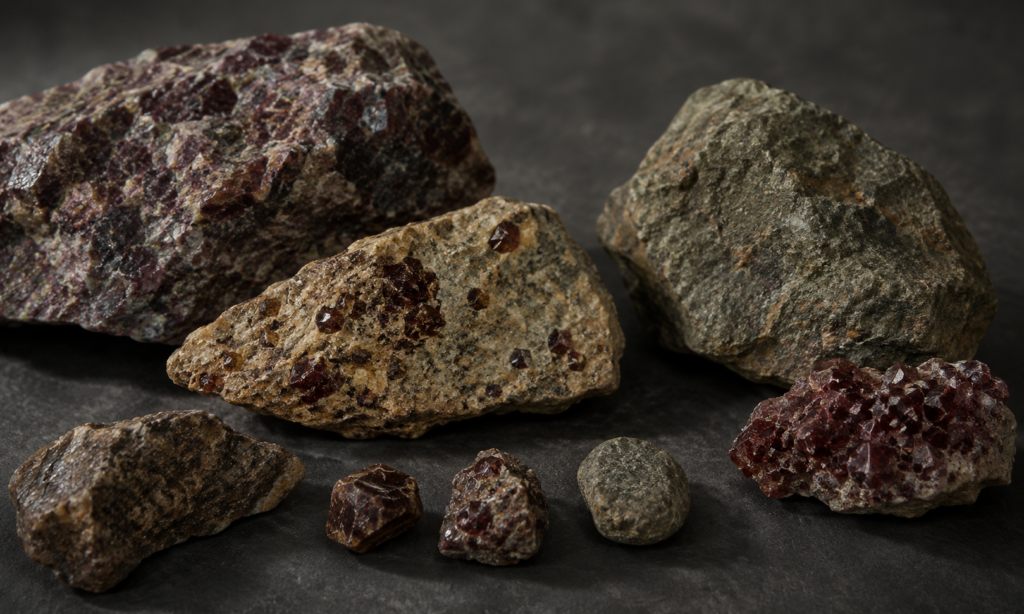
Place a deep wine-red garnet beside a purple-red stone, vivid orange gem, yellow-green garnet and intense green one, and the family resemblance may not be obvious. Garnet is often remembered as red, yet its colour range reaches far beyond that familiar image.
Garnet is not a red gemstone with a few unusual exceptions. Colour diversity is part of the identity of the family itself.
Colour Begins With the Garnet Family
Garnet is a mineral group rather than a single species. Its members share a basic crystal structure while differing in chemical composition, creating different colour possibilities. Pyrope and almandine are strongly associated with red, spessartine with orange, andradite with yellow through green, while grossular can extend from colourless and yellow through orange to vivid green.
To understand garnet colour, we first have to accept that different members of the family begin with different possibilities.
Red: The Colour That Defined Garnet
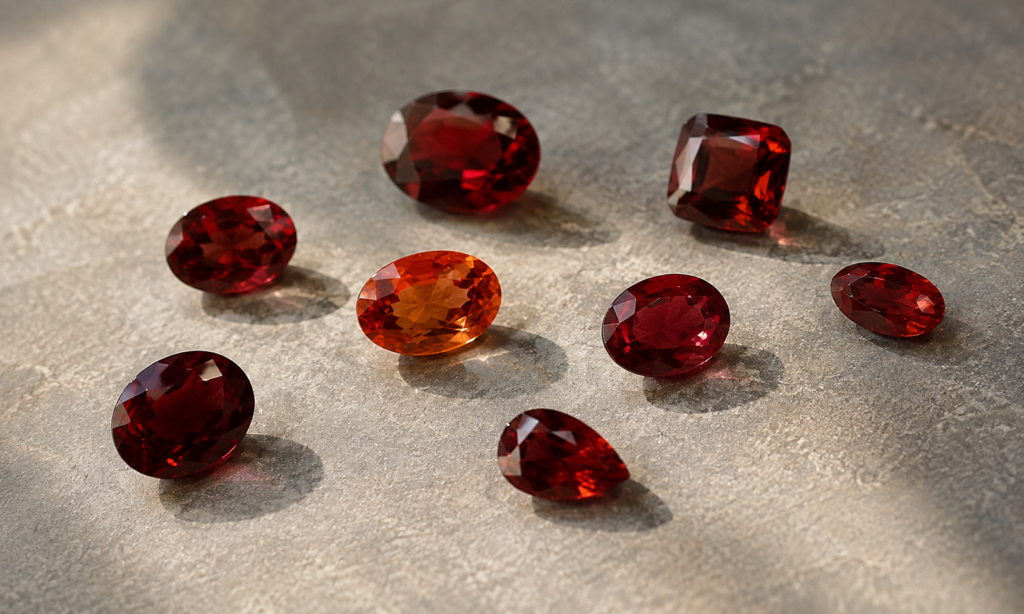
Even garnet’s most familiar colour is not one colour. Red garnets can move through deep crimson, wine red, reddish brown, orangy red and purple-red. Pyrope, almandine and compositions between them account for much of this territory, while individual stones create very different impressions within it.
Even garnet’s most familiar colour contains more variation than the word “red” suggests.
Rhodolite: When Red Moves Toward Purple
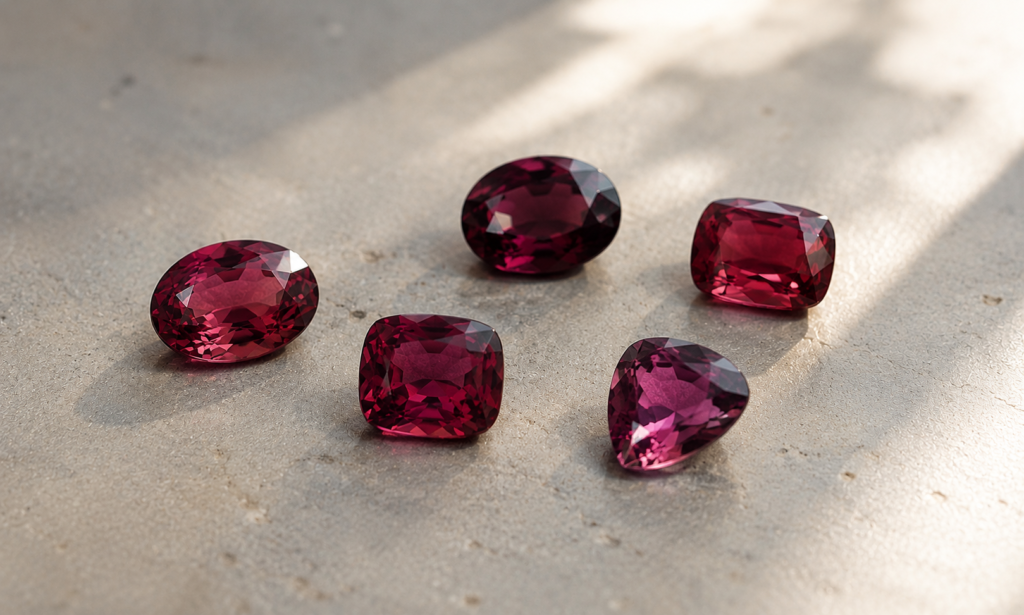
Rhodolite occupies a purplish-red part of the garnet world and is associated with pyrope–almandine compositions. As purple becomes more noticeable, the mood can shift toward berry, raspberry, plum or richer purple-red impressions. Nature does not create a single paint swatch called rhodolite; colour and composition move through continua.
A shift toward purple can make garnet feel like an entirely different gemstone without leaving the red side of the family.
Orange: One of Garnet’s Most Distinctive Directions
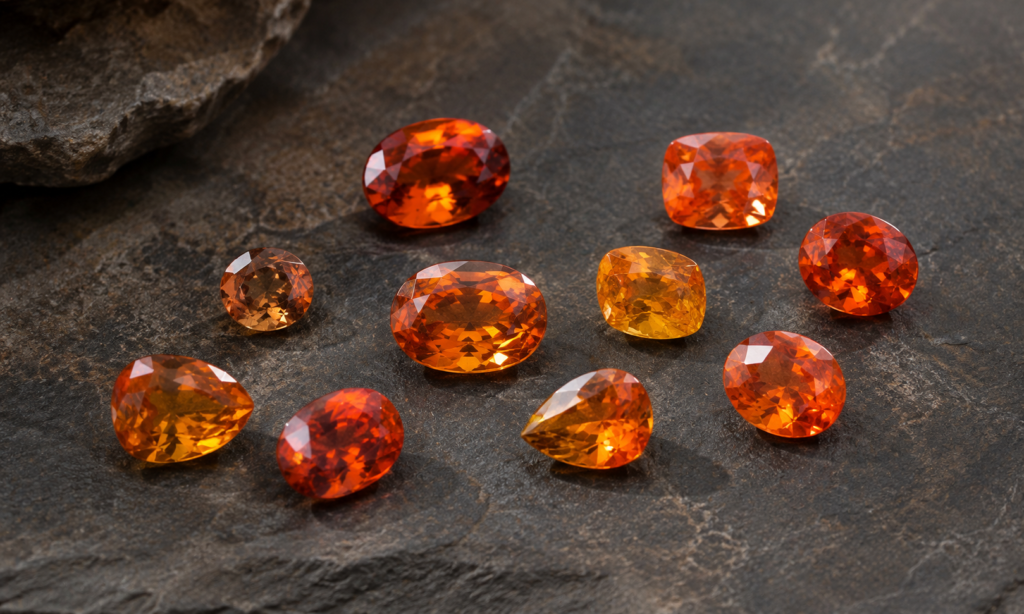
Spessartine opens another colour world, ranging through yellow-orange, strong orange and reddish or brownish orange. One stone may feel electric and saturated while another feels warmer, golden or earthier.
Orange garnet can feel electric, golden, fiery or earthy depending on the stone in front of us.
Spessartine Is Not the Only Orange Garnet
Colour alone does not always reveal mineral identity. Hessonite, a variety of grossular, can also appear orange, orangy red or brownish red. Two stones can occupy the broad orange family while belonging to different parts of the garnet group.
Colour can introduce a garnet, but it does not always tell us exactly which garnet we are looking at.
Green Changes Everything
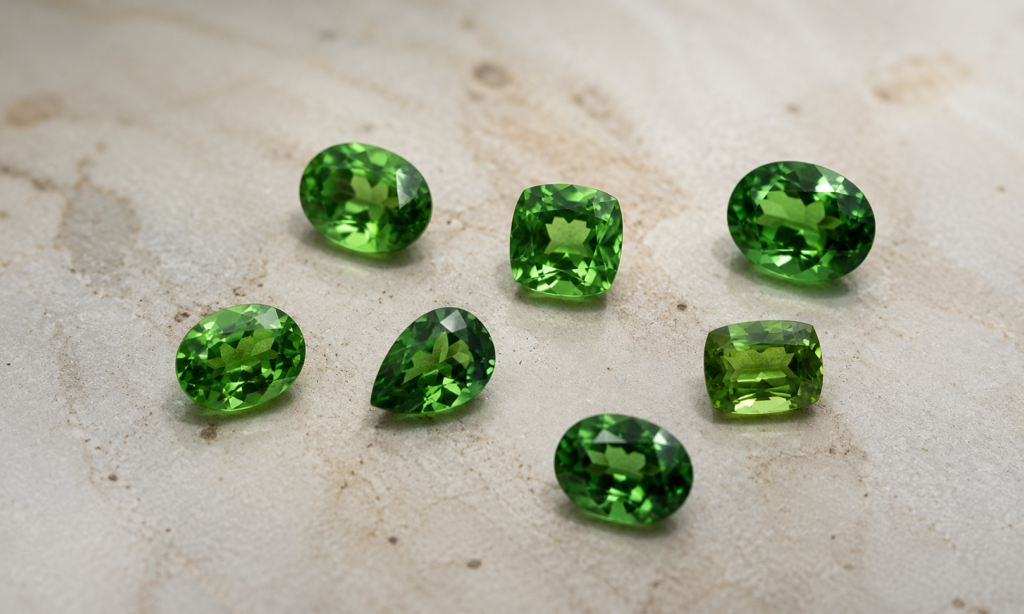
Green is perhaps the clearest break from the traditional image of garnet. The family includes yellow-green, softer green and vivid saturated green appearances, and more than one species can produce them. Tsavorite belongs to grossular, demantoid to andradite, and uvarovite is another green member.
Green is where the familiar image of garnet finally falls apart.
Tsavorite: The Green Side of Grossular
Grossular has a broad colour range, from colourless and yellow through orange and reddish tones to green. Tsavorite is its celebrated green expression, moving from yellowish green toward richer and more vivid greens. Those variations create different characters without requiring one shade to become the universal ideal.
Tsavorite shows how far the garnet family can travel from the colour most people associate with its name.
Demantoid: Another Green, Another Character
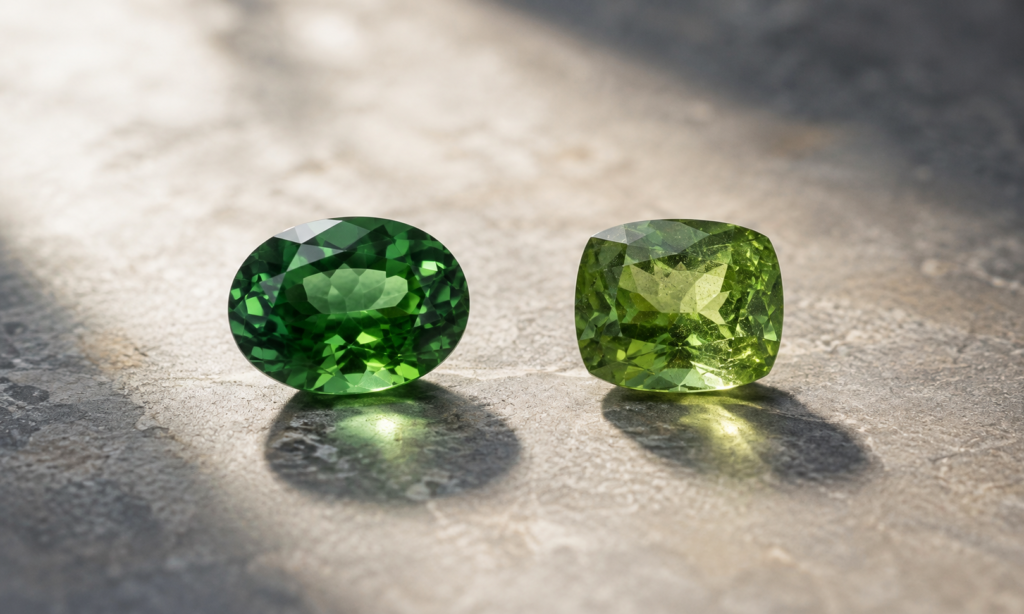
Demantoid is also green, but belongs to andradite rather than grossular. Andradite has high refractive index and strong dispersion, so demantoid can combine green body colour with conspicuous spectral fire. Tsavorite and demantoid can therefore share a broad colour while carrying different optical personalities.
Two green garnets can arrive at green through different branches of the family—and carry different optical personalities with them.
Yellow, Golden and the Colours Between
The palette also contains yellow, golden yellow, brownish yellow and yellow-green. Andradite can extend from yellow toward green, while grossular occupies several warmer areas. Not every attractive garnet colour needs a famous variety name.
Not every beautiful garnet colour needs a famous variety name.
What About Blue Garnet?
The old statement that garnet occurs in every colour except blue is no longer absolute. Blue and blue-green garnets have been documented, including unusual pyrope–spessartine material. Blue remains highly unusual, but its existence shows how difficult it is to reduce this family to simple colour rules.
Even the old phrase “every colour except blue” now needs an asterisk.
Some Garnets Do Not Keep the Same Colour
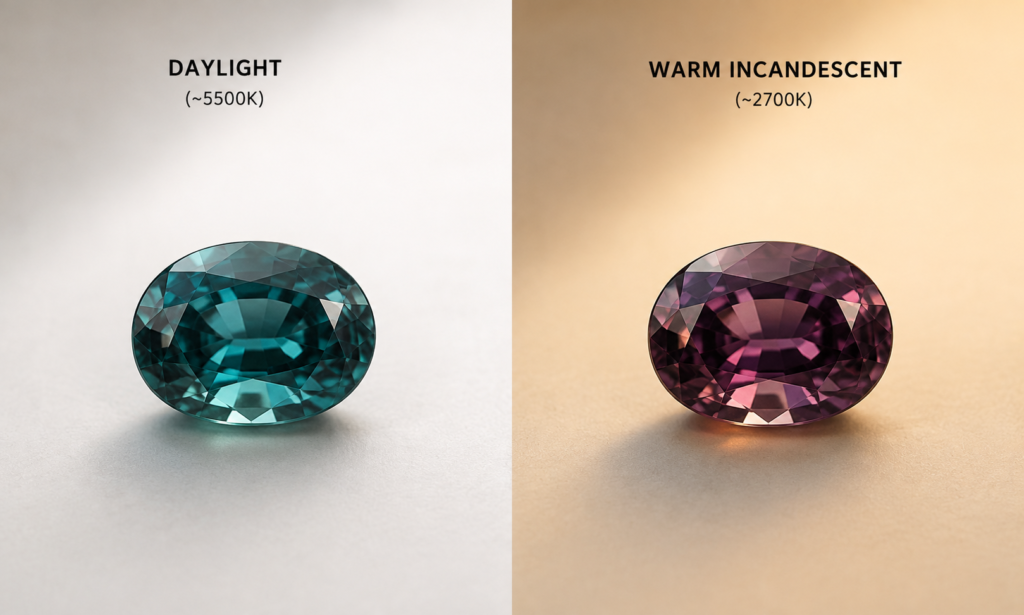
Certain garnets show a true colour-change phenomenon, appearing differently under different light sources. Pyrope–spessartine compositions are among the materials in which this can occur, but there is no single pair of colours every colour-change garnet must follow.
For some garnets, colour is not a single answer—it is a relationship between the gemstone and the light around it.
A Variety Name Is Only the Beginning
Two tsavorites need not look alike, and neither do two spessartines or rhodolites. Hue, tone, saturation, modifiers, cut and light return can all alter face-up appearance. A variety name gives useful context, not a fixed colour specification.
A variety name tells us where to begin looking. It does not tell us exactly what every stone will look like.
Tone Changes the Character of Colour
Tone changes more than whether a garnet looks light or dark. A lighter stone can feel more open, while a deeper one can feel denser or more dramatic. This can be seen across red, orange and green without making one tonal range universally preferable.
Tone does not simply make a garnet lighter or darker. It changes the mood of the colour.
Cut Changes How We Experience Colour
Colour begins in the material, but cut influences how it reaches us face-up. Proportions and facet arrangement affect light return, brightness and darkness, and whether colour feels open or deep.
The colour belongs to the material, but the way we experience it also belongs to the cut.
Light Is Part of Every Garnet Colour
Daylight, warm indoor illumination, cool LEDs and mixed lighting can shift coloured-gem appearances. This ordinary response should not be confused with true colour change. Every garnet interacts with its lighting environment; only some show the distinct phenomenon gemologists call colour change.
Every garnet responds to light. Only some garnets show the phenomenon we call colour change.
Colour Does Not Create a Hierarchy
A broader palette gives us more ways to appreciate garnet, not a ladder on which to rank it. Vivid green, intense orange, purple-red and deep traditional red belong to different visual and geological stories, and preference can reasonably lead different people toward different parts of the family.
A wider colour palette gives us more ways to appreciate garnet—not a ladder on which to rank it.
Garnet Is Better Understood as a Palette
Red, purple-red, orange, golden, yellow, green, unusual blue and colour-changing appearances do not form one neat rainbow chart. They emerge from a network of related minerals, compositions and optical behaviours, with further variation inside each colour world.
The deeper we move into garnet, the less useful a single colour becomes as its definition.
More Than a Spectrum
Garnet does not simply come in many colours. Its palette reflects the diversity of the mineral family itself: different species, mixed compositions and different ways of interacting with light. Familiar red remains part of the story, but it is no longer enough to define the whole family.
Garnet does not simply come in many colours. Its colours reveal how much diversity can exist inside a single mineral family.