
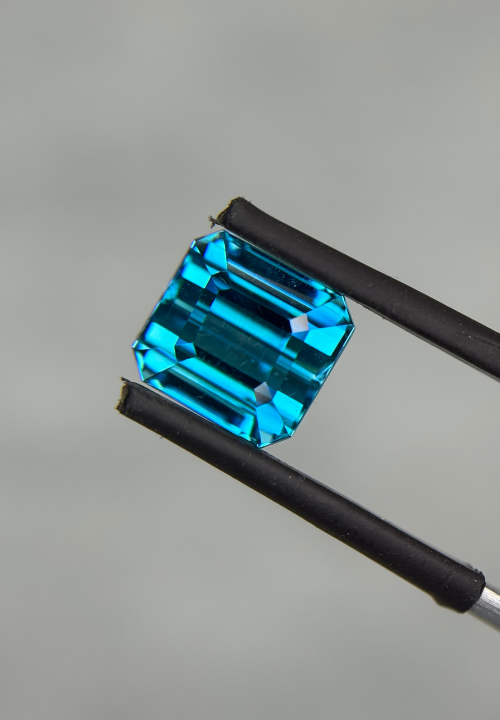
Blue tourmaline existed long before Paraíba entered the gem market. Within tourmaline’s enormous colour range, indicolite is the name traditionally associated with its blue side: from violetish blue through blue to greenish blue.
Its character does not depend on looking electric. Indicolite can be deeper, quieter and more atmospheric, showing another way tourmaline can carry blue.
Tourmaline had a blue story long before the world learned the name Paraíba.
What Exactly Is Indicolite?
Indicolite is not a separate mineral species. It is a colour-based variety or trade name used for blue tourmaline, including dark violetish blue, blue and greenish blue material. A gemstone described as indicolite may belong mineralogically to a species such as elbaite while the word indicolite describes its gem colour identity.
Indicolite tells us which side of tourmaline’s colour world we are looking at—not a separate mineral identity.
Indicolite Is Not One Exact Blue
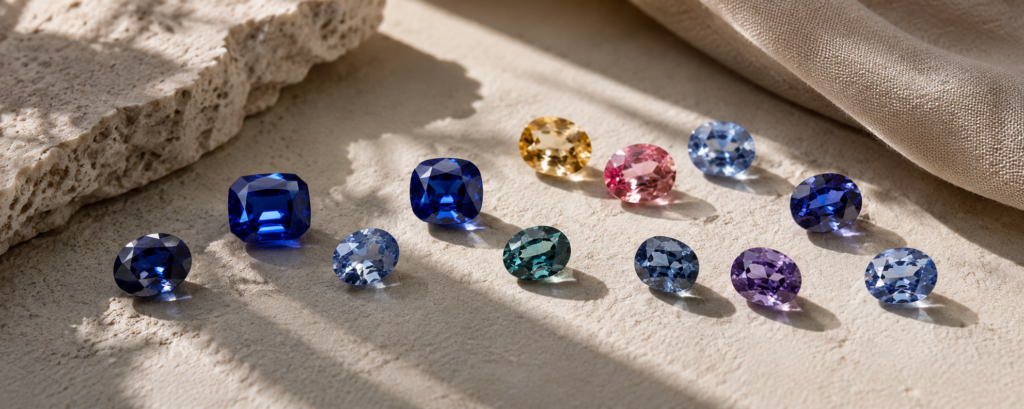
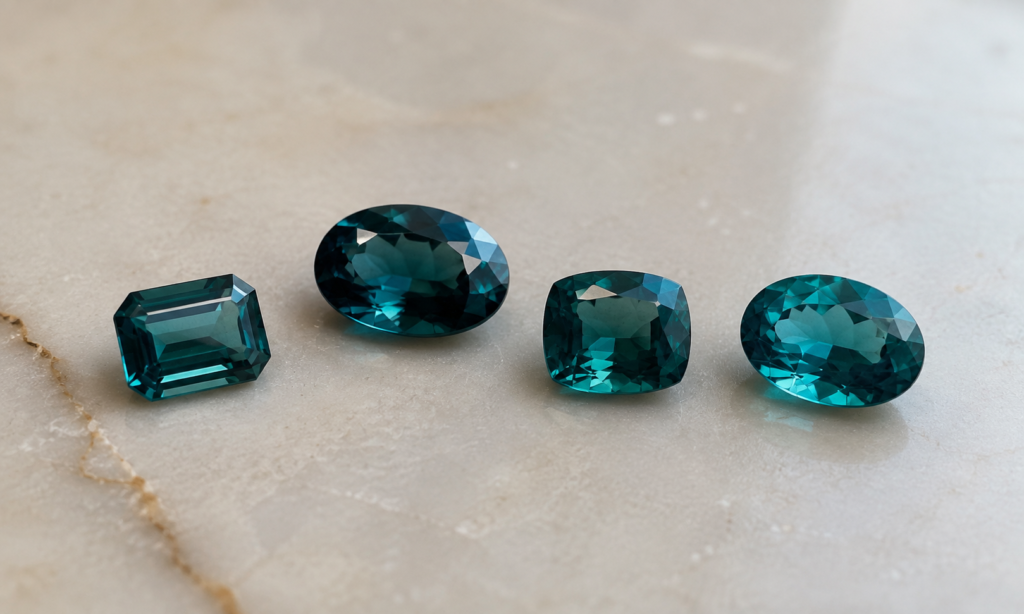
The name does not refer to one fixed colour swatch. One indicolite may lean slightly violetish, another may appear more straightforwardly blue, while another carries a noticeable green component.
Tone can vary too. Some stones are relatively open and bright; others are considerably deeper.
Indicolite is a blue family, not a single blue swatch.
Where Does the Blue Come From?
Iron is central to the colour story of traditional indicolite. Iron-related absorption can produce blue and blue-green appearances in tourmaline, distinguishing this colour mechanism from the copper-dominant story associated with Paraíba tourmaline.
Indicolite and Paraíba can both belong to blue tourmaline, while reaching blue through different chemistry.
Iron Can Create More Than One Kind of Blue
It would be too simple to say that iron merely switches tourmaline blue. Different iron states and interactions with other elements can influence whether a stone leans blue or green and how strongly it absorbs light.
The result is a continuum of blue and blue-green appearances rather than one predictable colour every time iron is present.
Iron does not simply switch tourmaline “blue.” Its chemical relationships help shape which blue we eventually see.
Why Does Indicolite Often Feel Deeper Than Paraíba?
Fine Paraíba became famous for highly saturated colour combined with unusual brightness and relatively light-to-medium tone. Iron-related blue tourmaline can occupy a different visual territory, sometimes becoming deeper, darker or more subdued.
This is a tendency rather than a rule. Indicolite does not need to imitate Paraíba to be distinctive.
Indicolite does not need Paraíba’s electricity. Its blue can have depth instead of voltage.
Green Is Often Part of the Indicolite Story
Greenish blue belongs comfortably within established descriptions of indicolite. Blue and green do not meet at one rigid border in tourmaline, and a green modifier does not automatically make a blue tourmaline less interesting.
A touch of green does not necessarily pull an indicolite away from its identity. Sometimes it is part of that identity.
Pleochroism Changes the Blue as You Move the Stone
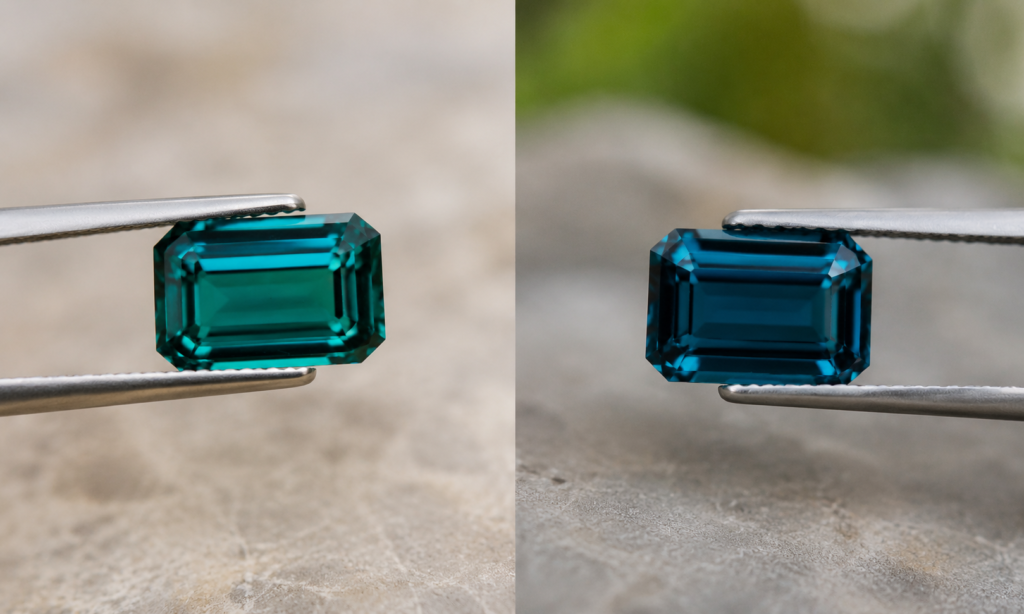
Tourmaline is strongly pleochroic, meaning colour and intensity can differ when the crystal is viewed along different optical directions. In indicolite, one direction may appear greener while another appears deeper, bluer or more violetish.
The gemstone therefore contains more visual complexity than a single face-up colour name suggests.
An indicolite does not contain only one visual blue. Direction can reveal another side of the colour already inside it.
Why Can Some Indicolite Look Almost Too Dark?
Strong absorption and pleochroism can make some blue tourmaline extremely dark along particular crystal directions. A stone may hold rich blue colour yet lose much of its visual appeal if large areas become nearly black face-up.
The goal is therefore not simply to find the deepest possible blue, but to retain enough returning light for the blue to remain visible.
Deep blue becomes interesting only while there is still enough light left inside it to see the blue.
Cutting Indicolite Is Really About Managing Direction
Because colour changes with crystal direction, the cutter has to choose orientation as carefully as shape. Pale rough may be oriented to strengthen face-up colour, while dark rough may need the opposite strategy to keep the finished stone open.
Carat retention, proportions, darkness and pleochroism all become part of the same decision.
The cutter does not merely shape an indicolite. The cutter chooses which direction of its blue will become the face of the gemstone.
Why Are Rectangular Indicolites So Common?
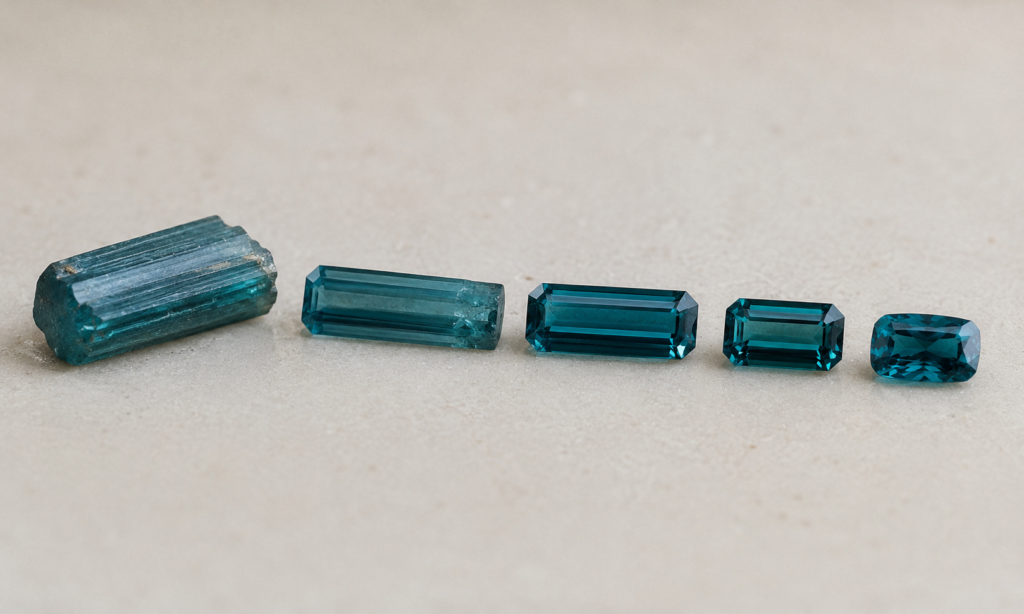
Tourmaline commonly grows as elongated prismatic crystals. Long rectangles, step cuts, elongated cushions and ovals can follow that natural habit efficiently, although the final choice still has to work with the stone’s colour orientation rather than yield alone.
The long shape often begins with the crystal. The final proportions begin with the cutter.
Indicolite and Paraíba Can Sometimes Look Closer Than Expected
The convenient picture of Paraíba as bright cyan and indicolite as dark blue is not always reliable. Some copper-dominant and iron-dominant blue-green tourmalines can overlap visually, especially when their tone and saturation are not extreme.
Not every bright blue tourmaline is Paraíba, and not every iron-coloured blue tourmaline has to look dark.
So How Can Gemology Explain the Difference?
When appearance overlaps, spectroscopy and chemical analysis can help reveal which elements dominate the colour mechanism. Copper-related absorption supports the Paraíba story, while iron-related absorption is characteristic of traditional indicolite-type blue.
Some stones can contain contributions from more than one colouring element, so laboratory interpretation is more reliable than trying to identify chemistry from colour alone.
Colour tells us what the stone looks like. Spectroscopy can help explain why it looks that way.
Does Indicolite Need to Be Pure Blue to Be Beautiful?
There is no need to rank every greenish modifier as a flaw. A slightly violetish blue can feel cool and deep; a greenish blue can feel oceanic; a darker blue can be dramatic; a medium blue may feel more open.
The useful question is how the colours work together in the individual gemstone.
The question is not how completely green disappears. It is whether blue and green make sense together in that particular stone.
How Should You Look at an Indicolite?
Begin with the character of the blue rather than asking whether it is blue enough. Notice green or violet modifiers, overall tone, dark extinction and whether the stone remains open under ordinary indoor light. Then consider how pleochroism and cutting orientation affect what appears face-up.
Gemological naming, treatment information and origin can add context afterwards when relevant.
Do not ask only how blue an indicolite is. Ask what kind of blue it becomes when light enters it.
Blue Without Electricity
Paraíba changed the modern image of blue tourmaline through electric copper-related colour. Indicolite belongs to another blue language: sometimes deeper, sometimes greener, sometimes slightly violetish and strongly influenced by direction.
Its value as a gemstone does not depend on becoming a substitute for Paraíba. Indicolite already has a visual identity of its own.
Paraíba showed the world how electric blue tourmaline could become. Indicolite reminds us how deep blue tourmaline can already be.