

Mention emerald and most people think first of Colombia, Zambia or perhaps Brazil. Nigeria is far less likely to appear in the same conversation, even though emerald and green beryl have been documented there for decades.
That makes Nigeria interesting for a different reason. It is not a newly discovered emerald country. It is an established gemstone-producing country whose emerald story remains comparatively unfamiliar—and whose beryl geology is still producing new material worth studying.
Nigeria is not new to emerald. What is new is how much attention the origin may be beginning to receive.
Nigeria Was Already a Gemstone Country
Emerald belongs to a much larger Nigerian gemstone story. The country is known for tourmaline, aquamarine and other varieties of beryl, alongside sapphire and numerous other gem materials.
Beryl occurs in several Nigerian geological environments, so emerald does not appear as an isolated curiosity. It is part of a country with unusually diverse gemstone mineralisation.
This context matters because an emerald origin does not become important in isolation. Mining knowledge, local trading networks and familiarity with gem-bearing geology all shape what eventually reaches the international market.
Nigerian Emerald Is Older Than the Current Attention Around It
The idea of Nigerian emerald is not new. Blue-green emerald from Nigeria was already being described in gemological literature in the early 1990s, and Nigerian emerald and green beryl have been studied for decades.
What Nigeria has lacked is not evidence of emerald, but the sustained international visibility associated with the largest established origins.
Nigerian emerald is not a new discovery. It is an old gemological story entering a new period of attention.
Where Does Nigerian Emerald Come From?
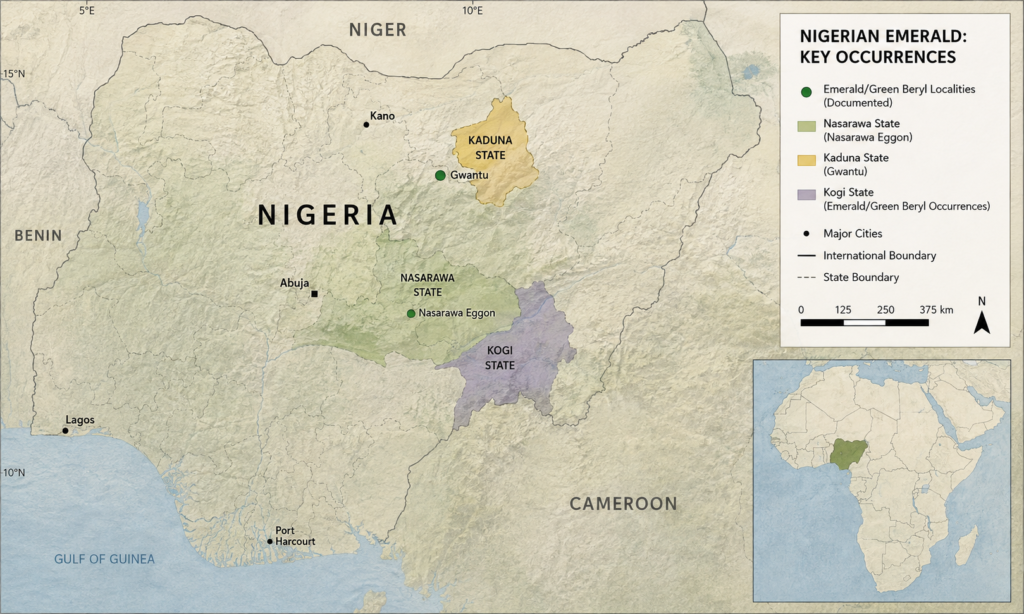
Emerald and green beryl occurrences have been reported from several parts of Nigeria, particularly in the central region. Areas associated with documented material include Nasarawa and Kaduna states, with other occurrences reported elsewhere.
Names such as Nasarawa Eggon and Gwantu appear in the gemological record, but it is important to separate the existence of an emerald occurrence from a deposit capable of supplying consistent quantities of facetable material.
Finding emerald in the ground and building an emerald market are two very different things.
Nigeria Adds Another Geological Route to Emerald
Nigeria is also interesting because some of its emerald geology differs from the better-known stories of Colombia, Zambia and Brazil.
Gemological research has described emerald associated with unusual granite-related geological environments in central Nigeria, including metasomatic alteration connected with alkaline granite systems. This adds another example of the different geological pathways capable of bringing beryllium together with the elements needed to create emerald colour.
Nigeria adds another geological route to the same green gemstone.
The Jos Ring Complex Makes the Story More Unusual
Central Nigeria is known for the Younger Granite complexes of the Jos Plateau region. These granite systems and related alteration processes are associated with a wide range of mineralisation.
For an emerald reader, the important point is not the technical terminology but the diversity of formation environments. Colombia’s famous emerald story is tied to black shale and hydrothermal fluids; Zambia’s to reaction zones in metamorphic rocks; Nigerian occurrences show that emerald can emerge through yet another geological setting.
What About the Bluish-Green Colour?
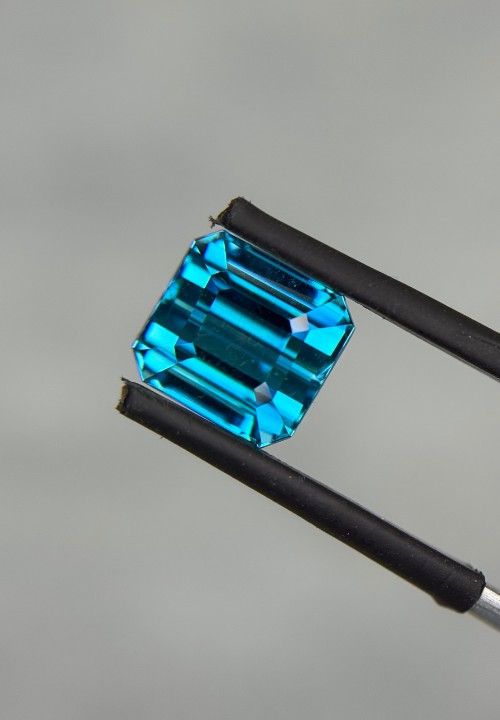
One of the more memorable characteristics documented in Nigerian material is a blue-green to bluish-green appearance. Gemological literature has described blue-green emerald from locations such as Gwantu in Kaduna State.
Iron can contribute to this cooler component of colour, alongside the chromium and vanadium associated with emerald’s green. This helps explain why some Nigerian stones can appear distinctly cool or blue-green.
But the wording matters: some Nigerian emeralds. The country does not produce one compulsory colour.
Bluish green may be one of Nigerian emerald’s most recognisable characters—but it is not a passport every Nigerian emerald must carry.
Why Can Iron Push the Green Toward Blue?
Emerald colour is created by the way trace elements interact with light inside beryl. Chromium and vanadium are strongly associated with emerald green, while iron can modify the resulting appearance and contribute to cooler or more bluish character in some material.
The same general principle helps explain why bluish-green emerald is not exclusive to Nigeria. Other origins, including Zambia, can also produce cooler greens influenced by their chemistry.
Chemistry can help explain a colour character. It does not turn that character into a reliable geographic label.
Nigeria Does Not Have One Colour
Documented Nigerian beryl covers a broader range than blue-green alone. Material may appear light green, mint-like, green or blue-green, and not every green beryl crystal should automatically be called emerald.
That distinction has become especially relevant with newer Nigerian discoveries.
Nigeria produces green beryl as well as emerald, and the boundary between the names should not be decided by geography alone.
Emerald or Green Beryl?
Emerald and green beryl belong to the same mineral species: beryl. The difference lies in how the green colour is interpreted within gemological nomenclature and convention.
A green crystal from an emerald-producing country does not become emerald simply because of its passport. Colour character and gemological identification still matter.
A green crystal from an emerald-producing country is not automatically an emerald.
2024 — A New Find Brings Nigeria Back Into the Conversation
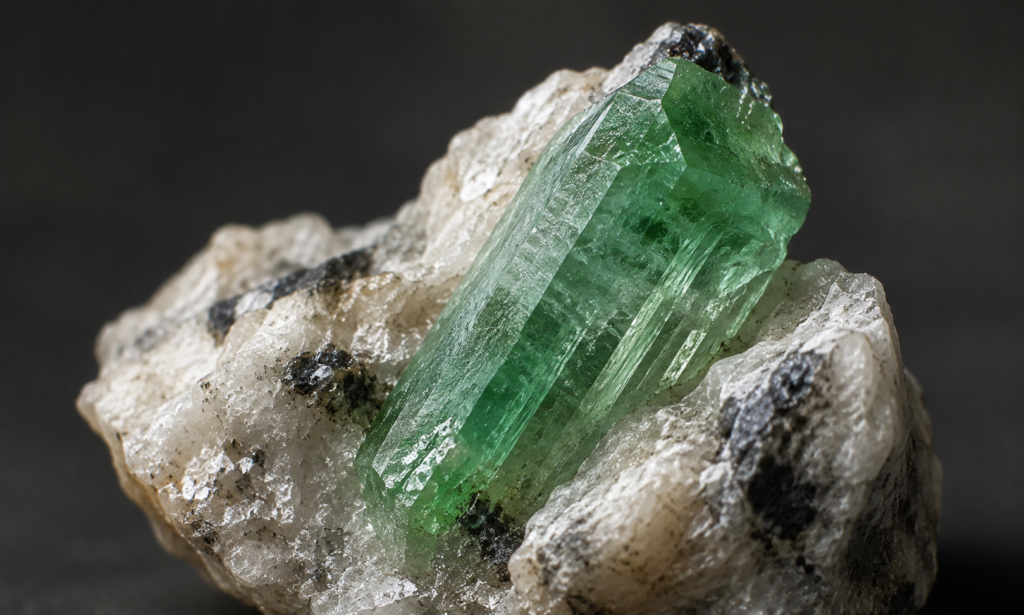
A particularly interesting recent development came from Nasarawa Eggon, where new green beryl material was discovered in 2024 and subsequently examined by GIA.
The material attracted attention for concentrated green colour zoning near parts of the crystals. Analytical work detected iron together with trace vanadium and chromium in the greener zones.
Importantly, the material was reported as green beryl, not automatically as emerald. That distinction makes the discovery more educational, not less important.
The newest Nigerian discovery is not important because it proves a new emerald boom. It is important because it reminds the gem world that Nigeria’s beryl story is still developing.
New Discovery Does Not Mean New Emerald Powerhouse
A new find can generate excitement very quickly, but an important international origin requires more than an interesting pocket of material.
Questions of reserve size, consistency, facetable yield, future production and market acceptance take time to answer. Earlier gemological reporting has also noted the comparatively limited supply of facet-grade Nigerian emerald.
A new pocket can create excitement. A major origin requires sustained production.
Nigeria Is Almost the Opposite of Zambia
Nigeria and Zambia are both African gemstone-producing countries, but their modern emerald industries tell very different stories.
Zambia became known for large-scale, mechanised production, particularly through Kafubu and Kagem, and developed a highly visible international supply system.
Nigeria’s emerald story is more fragmented: multiple occurrences, smaller-scale gemstone activity, limited facet-grade supply and a less established international emerald identity.
Geography may place Nigeria and Zambia on the same continent. Their emerald industries tell very different stories.
Small-Scale Mining Is Part of the Nigerian Gemstone Story
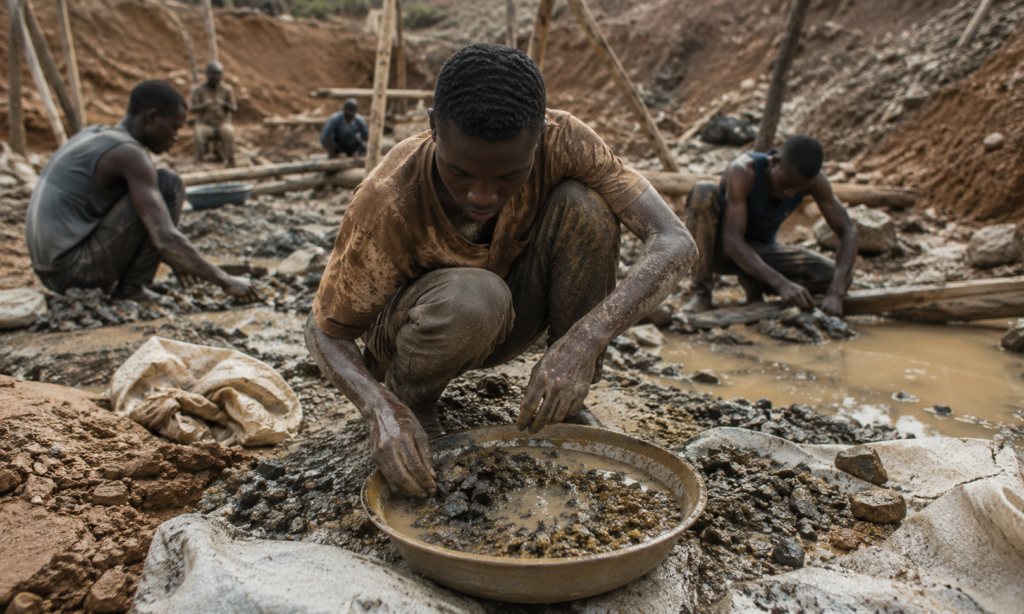
Artisanal and small-scale mining plays an important role in Nigeria’s broader gemstone sector. Local miners, dealers and regional trading networks can form a very different supply chain from the vertically organised systems associated with major industrial mines.
That difference affects how material is discovered, accumulated, documented and eventually introduced to international buyers. It should not be treated automatically as better or worse—only as a different structure.
Why Haven’t We Heard More About Nigerian Emerald?
Fame in the gemstone world requires more than the existence of beautiful crystals. Consistent facet-grade production, international distribution, documentation, trade relationships and decades of market visibility all contribute to the reputation of an origin.
Colombia accumulated centuries of emerald history. Zambia developed major industrial production. Brazil built several decades of recognised commercial supply.
Nigeria has not yet developed the same emerald ecosystem at comparable scale.
A gemstone origin becomes famous not only by producing beautiful stones, but by producing enough of them for the world to remember the name.
Could Nigerian Emerald Become More Important?
Possibly—but there is not yet enough evidence to predict how large its future role will become.
Nigeria has documented emerald, unusual geology, a major broader gemstone sector, historically reported blue-green material and continuing beryl discoveries. What remains uncertain is whether future production will provide consistent volumes of fine facetable emerald capable of building a larger international market.
Potential is not the same as production.
The Market Has Seen This Before
Gemstone reputations can change. Zambia was once far less prominent in the international emerald imagination than it is today. Brazilian emerald also had to overcome an older reputation dominated by commercial-grade production.
In both cases, sustained supply, fine material, documentation and market experience gradually changed perception.
Nigeria could follow its own path, but the stones themselves—and their consistency over time—will have to establish that reputation.
Origins do not become important because the market predicts them. They become important because the stones keep arriving.
Nigerian Origin Does Not Make an Emerald Better—or Worse
An unfamiliar origin should not be treated as a disadvantage. If a Nigerian emerald has beautiful colour, attractive transparency, a suitable cut and acceptable treatment, the absence of a famous country name does not diminish those qualities.
The reverse is equally important. Novelty should not become a substitute for quality. A stone should not command enthusiasm merely because its origin sounds new, unusual or potentially rare.
An unfamiliar origin is not a flaw. A fashionable origin is not a guarantee.
Can You Recognise Nigerian Emerald by Its Blue Tone?
No. The blue-green character documented in some Nigerian emerald is interesting, but it is not exclusive to Nigeria and it is not present in every Nigerian stone.
Other origins can produce bluish-green emerald, while Nigerian material itself can span different shades of green.
When geographic origin matters commercially, colour alone cannot establish it. A qualified gemological laboratory must evaluate the available evidence.
Colour can suggest a character. It cannot certify a country.
What Does “Origin: Nigeria” Actually Tell You?
A laboratory conclusion of Nigerian origin tells you where the emerald is believed to have formed. It does not automatically identify a particular mine or locality such as Nasarawa Eggon or Gwantu.
Nor does Nigeria automatically mean bluish green, fine quality, untreated, eye-clean, rare or investment grade.
Nigeria tells you where the emerald formed. The gemstone itself tells you what that formation produced.
Why Nigerian Emerald Is Worth Watching
Nigeria is worth watching not because it must become the next Colombia or Zambia, but because it demonstrates that the geography of emerald is still broader than the handful of origins most buyers know.
Less familiar regions can contain unusual geology, distinctive material and discoveries that force the gem world to reconsider what it thought it already understood.
For collectors and gemstone enthusiasts, that continuing process of discovery may be more interesting than trying to predict which origin will become fashionable next.
A New Chapter, Not a New Beginning
Nigeria’s emerald story did not begin with the latest discovery. Blue-green Nigerian emerald has appeared in gemological literature for decades, and several occurrences were known long before the current attention surrounding Nigerian beryl.
The 2024 Nasarawa Eggon green beryl discovery is therefore better understood as another chapter rather than a beginning. It is a reminder that Nigerian geology continues to produce material capable of attracting international gemological interest.
Whether Nigeria eventually becomes a larger source of fine emerald remains an open question. That uncertainty is part of what makes the origin worth following.
Nigeria is not entering the emerald story for the first time. It is reminding us that the story of emerald origins is still being written.