
Jewelry design often begins with a familiar outline and then searches for a gemstone that fits it. Tourmaline can invite the opposite approach. Its elongated crystals, unusual proportions, strong pleochroism and dramatic colour zoning can produce finished stones that were individual long before a jeweller began sketching around them.
Sometimes the design begins with a sketch. Sometimes it begins with a gemstone that refuses to fit the sketch.
Why Tourmaline Naturally Creates Unusual Gemstones
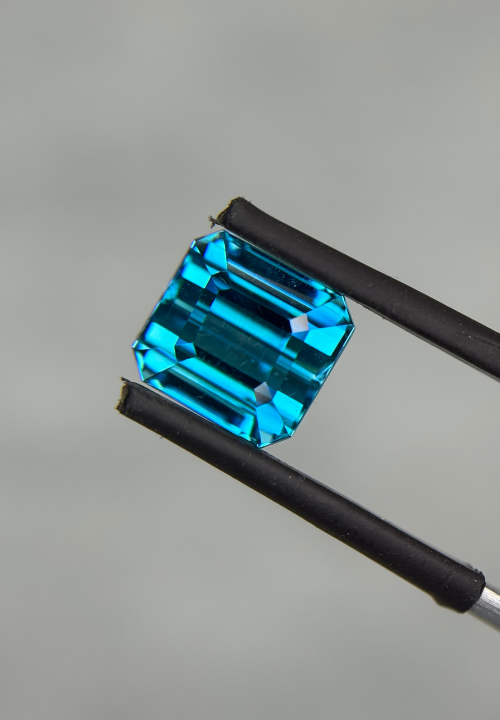
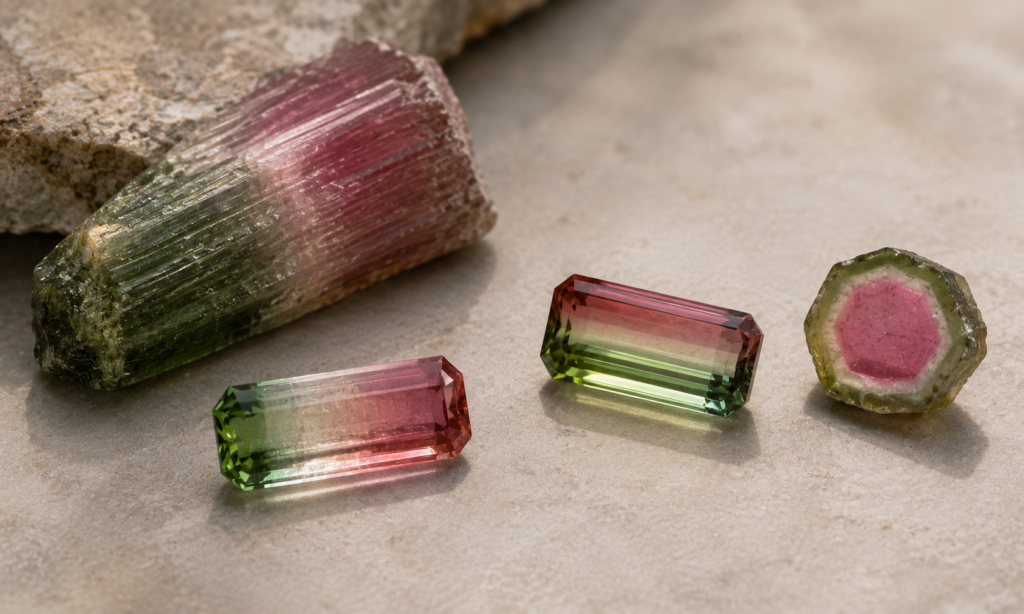
Tourmaline commonly grows as elongated prismatic crystals. That natural habit can lead cutters toward long rectangles, elongated cushions, narrow emerald cuts, long ovals and other non-standard proportions. Colour zoning can make the possibilities even more individual.
The unusual shape does not necessarily begin with the designer. It may begin with the crystal itself.
Why Not Cut Every Tourmaline Into a Standard Shape?
A calibrated size is convenient for repeatable jewelry, but forcing a long crystal into a standard outline can sacrifice substantial material. Following the rough more closely can preserve weight and create proportions that make better use of the original crystal. Yield is not the only concern: colour direction can also influence which shape and orientation make sense.
A standard shape may be convenient for jewelry. It is not always the shape that makes the most sense for the gemstone.
The Cutter Is Already Designing With the Stone
Tourmaline is strongly pleochroic, so colour and darkness can change with viewing direction. A crystal may appear relatively open in one direction and considerably darker in another. The cutter therefore considers orientation, depth, shape and proportion together rather than treating outline as an independent decision.
Long before a ring is designed around a tourmaline, the cutter has already designed around its colour.
Sometimes the Colour Determines the Shape
Bi-colour, tri-colour and watermelon tourmalines make this especially visible. Cutting can be chosen to preserve a transition between colours or reveal a particular zoning pattern. Watermelon crystals, for example, can be sliced across their growth direction to display a pink interior surrounded by green.
When colour has a direction, the cut often follows it.
This Is Where Jewelry Design Has a Choice
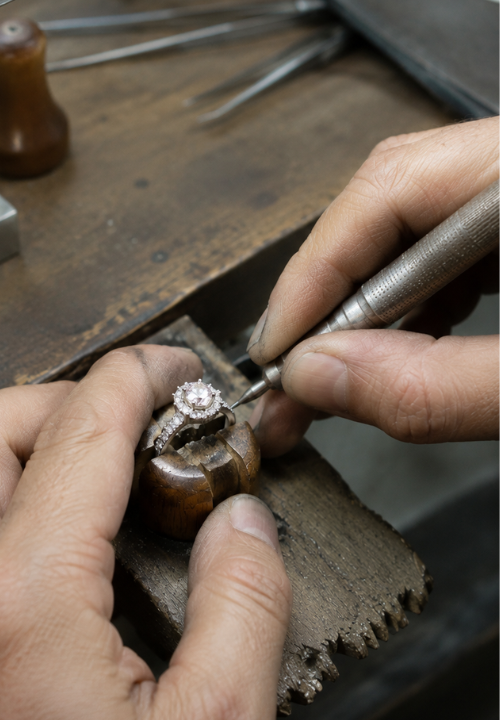
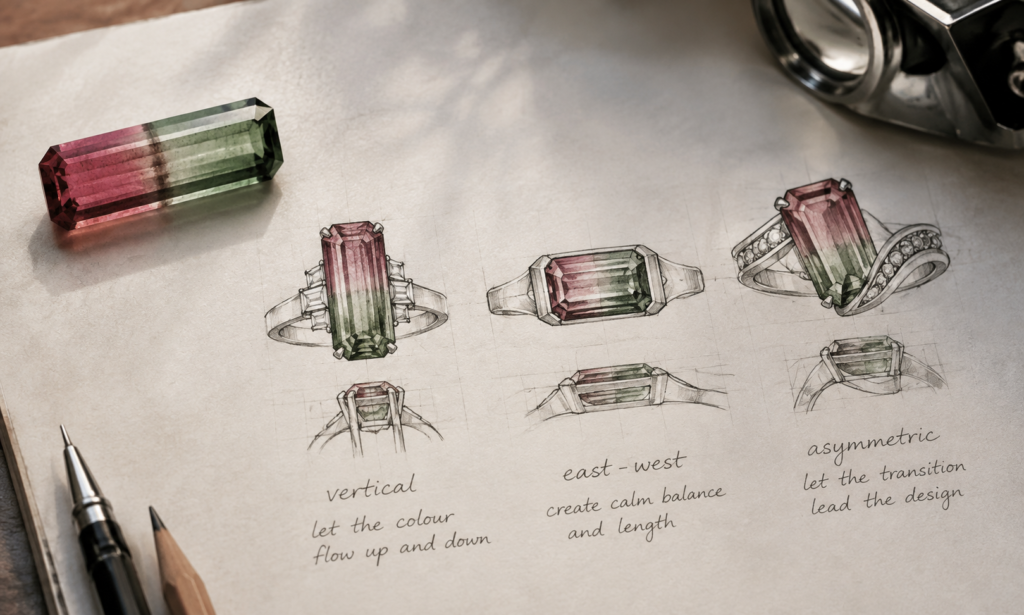
Once an unusually proportioned tourmaline reaches the jeweller, there are two broad approaches: make the gemstone conform as closely as possible to an existing design, or allow the design to respond to the gemstone. A long stone can establish a strong vertical or horizontal line. A bi-colour stone can make its transition the centre of the composition. An asymmetric outline can become deliberate asymmetry rather than something to disguise.
The question changes from “How do we fit the stone?” to “How do we continue what the stone has already started?”
An Unusual Proportion Can Become the Design
Imagine a tourmaline measuring roughly 15 × 5 mm. Within a calibrated system it may seem inconveniently narrow. In a stone-first design, the same proportion might become a long north–south ring, an east–west architectural composition, or a slender pendant. Non-standard dimensions can make a custom mounting a practical response rather than decoration for its own sake.
A proportion becomes awkward only when we insist that it should have been something else.
Colour Zoning Can Become Part of the Composition
With a bi-colour stone, the designer can decide how the colour transition should sit within the finished piece. It might run vertically, horizontally or at an angle. Metal, side stones and negative space can support that transition rather than competing with it. There is no universal rule that one tourmaline colour requires one particular metal.
Colour zoning does not have to be corrected. It can become the composition.
Asymmetry Does Not Always Need to Be Hidden
A colour boundary may be angled, an outline may be slightly irregular, or visual weight may sit more strongly on one side. Custom design can acknowledge those characteristics through directional metal lines, unequal negative space or deliberately different side details.
When the gemstone is asymmetric, symmetry becomes a choice—not an obligation.
The Setting Should Protect the Stone Without Hiding Its Character
Tourmaline has a Mohs hardness of about 7 to 7.5 and is used successfully in jewelry, but unusual shapes still require thoughtful setting. Sharp corners, narrow ends, large dimensions and exposed edges may influence prong position, bezel coverage, structural support and everyday wearability. Protection should not become so visually heavy that it unnecessarily hides the zoning or proportion that made the stone interesting.
A good setting should make the gemstone safer without making it less itself.
Designing Around the Stone Does Not Mean Saying Yes to Everything
Stone-first design is not permission to ignore engineering. Structural strength, security, balance, finger clearance, comfort and manufacturing limits can require compromises. Sometimes an idea that looks beautiful in a sketch is not the safest way to carry a particular gemstone.
Respecting the stone does not mean ignoring the jewelry that has to carry it.
Why One-of-a-Kind Stones Naturally Lead to Custom Jewelry
Repeatable jewelry works most easily with repeatable dimensions. A setting built around a standard 6 × 8 mm oval can be used again. A 13.8 × 6.1 mm tourmaline with a particular colour transition may never have an exact replacement. In that situation, custom jewelry is a logical response to a gemstone that is itself difficult to repeat.
When the gemstone cannot be repeated, the design around it naturally becomes less repeatable too.
One Stone Can Still Become Many Different Designs
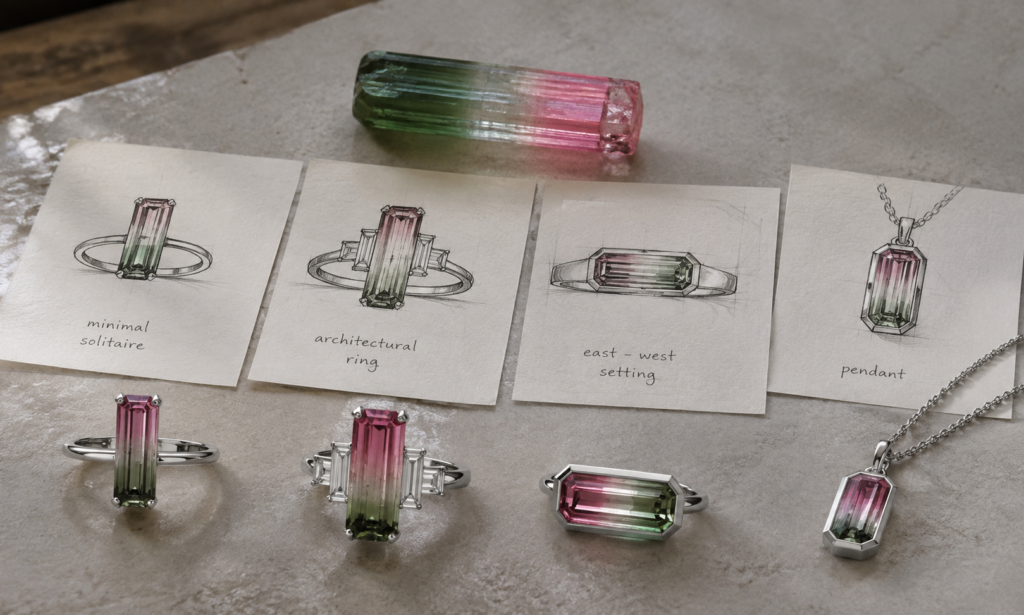
Designing around a gemstone does not mean that nature has already chosen one finished piece. The same tourmaline might become a minimal solitaire, an architectural ring, an east–west setting, a pendant or an asymmetric composition. The stone supplies constraints and opportunities; the designer still decides what to do with them.
Designing around the stone does not mean the stone gives us one answer. It gives us the right questions.
What Should You Notice Before Designing Around a Tourmaline?
Before choosing a setting, look carefully at the stone itself. Notice its dominant proportion, where the colours sit, whether zoning has a direction, which areas appear open or dark, and how the character changes when the stone is rotated. Consider its scale on the body and identify corners or narrow points that may need protection.
Before deciding what the jewelry should look like, understand what the gemstone already looks like.
The Most Interesting Design May Already Be in the Stone
By the time a tourmaline reaches a jeweller, crystal growth, chemistry and cutting have already made many visual decisions. Jewelry design does not always need to add more character. Sometimes its role is to recognise the character that is already present and give it a structure in which it can work.
The most individual piece of jewelry does not always begin with the most complicated design. Sometimes it begins by listening carefully to an unusual gemstone.
Stone First
Tourmaline can be long, narrow, multi-coloured, asymmetric, deep or simply unexpected. Those qualities do not always need to be corrected until the gemstone resembles a standard calibrated stone. Sometimes they are precisely what gives the finished piece its direction.
Designing around a one-of-a-kind tourmaline is not about forcing a gemstone into an idea. It is about discovering the idea the gemstone makes possible.