
Blue tourmaline existed long before Paraíba entered the gem market. Green tourmaline did too. What surprised the gem world in the late 1980s was not the discovery that tourmaline could be blue or green, but the unusual intensity and brightness of the new material from Paraíba, Brazil.
Paraíba did not introduce blue to tourmaline. It introduced a different experience of blue.
The Story Began in Paraíba, Brazil
The name began with copper-bearing tourmaline discovered in the Brazilian state of Paraíba and introduced internationally around 1989. Early gemological study showed unusually significant copper in the material, revealing a colouring mechanism not previously recognised as characteristic of gem tourmaline.
The discovery was not simply a new deposit. It revealed a new colour mechanism within gem tourmaline.
Copper Is the Key to the Paraíba Colour Story
Copper is central to the vivid blue-to-green colour system associated with Paraíba tourmaline. This differs from many traditional blue tourmalines, often called indicolite, whose blue colour is commonly associated with iron.
Two tourmalines can both be blue while arriving at blue through different chemistry.
Copper Alone Is Not the Whole Story
Finding copper does not automatically turn every tourmaline into Paraíba. Trace amounts can occur without producing the characteristic appearance. Concentration, manganese, iron and the broader absorption system influence the final colour. Modern definitions therefore consider appropriate colour together with copper-and-manganese-related chemistry.
Copper opens the door to Paraíba colour. The rest of the chemistry helps decide what walks through it.
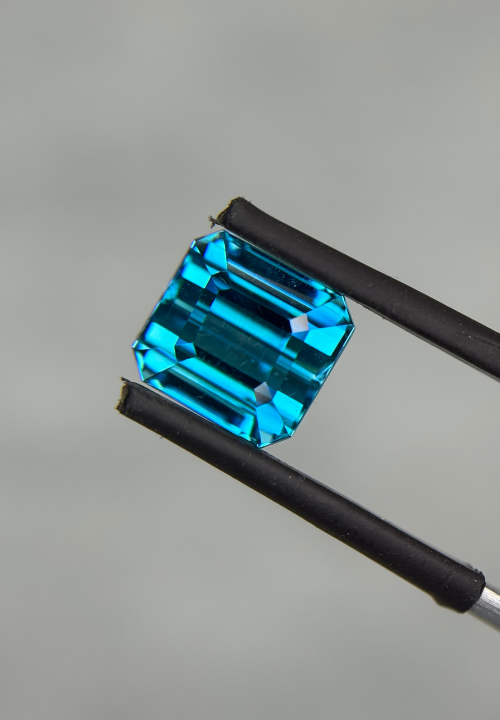
Why Does Paraíba Often Look “Neon” or “Electric”?
Words such as neon, electric and glowing are descriptive trade language rather than literal statements that the gemstone produces its own light. Fine Paraíba material can combine strong saturation with considerable brightness and a light-to-medium tone, allowing strong colour without necessarily appearing visually heavy or dark.
Paraíba can hold strong colour without always becoming visually heavy.
Brightness Is Not the Same as Fluorescence
When someone says a Paraíba seems to glow, they are usually describing the visual character of its bodycolour, not necessarily fluorescence, phosphorescence or a gemstone that emits visible light in darkness.
Paraíba does not need to produce light to look luminous. Its colour can create that impression on its own.
Paraíba Is Not One Exact Shade of Blue
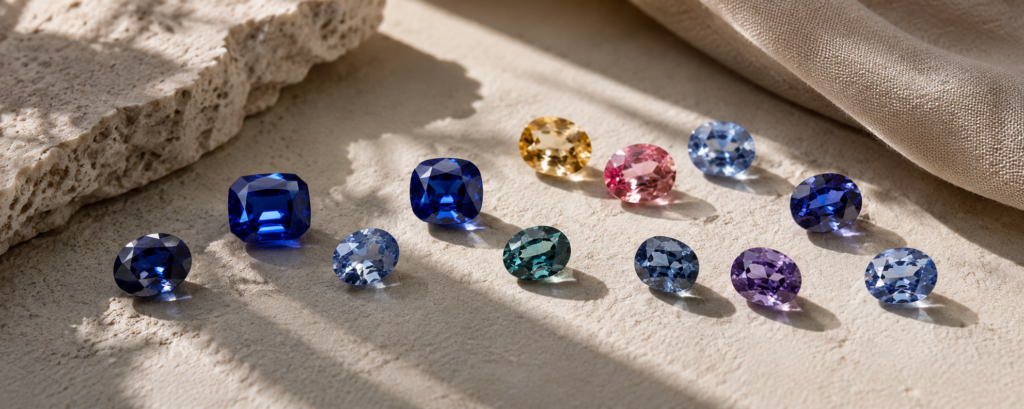
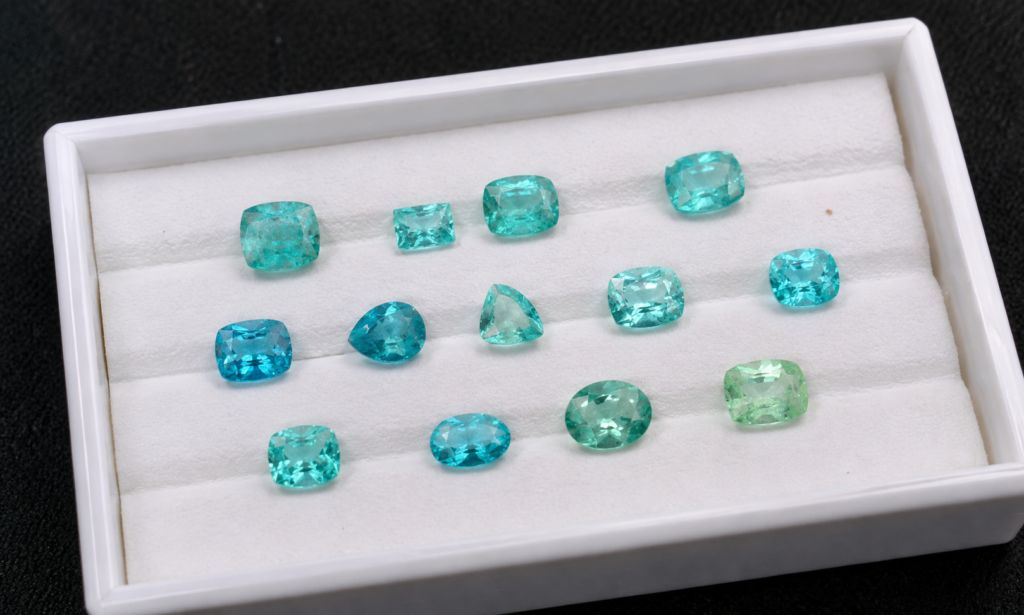
The recognised Paraíba colour family extends beyond the turquoise or cyan blue most commonly pictured online. Depending on the laboratory framework, qualifying material can include vivid blues, greenish blues, bluish greens and greens. Laboratories do not all apply identical reporting boundaries.
Paraíba is a colour family, not a single colour swatch.
Then What Is “Neon Blue”?
Neon blue is widely used to communicate an impression of intense, bright blue or cyan colour. It is useful descriptive language, but it is not a universal laboratory colour grade. Terms such as electric, neon and turquoise developed because ordinary colour words struggled to communicate how unusual fine copper-bearing tourmalines appeared.
“Neon” describes an impression. It is not a laboratory colour grade.
Paraíba Can Be Green Too
Blue created the strongest public image of Paraíba, but copper-bearing Paraíba tourmaline can also occupy greenish-blue, bluish-green and green territory. Green should not automatically be treated as an imitation of the blue ideal.
Blue may be the colour that made Paraíba famous. It is not the only colour in the Paraíba story.
What Role Does Manganese Play?
Manganese adds another layer to the colour system. In some copper-bearing rough, manganese-related absorption can contribute purple, violet or reddish components that partly mask copper-related blue and green. Heating can reduce some of those components, allowing blue or green to become visually stronger.
Sometimes heating does not create the copper colour. It removes another colour that was competing with it.
Why Is Heat Treatment Common in Paraíba Tourmaline?
Heating is common in copper-bearing tourmaline and can shift purplish or violet material toward blue or green appearances. It changes the colour balance; it does not add copper to a stone that lacked copper in the first place. An important limitation is that such heating cannot always be conclusively detected.
Heating can modify the colour balance. It does not put copper into a stone that never had it.
Brazil Is Where the Name Began — Not Where the Story Ended
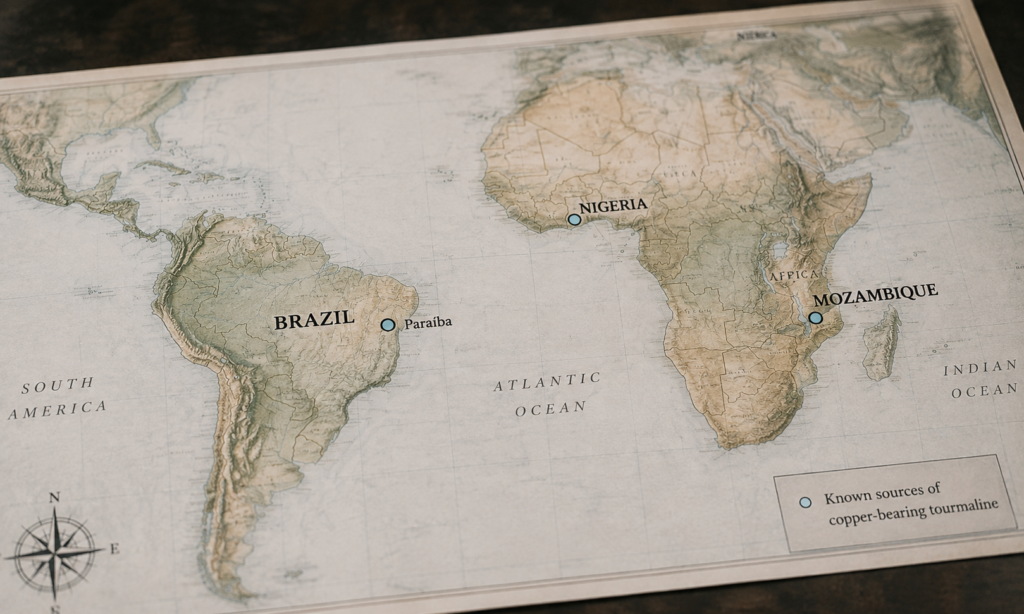
After the Brazilian discoveries, significant copper-bearing tourmaline was also found in Nigeria and Mozambique. Material from these origins can overlap strongly in colour and conventional gemological properties, so appearance alone cannot reliably determine country of origin. Advanced trace-element analysis may be required.
Colour can suggest a Paraíba character. It cannot reliably tell you which country the crystal came from.
So Does “Paraíba” Mean Brazil?
Historically, the name comes directly from Paraíba, Brazil. In modern gemological and trade usage, the term can be applied to qualifying copper-and-manganese-bearing tourmaline of appropriate colour without restricting the stone to Brazilian origin. Brazilian origin is a separate geographic conclusion requiring its own evidence.
Paraíba can describe a recognised gem variety. Brazil describes geographic origin. They are related, but they are not the same statement.
Can You Identify Paraíba by Colour Alone?
No. A vivid blue or green appearance may suggest the possibility, but other tourmalines can occupy overlapping colour territory. Paraíba identification depends on gemological evidence, including chemical analysis, rather than visual resemblance alone.
A Paraíba-like colour is an appearance. Paraíba identification is a gemological conclusion.
Why Two Paraíba Tourmalines Can Still Look Completely Different
Even qualifying Paraíba tourmalines can differ dramatically. Hue, tone, saturation, clarity, pleochroism, stone thickness and cutting all influence what we see face-up. One stone may appear electric cyan, another greenish blue, another vivid green, and another softer blue-green.
The name Paraíba tells us something important about the gemstone. It does not tell us everything about how beautiful that individual stone will be.
How Should You Look at Paraíba Colour?
Before concentrating on labels such as neon, simply observe the stone. Does the colour remain bright or become visually dark? How do blue and green interact? Does the cut create large dark areas? How does the colour behave in ordinary indoor light? Then gemological information—designation, origin when determined and treatment disclosure—can add context.
See the colour first. Understand the chemistry second. Read the origin third.
[IMAGE PLACEHOLDER — NATURAL-LOOKING GROUP OF THREE OR FOUR PARAÍBA-COLOUR TOURMALINES with different shapes, sizes, tones and blue-green balances under credible neutral lighting; purpose: show that Paraíba is not one Pantone-like colour; avoid perfect colour progression, exaggerated CGI glow and macro inclusion imagery]
Why Paraíba Still Looks Different
Paraíba became famous not simply because it was blue or green. Copper-related colour chemistry allowed tourmaline to display those familiar hues with a combination of saturation, brightness and tone that looked unusually vivid. Words such as electric, neon and glowing followed because people needed language for the impression.
Paraíba became famous because copper gave tourmaline a colour people already knew—blue and green—in a way they had rarely seen before.