
Place several pink-to-red tourmalines beside one another and the problem becomes obvious. A pale pink stone is easily called pink tourmaline. A rich red stone may comfortably be called rubellite. Between them, however, nature offers a continuous range rather than a clearly marked border.
The difficult part about defining rubellite is not defining red. It is deciding where pink stops being pink enough to need another name.
First, Rubellite Is Not a Separate Mineral Species
Rubellite is not a separate mineral species from tourmaline. It is a variety or trade name used primarily for pink-to-red colour character. Mineral species within the tourmaline group are defined through mineral chemistry and structure; names such as rubellite describe how gem material is recognised and discussed in the trade.
Rubellite tells us about the colour character of a tourmaline, not a new mineral identity.
So What Does “Rubellite” Actually Mean?
This is where the terminology becomes less precise than many buyers expect. GIA describes rubellite broadly across pink, red, purplish red, orangy red and brownish red tourmaline, while also acknowledging that some members of the trade argue that pink material should not be included. Other gemological references use the term more narrowly for red tourmaline and recognise that the pink-to-red boundary can be disputed.
Rubellite has a recognised meaning, but not a universally agreed colour border.
Why Do Many People Reserve Rubellite for Stronger Colour?
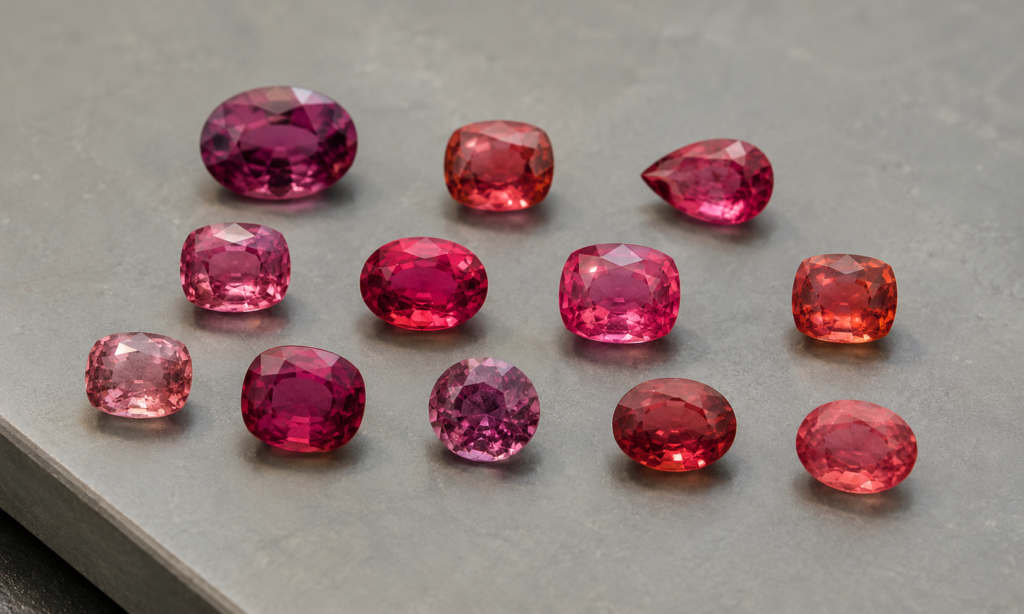
In practical trade language, rubellite is often associated with the richer, more saturated end of the pink-to-red tourmaline spectrum. Pale and softer pinks are more naturally described as pink tourmaline, while strong pink-red, raspberry and red appearances are more likely to attract the rubellite name.
This is a tendency in naming, not a universal laboratory threshold.
The deeper and more saturated the pink-to-red colour becomes, the more naturally the trade tends to reach for the name rubellite.
Rubellite Does Not Have to Be Pure Red
Rubellite should not be imagined as tourmaline that successfully imitates one exact ruby red. Its recognised colour territory can include raspberry, purplish red, rich pink-red, warmer orangy red and other related appearances.
Rubellite is not tourmaline trying to become ruby. It has its own red family.
Manganese Is Central to the Pink-and-Red Story
Manganese is an important part of the chemistry behind pink and red colour in tourmaline, while colour centres associated with irradiation can also contribute to some pink-to-red appearances. The important distinction is that chemistry creates the colour first; the name rubellite is a human classification applied to the appearance afterwards.
Chemistry creates the colour. The trade decides what to call that colour.
Why Can Rubellite Be More Included Than Some Other Tourmalines?
Pink-to-red tourmaline commonly tolerates more eye-visible inclusions in the market than many green-to-blue tourmalines because this colour family is often naturally more included. That does not mean rubellite must be included, or that clean material does not exist.
Clarity expectations therefore make more sense when considered alongside colour family and the individual stone rather than applied identically to every tourmaline.
Rubellite can be clean, but the pink-to-red tourmaline family does not always give clarity as freely as some other tourmaline colours.
Strong Colour Can Sometimes Hide Its Own Beauty
A tourmaline can have powerful red saturation yet become so dark that much of its colour is difficult to experience face-up. Fine appearance depends on more than simply pushing colour deeper.
Brightness, tone, transparency, cutting and the distribution of dark areas all affect whether a rich red tourmaline still feels alive with light.
More colour is not always more beauty if the stone becomes too dark to return it.
Cutting Has to Manage Both Colour and Darkness
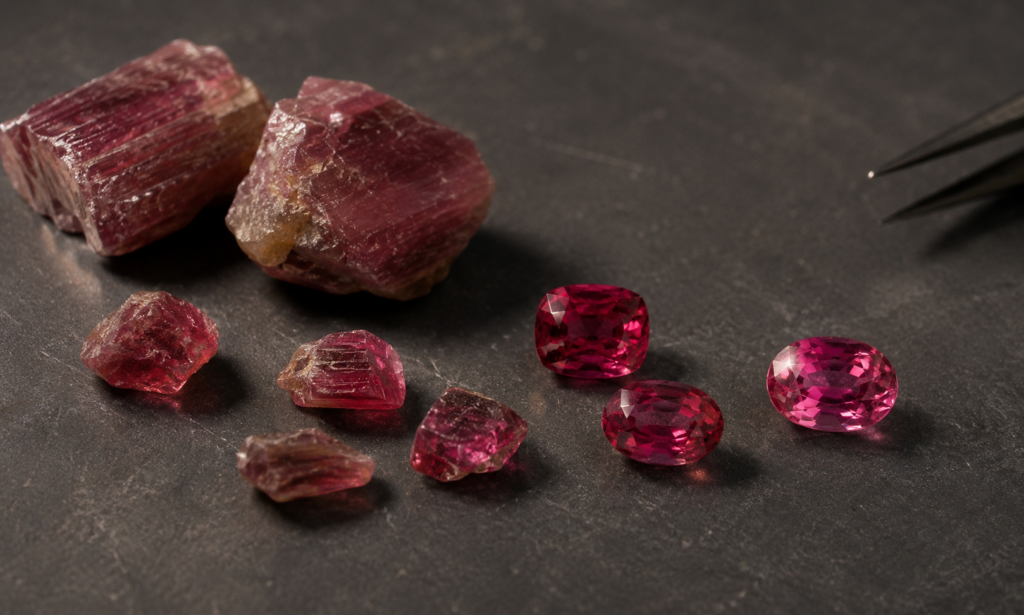
Tourmaline is strongly pleochroic, so colour and intensity vary with crystal direction. For already saturated pink-to-red material, orientation can therefore influence whether the finished stone looks open and bright or excessively dark.
A cutter may sacrifice rough weight while balancing colour, tone, clarity and proportions rather than simply preserving the largest possible finished carat weight.
A cutter may have to sacrifice weight to let a strong red tourmaline remain alive with light.
Can Pink Tourmaline Be Treated to Look Stronger?
Pink tourmaline can be irradiated to increase or modify colour saturation, and such treatment may not always be detectable. Natural radiation can also participate in the formation of some colour centres.
The name rubellite therefore describes colour character; by itself it does not prove that a stone is untreated.
The name rubellite describes colour character. It does not, by itself, certify treatment history.
Does Rubellite Stay Red in Different Lighting?
A claim sometimes repeated online is that a “true” rubellite must remain exactly red under every kind of light. That is not a useful universal diagnostic rule. Like other coloured gemstones, its appearance can respond to illumination, pleochroism, tone, cut and viewing direction.
Rubellite should not be defined by an internet rule that it must look exactly the same under every light.
Is Rubellite More Valuable Than Pink Tourmaline?
Fine rubellite can be highly sought after, and the name is often associated with stronger, richer material. But the word itself does not guarantee quality. A dark, heavily included or poorly cut rubellite can be less visually compelling than a bright, beautifully cut pink tourmaline.
A stronger name cannot rescue a weaker gemstone.
Then When Should We Call a Tourmaline Rubellite?
There is no scientifically fixed saturation percentage at which pink tourmaline suddenly becomes rubellite. The term becomes most useful when a stone sits clearly in the rich, saturated pink-to-red territory associated with rubellite in established trade usage.
When a stone sits close to the uncertain boundary, calling it pink tourmaline can be the clearer description rather than an inferior one.
When the colour sits clearly in rich pink-to-red territory, rubellite becomes a useful name. When the boundary is uncertain, “pink tourmaline” is not a lesser description—it is simply the clearer one.
How Should You Look at Rubellite?
Instead of beginning with the name, look first at the red itself. Is the stone pink-red, raspberry, purplish red, warmer red or another variation? Is the tone open or dark? Does the cut keep the colour lively? Do inclusions interfere with the face-up appearance?
The label can then add context to a gemstone whose individual character you have already seen.
See the red first. Decide what the name contributes second.

A Name Without a Perfect Border
Nature does not grow tourmaline according to trade categories. Pink gradually becomes stronger, redder or more saturated across a continuum, while people create names to make that continuum easier to discuss.
Rubellite is a useful and established name, but its boundary with pink tourmaline remains softer than a scientific measurement might suggest. Understanding that ambiguity makes the name more meaningful, not less.
Nature does not draw a line between pink tourmaline and rubellite. The trade does—and that line has always been a little soft.