
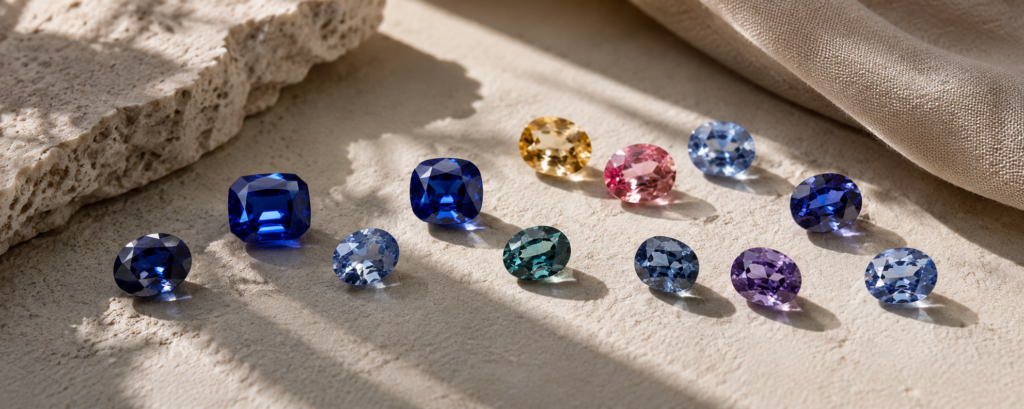
Blue may be the colour most closely associated with sapphire, but the sapphire family extends far beyond it. Natural sapphires can appear pink, yellow, orange, green, purple, colourless and in colours that sit somewhere between familiar names.
This variety is one of sapphire’s defining characteristics. Yet knowing the colour name is only the beginning. Two stones can both be called blue sapphire, for example, while looking remarkably different because their exact hue, lightness or darkness, and strength of colour are not the same.
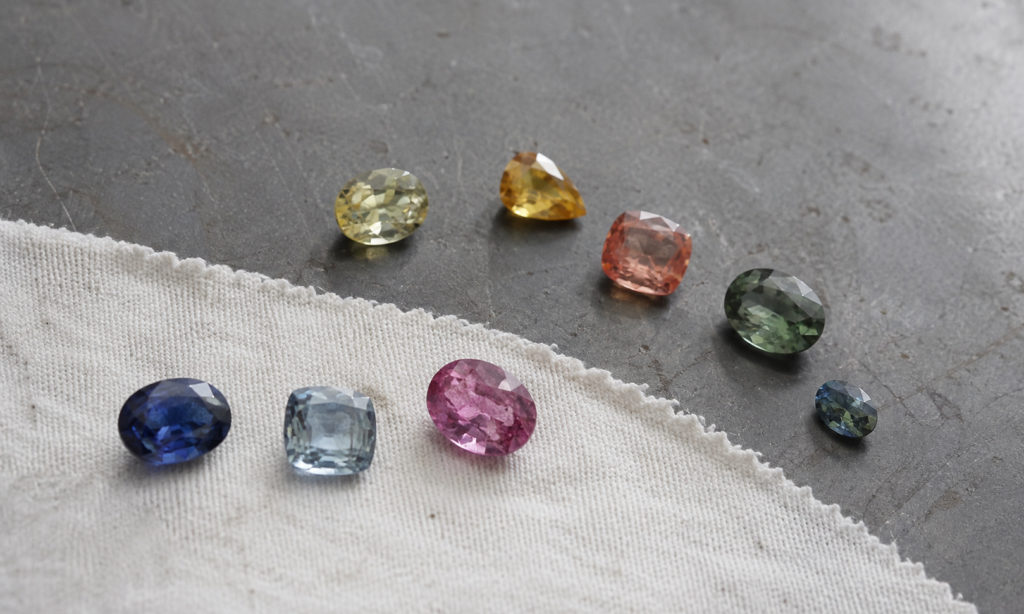
Understanding Sapphire Colour
When describing gemstone colour, three ideas are particularly useful: hue, tone and saturation. Together they explain why a simple colour label can cover such a wide range of appearances.
- Hue is the basic colour we perceive, such as blue, pink or yellow. A sapphire may also carry a secondary hue, giving descriptions such as violetish blue or orangy yellow.
- Tone describes how light or dark the colour appears.
- Saturation describes the strength or intensity of the colour, from subdued or greyish to strong and vivid.
These qualities work together. A strongly saturated blue can still appear too dark if its tone is very deep, while a lighter sapphire can look bright and open even with gentler saturation. This is why colour is better understood as a range rather than a collection of fixed labels.
Blue: Sapphire’s Best-Known Colour
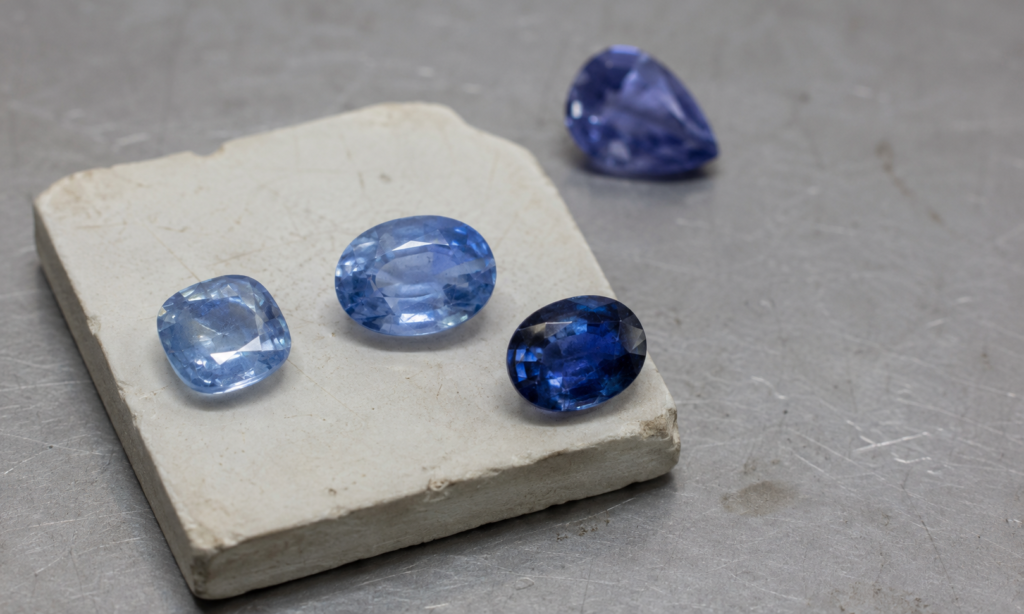
Blue sapphire itself covers a broad spectrum. Depending on the stone, the blue may lean slightly greenish or violetish, while tone can range from relatively light and airy to deep and intense.
For many fine blue sapphires, the appeal comes from a balance: enough saturation for the colour to feel rich, but enough brightness for the stone to remain lively rather than becoming overly dark. Cut, colour zoning and lighting can all affect that balance when the sapphire is viewed face-up.
Names such as Royal Blue and Cornflower Blue are used in the trade for particular blue appearances. They can be useful descriptions, but neither name represents every desirable blue sapphire, and each deserves more context than the label alone provides.
Beyond Blue: The Fancy Sapphire Palette
Sapphires outside the blue range are often referred to collectively as fancy sapphires. Their colours can be delicate and pastel or strongly saturated, and secondary hues can give each stone a distinctly different character.
Pink and Purple
Pink sapphire can range from soft, pale pink to much stronger saturation, sometimes with purplish or orangy modifiers. As the dominant colour shifts toward purple, the stone may instead be described as purple sapphire.
The boundary between pink sapphire and ruby requires particular care. Both are corundum coloured in part by chromium, and the point at which a stone is classified as ruby rather than pink sapphire is a colour-classification question rather than a simple rule that can be judged from the word “pink” alone.
Yellow and Orange
Yellow sapphire spans from pale lemon-like hues to richer golden and orangy yellows. Orange sapphire occupies its own part of the spectrum, while stones between yellow and orange can show a mixture of both.
Within the broader pink-to-orange region is Padparadscha sapphire, a special colour description associated with a narrow combination of pink and orange. Because the name has specific gemological and laboratory considerations, it is better understood as more than simply another synonym for peach-coloured sapphire.
Green
Green sapphire may range from yellowish green through green to bluish green. In some stones, the face-up green appearance can also be influenced by blue and yellow colour components or zoning within the crystal. The result can vary from muted, earthy greens to brighter teal-leaning appearances.
Colourless, Grey, Brown and Dark Sapphire
Not every sapphire is defined by vivid colour. Colourless sapphire is also known in the trade as white sapphire, while grey, brown and very dark sapphires occupy quieter parts of the corundum palette. Their appearance can be valued for different reasons from the strongly saturated colours most often associated with sapphire.

When One Sapphire Shows More Than One Colour
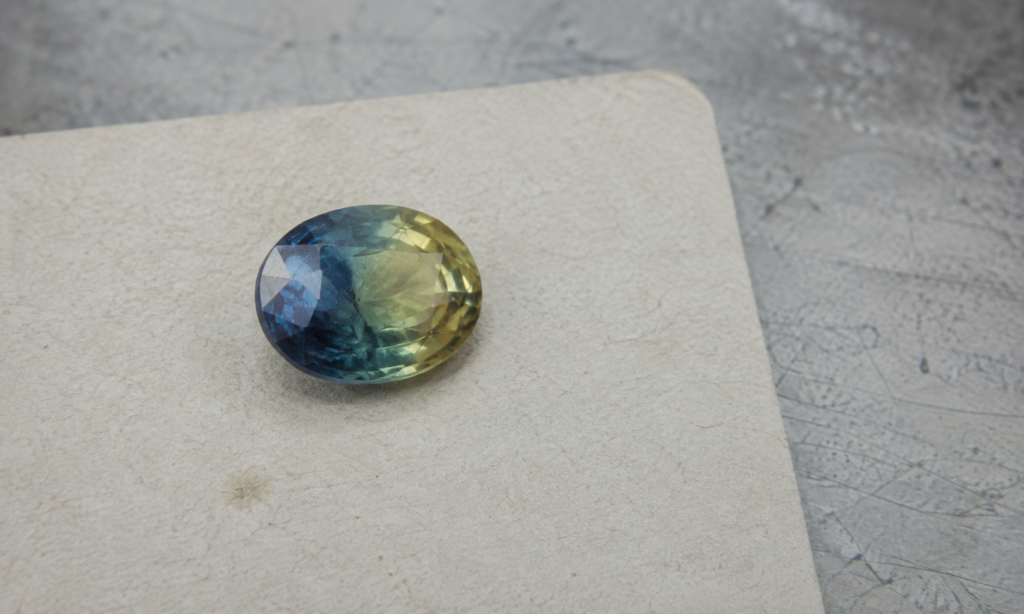
Some sapphires contain distinct areas of different colour. When these zones form an important part of the stone’s face-up appearance, the material is often described as parti-coloured sapphire. Blue and yellow combinations are particularly recognisable, but other mixtures occur.
Colour zoning is not automatically positive or negative. In some sapphires a cutter may try to minimise distracting zoning or orient it to create a more even appearance. In a parti sapphire, by contrast, visible separation and interaction between colours can become the character of the stone itself.
Sapphires That Change Colour
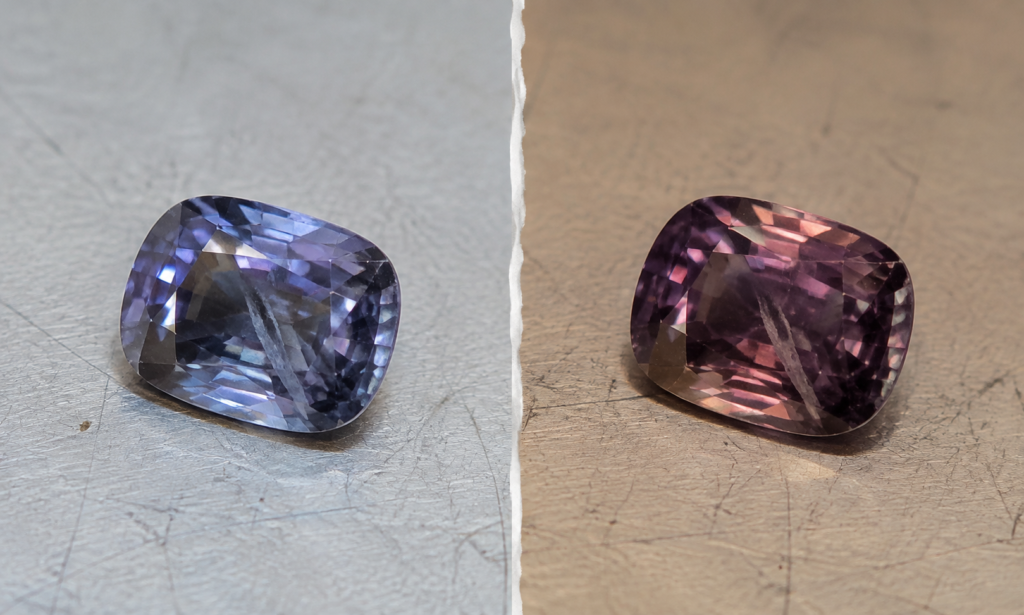
Colour-change sapphire is different from parti-coloured sapphire. Instead of displaying separate colour zones at the same time, a colour-change sapphire changes its overall colour appearance when viewed under different types of illumination.
A stone may, for example, appear blue or violet under daylight-equivalent illumination and shift toward violetish purple or reddish purple under incandescent light. The exact colours and strength of the change vary from stone to stone.
Why the Same Sapphire Can Look Different
Gemstone colour is not experienced in isolation. The light source, viewing angle and surrounding environment can influence what our eyes perceive. Sapphire can also show colour zoning or directional colour, while the cut determines how much light returns through different areas of the stone.
This is why a sapphire may look slightly different beside a window, under warm indoor lighting and in a controlled studio photograph. A single image can be useful, but it cannot always communicate the complete colour character of a gemstone.
Is One Sapphire Colour Better Than Another?
There is no single sapphire colour that is inherently better for every person. Certain colours, origins and combinations of quality can be rarer or command stronger market demand, but rarity and personal preference are not the same thing.
When looking at colour, consider more than the name. Notice whether the tone feels too light or too dark for your preference, whether the saturation gives the stone enough presence, whether the colour remains attractive in different lighting, and whether the cut allows the sapphire to stay bright and expressive face-up.
A colour name tells you where to begin looking. The individual sapphire tells you the rest.
That distinction becomes especially important within blue sapphire, where terms such as Royal Blue and Cornflower Blue describe only part of a much wider spectrum. Understanding the colour family first makes those more specific descriptions easier to place in context.