
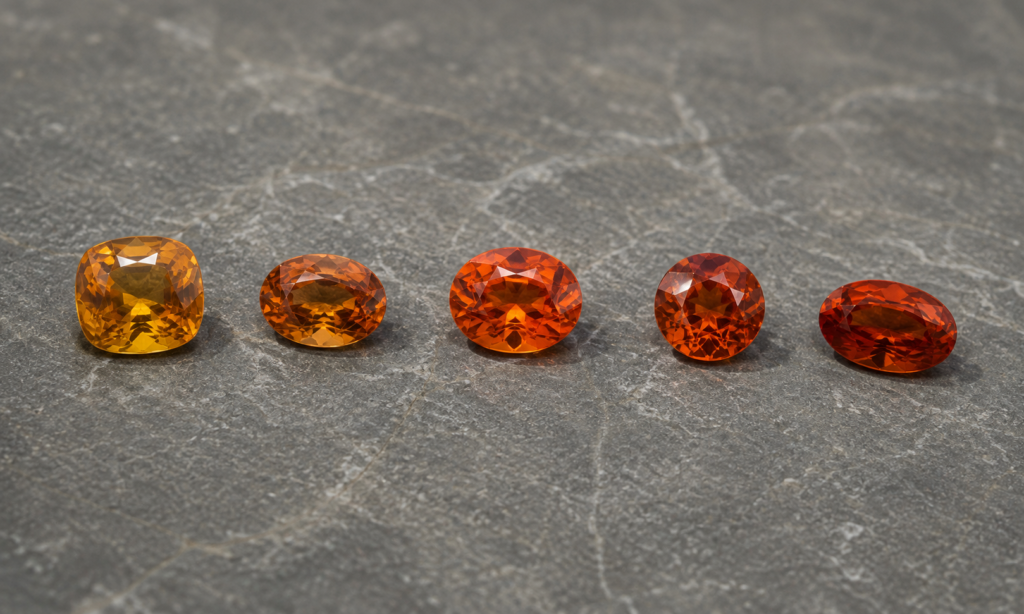
If red is garnet’s most familiar face, spessartine reveals a much brighter side of the family. Its colours can move from golden citrus and yellow-orange through vivid mandarin-like orange to warmer reddish and red-orange expressions.
Spessartine is not defined by one perfect orange. Its character lives across a warm spectrum.
First, What Is Spessartine?
Spessartine is a major mineral species within the garnet group. Its ideal composition is manganese aluminium garnet, Mn₃Al₂(SiO₄)₃. It is not simply an orange variety of another garnet species.
Spessartine is not simply an orange-coloured garnet. It is one of the mineral species that make up the garnet family.
Manganese Is Central to the Colour Story
Manganese is fundamental to spessartine chemistry and plays an important role in its optical behaviour. Gemological studies also show that natural stones can contain other components, including iron, so the finished colour cannot always be reduced to one element acting alone.
Spessartine’s orange begins with chemistry, but the colour we finally see depends on more than one element alone.
Spessartine Is Not One Orange
Spessartine occupies a broad warm palette: orangy yellow, golden orange, vivid orange, reddish orange and warm orange-red all occur naturally.
Orange is not a single destination in spessartine. It is an entire landscape.
So What Does “Mandarin Garnet” Mean?
“Mandarin garnet” is a trade term associated with especially vivid orange spessartine. It does not describe a separate mineral species. Spessartine is the mineral identity; Mandarin is a commercial colour expression that became particularly prominent with modern African material.
“Mandarin” describes a celebrated expression of spessartine colour. It does not create a new garnet species.
Mandarin Is a Colour Idea, Not a Universal Boundary
Natural colour does not arrive with a fixed line separating Mandarin from every neighbouring orange. Trade terminology can be useful for communication, but it should not be mistaken for a universally defined gemological colour boundary.
Nature does not draw a line through orange and label one side “Mandarin.”
Orange Can Move Toward Yellow
Historical material from the Ramona district of California demonstrates how spessartine can move toward bright orangy yellow and yellowish orange. These citrus and golden expressions belong naturally within the species, even when they differ from the vivid orange most strongly associated with the modern Mandarin image.
As orange moves toward yellow, spessartine can feel lighter, brighter and more citrus-like without becoming less itself.
Orange Can Move Toward Red
At the other side of the palette, orange can deepen toward reddish orange and warm orange-red. Gemological reports have documented orange-red spessartine from Madagascar, showing that the species does not stop at a single pure-orange appearance.
At the other end of its palette, spessartine allows orange to deepen toward the warmth of red.
Garnet Chemistry Does Not Always Stay in Neat Boxes
Natural garnets commonly form solid-solution relationships. Spessartine can contain other garnet components, including pyrope and almandine, so continuity in colour can accompany continuity in chemistry.
The colour spectrum feels continuous because garnet chemistry can be continuous too.
There Is No Single Landscape Behind Spessartine
Spessartine has been documented across the world, including the United States, Sri Lanka, Namibia, Nigeria, Tanzania, Madagascar and Mozambique. These are different source chapters, not a ranking.
There is no single landscape behind spessartine orange.
Before Africa, California Was an Important Chapter
For much of the twentieth century, the Little Three mine near Ramona, California, was an important source of fine spessartine. Its bright orangy-yellow to yellowish-orange material became well known among collectors before later African discoveries reshaped the gemstone’s modern public image.
Before vivid African orange reshaped the modern image of spessartine, California had already given the gemstone an important place among collectors.
African Discoveries Changed the Modern Image
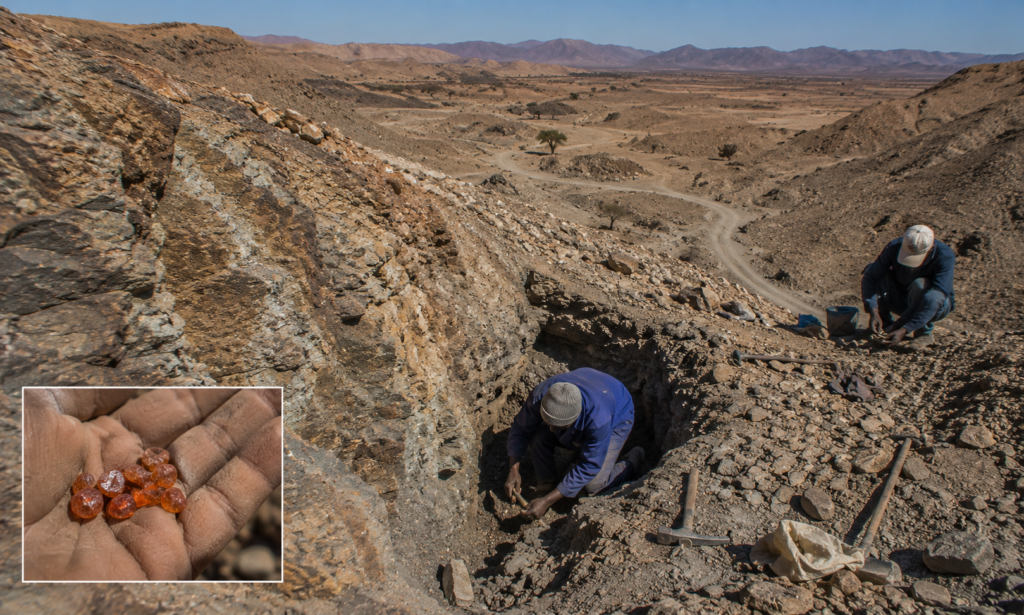
African discoveries from the early 1990s onward brought fresh attention to spessartine. Namibia became especially important to the Mandarin story, followed by material from Nigeria and Tanzania.
The modern image of spessartine was shaped not by one discovery, but by a succession of new orange deposits.
Namibia and the Rise of “Mandarin”
Namibian spessartine helped make vivid orange and the name Mandarin familiar in the modern gem trade. Yet one deposit does not define the species: compelling orange occurs beyond Namibia.
Namibia helped make “Mandarin” famous, but the colour story of spessartine extends far beyond one deposit.
Nigeria Added Another Orange Chapter
Nigerian material became another important part of the modern spessartine story from the late 1990s. Strong orange and warmer modified appearances added to the market’s visual range, while also showing why colour alone should not be used as a reliable passport for origin.
Source can add context to an orange. It does not turn colour into a reliable passport.
Clarity Is Part of Spessartine’s Character
Spessartine can show eye-visible inclusions more readily than some familiar red garnets. Some stones look open and transparent; others carry more obvious natural internal features. Clarity changes the experience, but microscopic perfection does not define the species.
Transparency can make orange feel especially open and luminous, but microscopic perfection is not the definition of spessartine.
Cut Changes the Energy of Orange
Spessartine can show lively brilliance when well cut. Proportions, facet arrangement, depth and polish influence whether its orange feels open and bright or denser and more dramatic. The cut does not create the body colour, but it strongly affects how that colour reaches the eye.
In spessartine, cut does not create the orange—but it can decide whether that orange feels quiet or alive.
Tone Changes the Mood More Than the Identity
A lighter orange can feel fresh and citrus-like; a saturated medium orange can feel energetic; deeper red-orange can feel warmer and more dramatic. These are different moods within the same broad colour family rather than steps on a universal ladder.
The same orange family can move from sunlight to ember simply by changing tone and modifiers.
Spessartine and Hessonite Can Both Be Orange
Orange alone does not establish spessartine identity. Hessonite is an orange to reddish variety of grossular garnet and can occupy overlapping visual territory. The two belong to different mineral branches even when their colours appear related.
Orange belongs to more than one branch of the garnet family.
Treatment Is Not the Main Story
Routine colour enhancement is not the defining story of spessartine in the market. Its orange is fundamentally connected with natural mineral chemistry and composition, although treatment should never be discussed with unnecessary absolute claims.
Spessartine is compelling because its orange is fundamentally a story of mineral chemistry, not a colour identity built around routine enhancement.
Orange Does Not Need to Be at Its Brightest
Vivid orange material receives strong market attention, and that preference helps explain the prominence of Mandarin terminology. It does not make golden, yellow-orange or deeper red-orange expressions aesthetically invalid. Each shifts the mood of the stone in a different direction.
Market preference can explain why one orange receives more attention. It does not decide which orange an individual person should find beautiful.
From Rough Orange to Jewelry
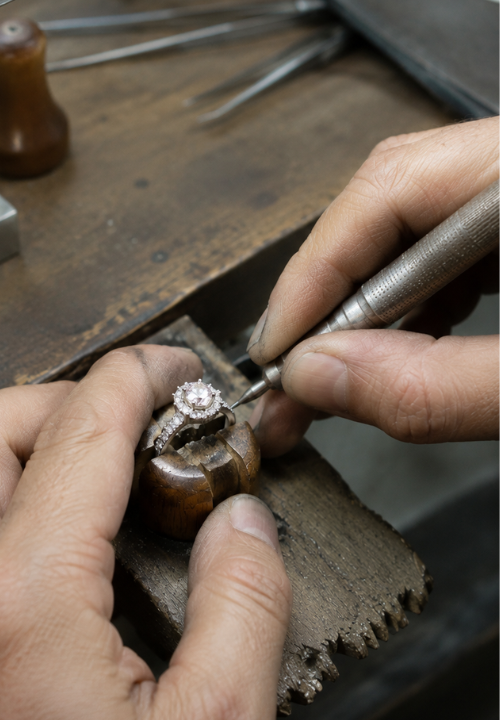
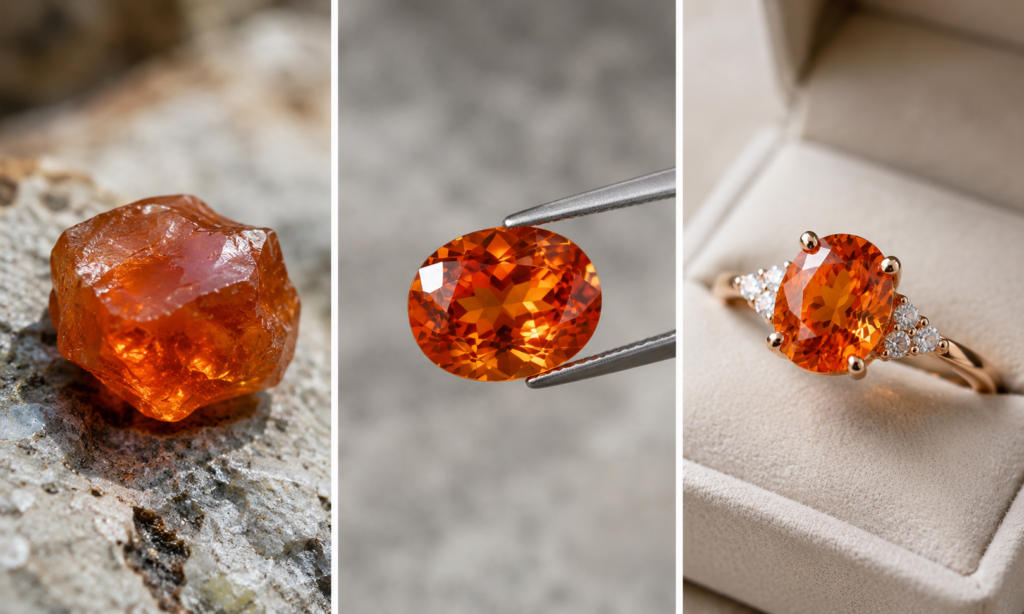
The transformation from rough spessartine to a finished jewel can change almost everything about the material’s form. Cutting creates facets and light return; design gives the stone a new context. Yet the warmth of orange remains the thread connecting mineral, gemstone and jewel.
Cutting changes the form of spessartine completely, yet the warmth of the material remains recognizable throughout the journey.
An Entire World Inside Orange
Mandarin is an important chapter in the spessartine story, but it is not the whole story. From golden citrus tones through vivid orange and into warm red-orange, spessartine shows how much personality can exist inside a colour that initially sounds simple.
Spessartine does not ask us to find the one correct orange. It shows us how many different personalities the colour orange can have.