
There is no single perfect kind of tourmaline. Some stones are vivid, some are quiet, some divide themselves into two colours, and some arrive in proportions that would never fit a calibrated setting. We ask whether colour, light, clarity, cut and individual character make sense together.
We are not searching for one perfect kind of tourmaline. We are looking for individual stones that make us want to look twice.
Colour Is Where We Begin
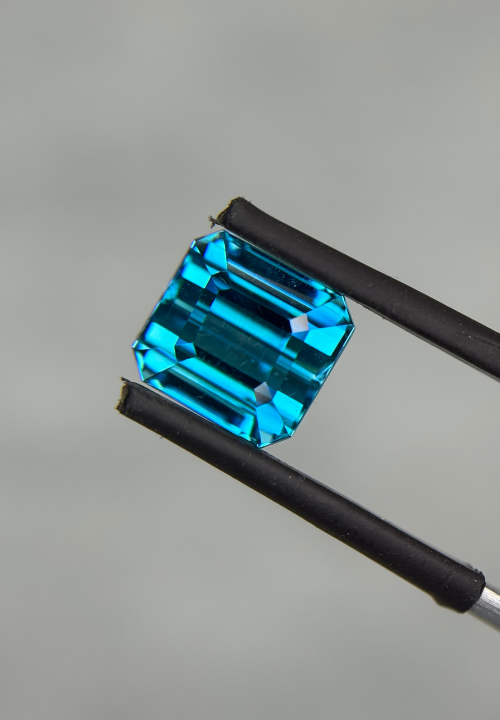
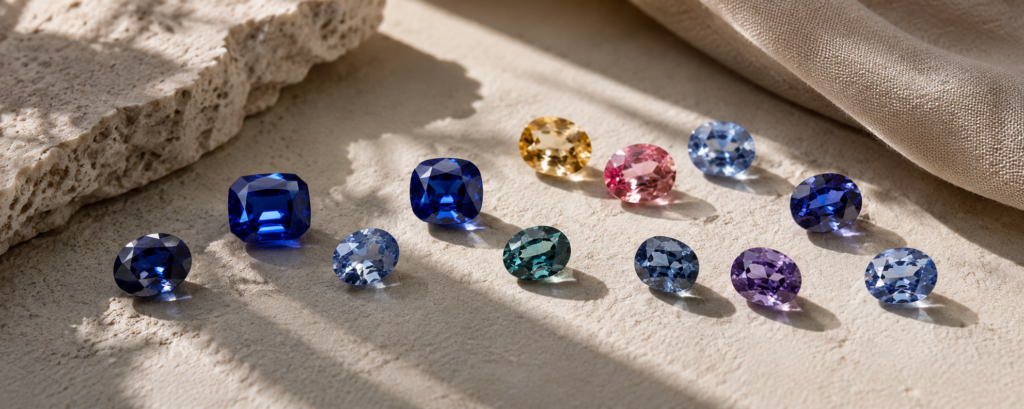
Colour is usually the first thing that catches our attention, and it is one of tourmaline’s most important quality factors. Yet tourmaline ranges from electric blue and deep green to raspberry red, soft pink, peach, mint, grey-green and multicoloured material. Strong saturation can be beautiful, but quieter colours can have their own appeal.
Colour comes first—but “more colour” is not always the same thing as “better colour.”
We Look at the Colour Before We Look at the Name
Rubellite, indicolite, chrome, Paraíba, Brazil, Mozambique or Afghanistan can add useful information about colour, chemistry, history, provenance or market identity. But a name should not be responsible for making the gemstone attractive. We prefer to see the stone first and understand the label second.
A trade name can explain a gemstone. It should not have to convince us to like it.
We Ask Whether the Colour Still Feels Alive
Hue alone is not enough. A tourmaline can have strong saturation yet become so dark face-up that much of its colour is difficult to see. Extinction, depth, orientation and cutting can influence whether the stone remains open and lively.
We want to see the colour, not merely know that the colour is there.
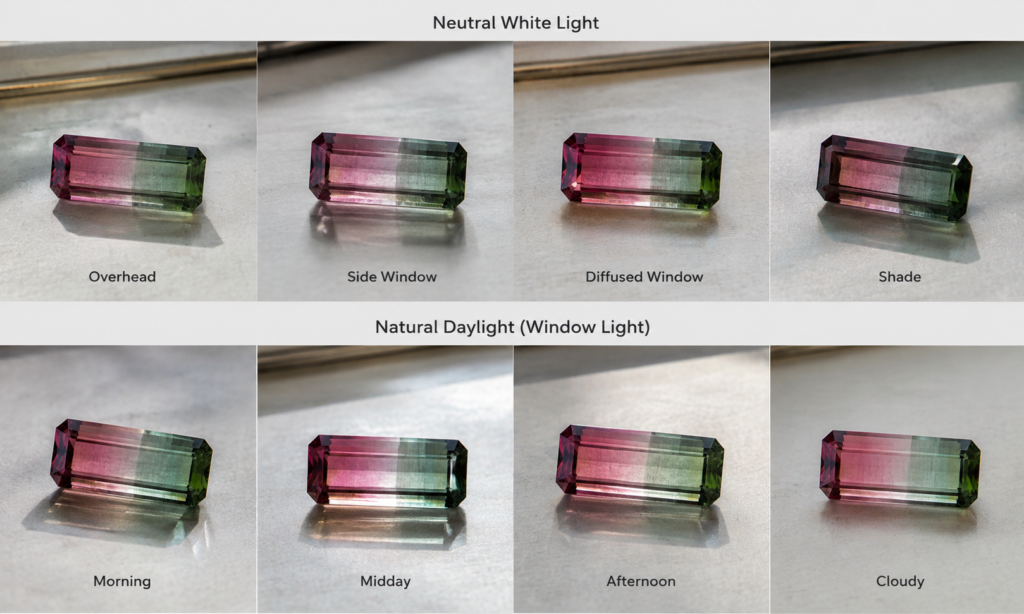
We Look at the Stone in More Than One Light
Tourmaline does not have to look identical everywhere. Light source, viewing angle, tone and pleochroism can influence appearance. We want to understand how the gemstone behaves as the light changes, rather than demand perfect colour consistency.
A gemstone does not need to look identical in every light. We want to understand how its character moves with the light.
Clarity Matters When It Interrupts the Stone
Tourmaline can contain natural inclusions, and clarity expectations are not identical across every colour variety. Pink and red tourmalines can be more included than many green and blue stones. We are not searching for microscopic perfection. We care more about whether an inclusion becomes distracting face-up, while significant fractures or surface-reaching features deserve separate attention for durability.
We do not ask whether a tourmaline contains inclusions. We ask whether the inclusions become the first thing we see.
We Care More About Face-Up Appearance Than Magnification
Magnification helps us understand a gemstone, but jewelry is normally experienced with the eye. A small internal feature that disappears during normal viewing does not necessarily diminish an otherwise compelling stone. Durability remains a separate consideration.
Magnification helps us understand the gemstone. It should not replace the experience of actually looking at it.
Cut Matters When It Changes the Colour
Tourmaline is strongly pleochroic, so orientation can have a pronounced effect on face-up colour and darkness. Cutters may orient lighter rough to strengthen colour or darker rough to keep the finished stone more open. We therefore look at what the cutting actually allows the colour and light to do.
We do not judge the cut only by symmetry. We judge what the cut allows the colour to do.
We Watch for Darkness, Window and Dead Areas
Large areas of extinction, obvious windowing or a lifeless centre can interfere with the experience of a coloured stone. But we do not expect every tourmaline to behave like a precision-cut optical demonstration. A small compromise may be acceptable when the overall stone remains balanced and compelling.
A gemstone does not need perfect optics. It needs enough life for its character to come through.
We Do Not Reject an Unusual Shape for Being Unusual
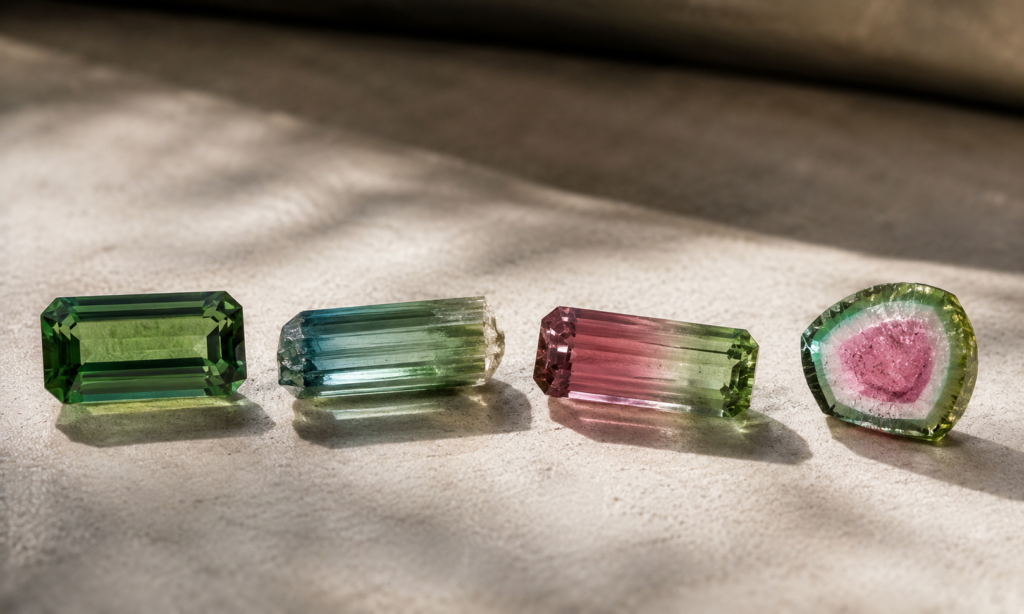
Tourmaline commonly grows as elongated prismatic crystals, so long and non-standard finished proportions are natural outcomes of the material. A narrow rectangle, elongated cushion or freeform outline is not automatically a cutting problem.
An unusual proportion is not automatically a cutting problem. Sometimes it is the beginning of the design.
Colour Zoning Can Be a Feature, Not a Defect
Even colour can be desirable in a single-colour stone, but tourmaline is also famous for bi-colour, tri-colour and watermelon material. In those stones, zoning may be the reason the gemstone is distinctive at all.
In tourmaline, uneven colour can sometimes be the entire point.
We Look for Character, but Character Still Needs Balance
Being unusual is not enough by itself. A rare-looking colour, dramatic zoning or unconventional shape can catch the eye, but the stone still needs coherence. If it is so dark that its colour disappears, so included that the eye cannot leave the inclusions, or cut in a way that makes it lifeless, uniqueness alone does not solve the problem.
Different is interesting. Different and beautiful is what makes us stop.
Origin Adds a Story, Not Permission to Ignore the Stone
Brazil, Afghanistan, Mozambique, Tanzania and other origins can add geology, history and provenance. In categories such as Paraíba, documented origin may also affect market value. But a famous place name does not guarantee the beauty of an individual stone.
We like knowing where a gemstone began. We still choose it for what it became.
Treatment Is Information, Not an Automatic Rejection
Tourmaline can be treated, including by heat and irradiation. Treatment status does not automatically determine whether a stone is visually compelling. What matters to us is being accurate about what is known, following reliable laboratory information when available, and avoiding claims that cannot be supported.
Treatment does not automatically decide whether we like a gemstone. Honesty about what is known does matter.
We Think About What the Stone Could Become
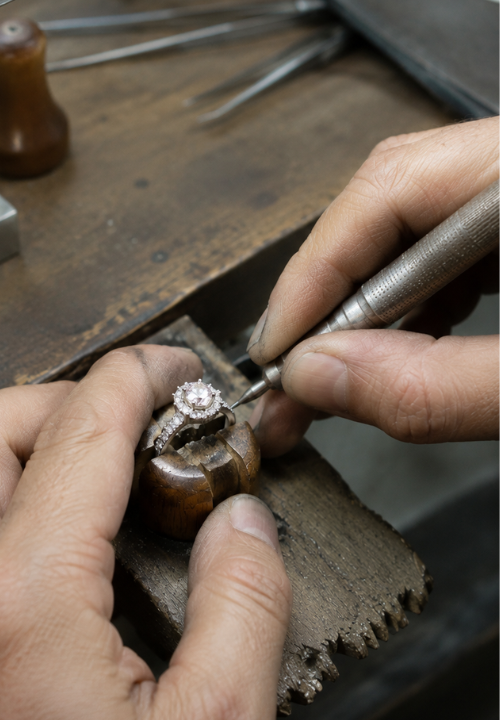
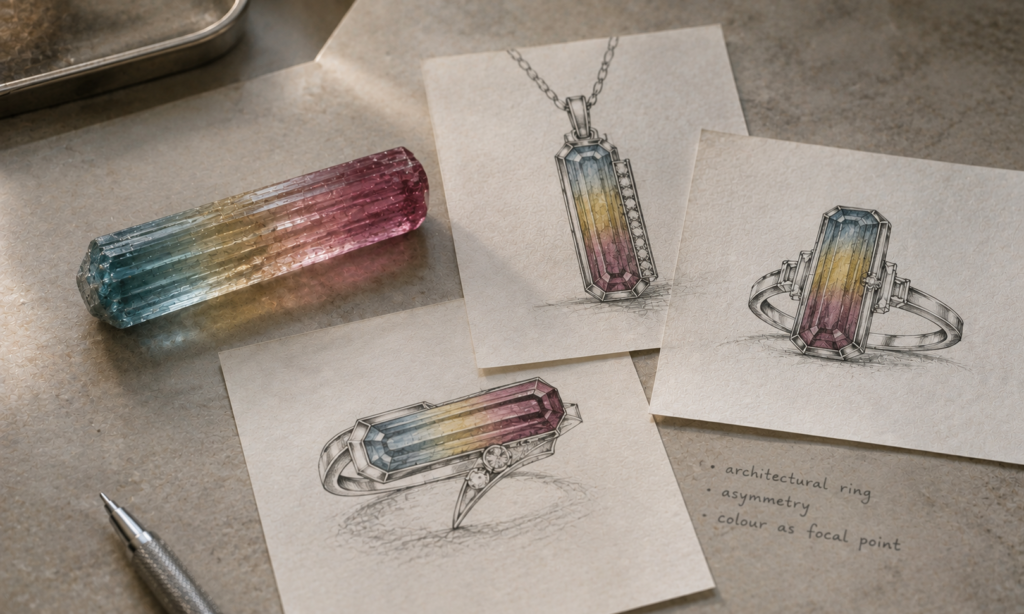
Sometimes a loose tourmaline becomes more interesting when we imagine its future. An elongated stone may suggest an architectural ring or pendant. A colour transition may become the centre of a composition. An asymmetric outline may invite a design that responds to it rather than hiding it.
Sometimes we choose a gemstone not only for what it is, but for what we can already imagine it becoming.
What Makes Us Say Yes?
There is no single checklist that every tourmaline must pass. We ask whether the colour makes us stop, whether it remains visible and alive, whether the cut helps rather than fights it, whether inclusions remain quiet enough not to dominate, and whether the stone has a character that feels genuinely its own.
Most importantly, we ask whether we can understand why someone might choose this particular tourmaline instead of another.
We are not looking for a gemstone that wins every category. We are looking for a gemstone whose qualities belong together.
The Stone Has to Make Sense as a Whole
Tourmaline resists simple formulas. It has no single colour, clarity expectation, shape, origin or visual personality. Colour is where we begin, but light, clarity, cutting, character and possibility eventually have to work together.
We begin with colour. We look for light. We listen to the character of the stone. And in the end, we choose the tourmaline that feels complete as itself.