
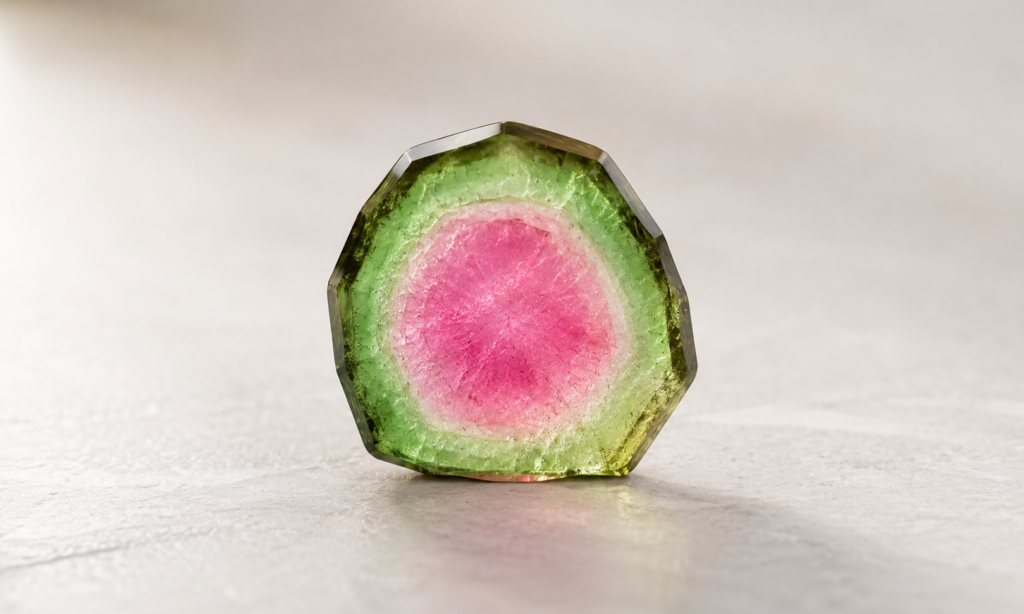
A polished slice of watermelon tourmaline can look almost deliberately designed: pink or reddish pink at the centre, green around the outside, and sometimes a paler or nearly colourless zone between them.
The pattern is not painted onto the gemstone and it is not assembled from separate pieces. It develops while one tourmaline crystal grows through changing chemical conditions.
Watermelon tourmaline looks designed because its growth history happens to leave a design behind.
What Exactly Is Watermelon Tourmaline?
Classic watermelon tourmaline describes a distinctive colour-zoning pattern in which a pink or reddish inner area is surrounded by green outer material. Viewed across the crystal, the resemblance to a slice of watermelon explains the trade name.
It is important that the name describes an arrangement of colours, not simply their presence.
Watermelon is not simply a colour combination. It is a colour arrangement.
It Begins With the Inner Growth
A tourmaline crystal develops progressively. The material toward the centre formed earlier than the layers that later grew around it.
In a classic watermelon pattern, the earlier inner growth develops pink or reddish colour. The crystal does not stop there; it continues interacting with its geological environment and adding new material.
The centre of a watermelon tourmaline is the older part of the crystal.
Then the Environment Changes
The chemistry of the fluid or melt surrounding a growing tourmaline does not have to remain constant. As the available elements and their concentrations change, the chemistry incorporated into later crystal growth can change too.
Because tourmaline colour is closely connected with its chemistry, later growth can develop a different colour from the core.
The crystal did not change colour all at once. It grew a new colour around the colour it already had.
Why Does the Green Surround the Pink?
Tourmaline can develop concentric colour zoning, meaning new layers grow around earlier portions of the crystal. If the inner growth is pink and later growth becomes green, the result can be a pink core surrounded by a green outer zone.
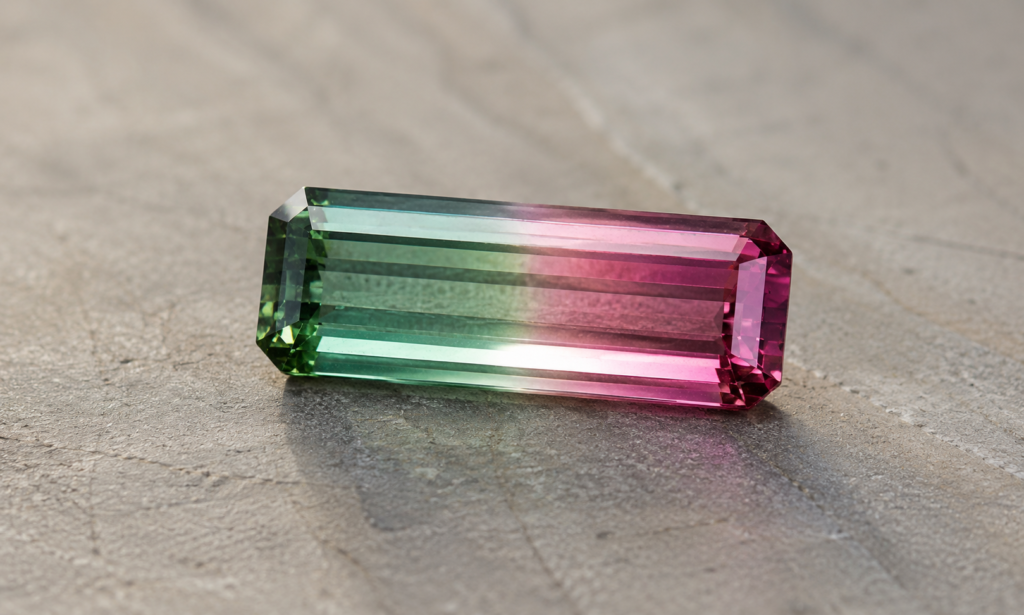
This is different from the familiar bi-colour arrangement in which two colours may divide a crystal more noticeably along its length.
Bi-colour records change along the crystal. Watermelon can record change around the crystal.
Why Can the Colour Boundary Be So Sharp?
When the chemistry of the growth environment changes, the new crystal material can preserve that difference as a distinct zone. Colour-causing components do not necessarily redistribute rapidly enough through the already-formed crystal to erase the boundary.
The result can be a surprisingly sharp transition between growth zones, although natural boundaries can also be softer or more complicated.
A sharp colour boundary can preserve a chemical change instead of quickly blending it away.
Natural Watermelon Tourmaline Does Not Have to Look Perfect
The textbook image is simple: a neat pink centre surrounded evenly by green. Natural crystals are often more complicated.
The pink may sit off-centre. One side of the green layer may be thicker than another. A pale or colourless zone may appear between colours. Additional bands may be present, and the outline itself may be irregular.
Those variations are not failures of the watermelon pattern. They are part of the way an actual crystal grew.
The textbook pattern is simple. Natural watermelon tourmaline rarely has to be.
Why Is Watermelon Tourmaline Often Cut as a Slice?
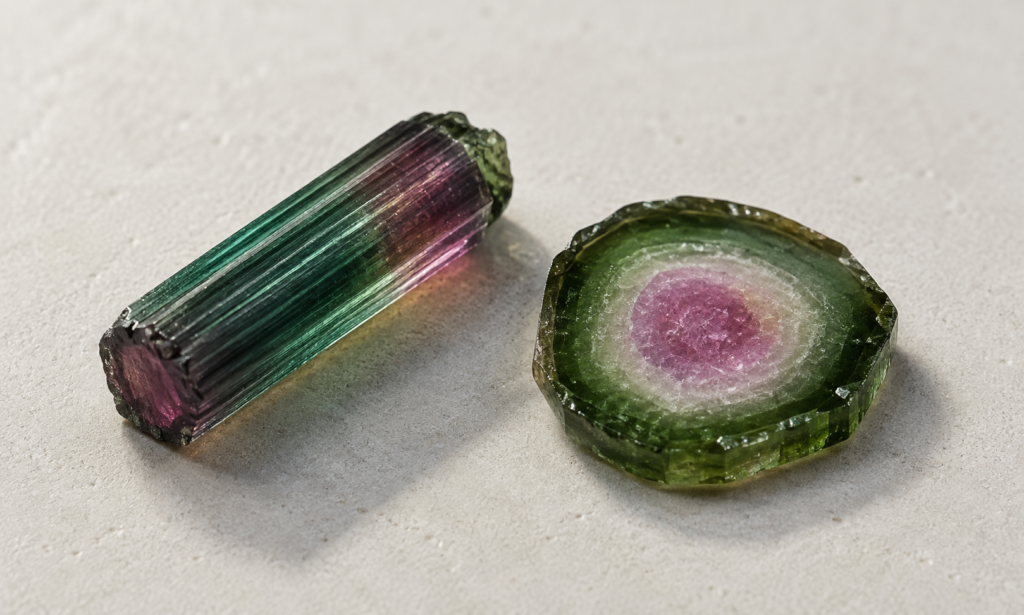
The famous concentric pattern is easiest to understand when the crystal is viewed across its growth structure. Cutting an elongated crystal roughly perpendicular to its length can expose the inner and outer zones together.
A polished slice can therefore reveal the pink centre and green rim in a way that a conventional cut might not.
The slice does not create the watermelon pattern. It simply cuts across the crystal in the direction that reveals it.
Does Watermelon Tourmaline Have to Be Faceted?
No. Some watermelon tourmaline is faceted, carved or otherwise shaped, but polished crystal slices are especially well suited to preserving the zoning that gives the material its identity.
In this case, maximum sparkle does not always need to be the cutter’s primary objective. Keeping the natural colour composition visible can be more important.
For watermelon tourmaline, preserving the pattern can matter more than creating maximum sparkle.
Watermelon Tourmaline Is Part of a Larger Colour-Zoning Story
Tourmaline showing multiple colours is broadly part of the parti-coloured or multicoloured tourmaline story. Watermelon is a particularly recognisable zoning arrangement within that larger family.
It is not a separate mineral species. The name tells us about how the colours are organised within the tourmaline.
Is Watermelon Tourmaline Rare?
The name alone does not describe one universal level of rarity or quality. Watermelon tourmaline can range from relatively modest material to unusually attractive and distinctive examples.
Colour strength, contrast, transparency, size, the completeness of the zoning and how successfully the material can be cut or used in jewellery can all affect how a particular piece is perceived.
The name may be the same. The quality of the pattern can be very different.
What Makes One Watermelon Pattern More Interesting Than Another?
Rather than looking for one supposedly perfect formula, it is more useful to observe how the pattern works as a whole. Is the pink delicate or saturated? Is the green subtle or strongly contrasting? Is the transition sharp, soft or separated by a pale zone? Does the shape of the slice complement the zoning?
Some people may prefer an almost concentric composition. Others may find an irregular, off-centre pattern more expressive.
The most interesting watermelon tourmaline is not necessarily the most symmetrical one. It is the one whose pattern feels complete in its own way.
Watermelon Tourmaline Gives Jewellery a Different Starting Point
A watermelon slice already contains shape, colour placement, a centre and an outer border before a jewellery designer begins drawing.
That can encourage a restrained approach: a pendant, ring or pair of earrings in which the setting follows the individual outline and leaves enough visual space for the zoning to remain the main event.
With watermelon tourmaline, the gemstone already arrives with its own composition.
[IMAGE PLACEHOLDER — REFINED MAISON JEWELLERY PIECE designed around a realistic natural watermelon tourmaline slice with slightly irregular outline, pink inner zone and green outer zoning; minimal setting follows and protects the stone without overwhelming its pattern; purpose: show jewellery design responding to the gemstone rather than forcing perfect symmetry; realistic construction, no macro inclusion imagery]
A Cross-Section Through Time
When we look at a watermelon tourmaline slice, we are not seeing only pink surrounded by green. We are looking across successive stages of crystal growth.
The inner material formed earlier. Later growth surrounded it. Somewhere between those stages, the chemical environment changed enough for the colour to change with it.
Cutting across the crystal makes that sequence visible all at once.
A watermelon tourmaline slice is more than a pattern of pink and green. It is a cross-section through the life of a crystal.