

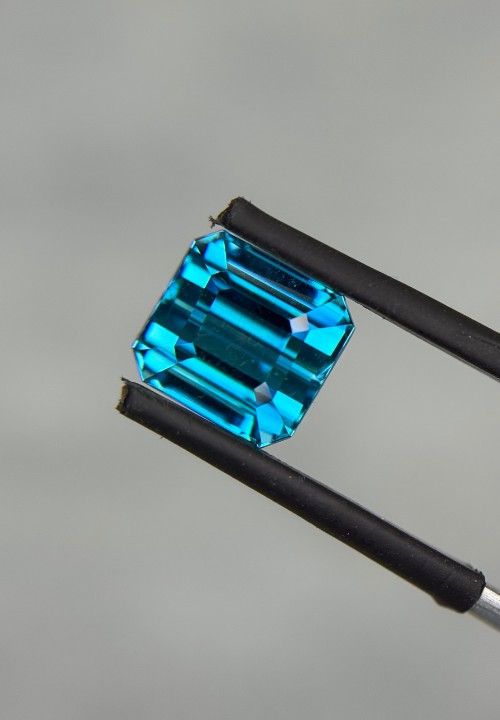
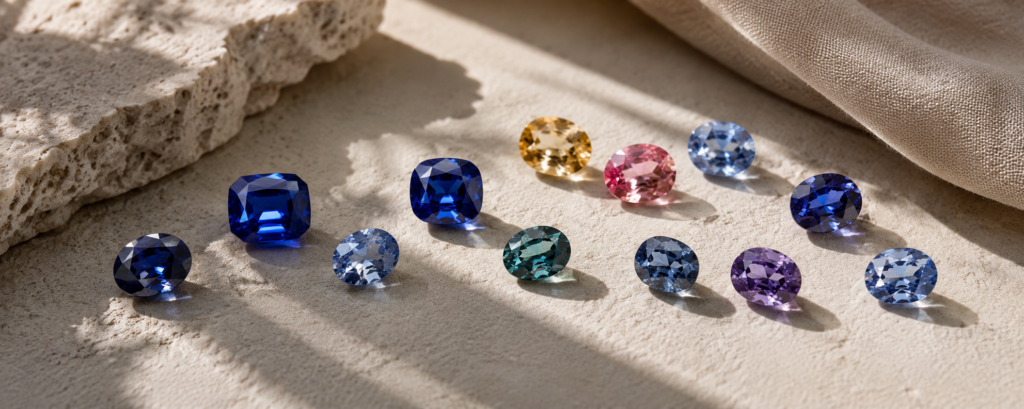
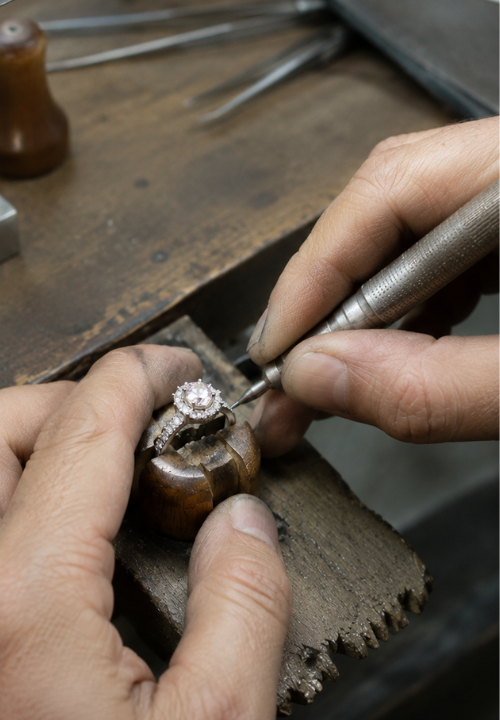
Once we know how to read a gemstone laboratory report, another question appears: how much of the gemstone do we now understand? A report can establish important facts that may be difficult or impossible to confirm from appearance alone. But it is not a complete biography of the stone, and it is not a substitute for seeing the gemstone itself.
A laboratory report can tell us important facts about a gemstone. It cannot experience the gemstone for us.
What It Can Tell You: What the Material Is
Identification is one of the strongest roles of a gemological laboratory. Testing can establish whether a material is corundum, beryl, spinel, tourmaline, zircon or another gemstone material, and reports can distinguish natural material from laboratory-grown material where applicable.
This matters because appearance alone can be misleading. A blue gemstone is not automatically sapphire, and a red gemstone is not automatically ruby. A report can answer the fundamental question: what is this material?
What It Can Tell You: Evidence of Treatment
Laboratories can also look for detectable evidence of treatments relevant to a particular gemstone. Depending on the material and testing scope, this can include heating, clarity enhancement, dyeing, impregnation, diffusion and other processes.
The word detectable is important. A laboratory is examining evidence present in the gemstone using methods such as microscopy, spectroscopy and chemical analysis. Its conclusion reflects what the observations and testing support; it is not a time machine recording every event in the stone’s history.
What It May Tell You: Geographic Origin
For certain gemstones and report types, a laboratory may also provide an expert opinion on geographic origin. This conclusion can draw on internal features, gemological properties, trace-element chemistry and spectroscopy, compared with reference samples and databases from known deposits.
A country name on a report is therefore not a label discovered inside the gemstone. It is an interpretation of multiple lines of evidence, and origin determination is not available or conclusive for every gemstone.
A country on a gemstone report is a conclusion drawn from evidence, not a label discovered inside the stone.
Sometimes “Inconclusive” Is the Correct Answer
Natural deposits do not always separate themselves into perfectly distinct gemological signatures. Characteristics from different geographic sources can overlap, leaving the evidence insufficient to support one origin over another.
In those situations, an inconclusive result can be the scientifically responsible conclusion. It does not necessarily mean that testing failed. Sometimes the evidence simply does not justify a more specific answer.
What It Can Describe About the Stone
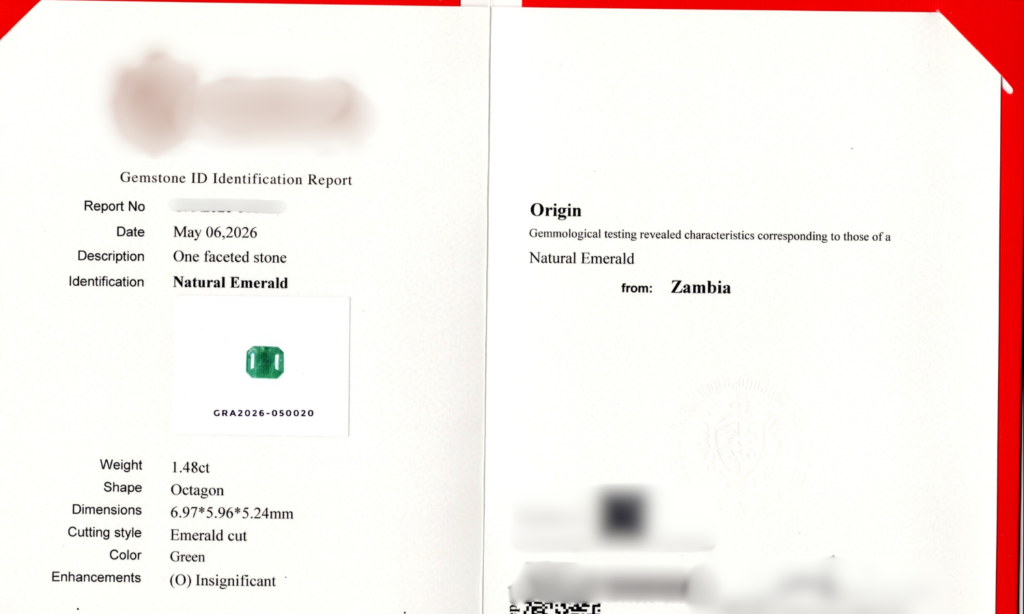
A report can also provide a physical description: weight, measurements, shape, cutting style, colour description, transparency or a photograph, depending on the laboratory and report type.
These fields are useful, but description is not the same as complete visual experience. A measurement tells us dimension, not how a proportion feels in person. A colour word records a laboratory description, not every nuance under every light. A photograph captures one representation of a gemstone rather than every way it can appear.
What It Cannot Tell You: Whether You Will Find the Stone Beautiful
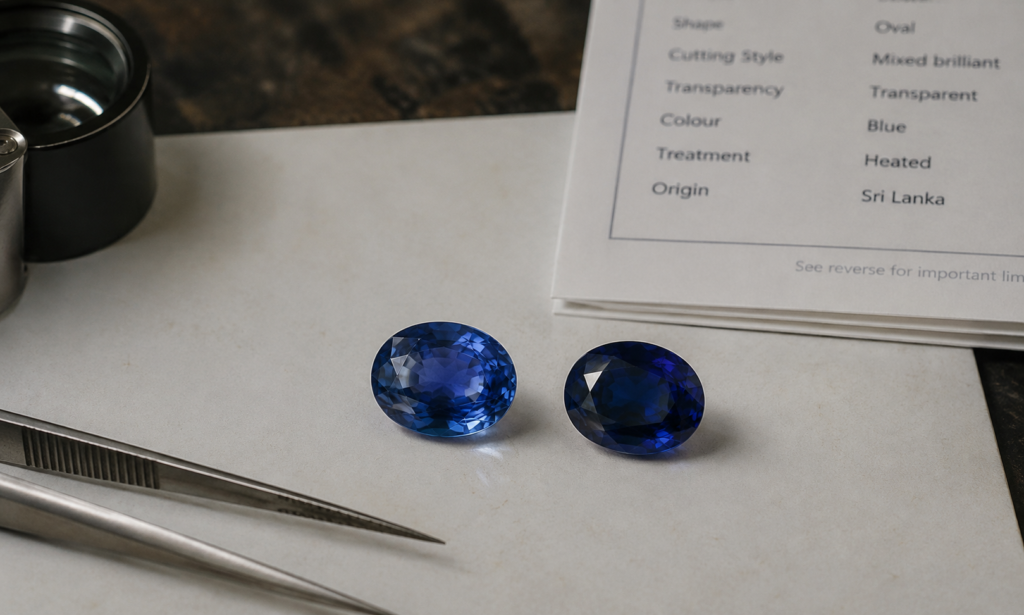
Imagine two sapphires with similar weight, the same broad treatment status and the same geographic-origin conclusion. On paper, they may appear remarkably alike. In person, one might show an open blue with lively reflections while another is deeper, quieter or differently zoned.
Neither description automatically makes one the better gemstone. Different people can respond to the same stones differently. Laboratory information can provide context, but it cannot decide which colour, proportion or visual personality someone will find beautiful.
Two gemstones can look similar on paper and feel completely different in the hand.
“No Indications” Is Not a History Book
Laboratory wording is deliberately precise. If a report states “no indications of heating,” it communicates the conclusion supported by the evidence and testing performed. It should not be silently expanded into a stronger claim that the laboratory has somehow observed the gemstone throughout its entire history.
This is not a weakness of gemological reporting. It is part of responsible scientific language: report what the evidence supports, and avoid claiming more than the examination can establish.
What It Cannot Tell You: The Price
A laboratory report is not automatically an appraisal. Origin, treatment status and other report information can influence how a gemstone is understood in the market, but they do not by themselves establish a final monetary value.
Price can also reflect the stone’s actual appearance, size, cut, clarity, rarity, market demand, commercial context and, in some cases, provenance. A report can provide information that affects value without becoming a price tag.
A Famous Origin Is Still Not a Quality Grade
A report might state Sri Lanka, Myanmar, Colombia, Zambia or another geographic origin. That tells us something meaningful about where the laboratory believes the gemstone formed, but it does not automatically say beautiful, exceptional or best.
The same source can produce gemstones with a wide range of appearances. Geographic origin can carry historical, geological and market significance while remaining only one part of the individual stone’s story.
The Report and the Gemstone Have Different Jobs
The most useful way to think about a report is not as a competitor to looking at the gemstone. The two provide different kinds of information. Laboratory analysis can address identity, detectable treatment and, in appropriate cases, geographic origin—questions that appearance alone may not reliably answer.
The gemstone itself gives us colour in changing light, movement, proportion, presence and personal response. Understanding both creates a fuller picture than asking either one to do the other’s job.
The report gives context to the gemstone. The gemstone gives meaning to the report.
Know What Question You Are Asking
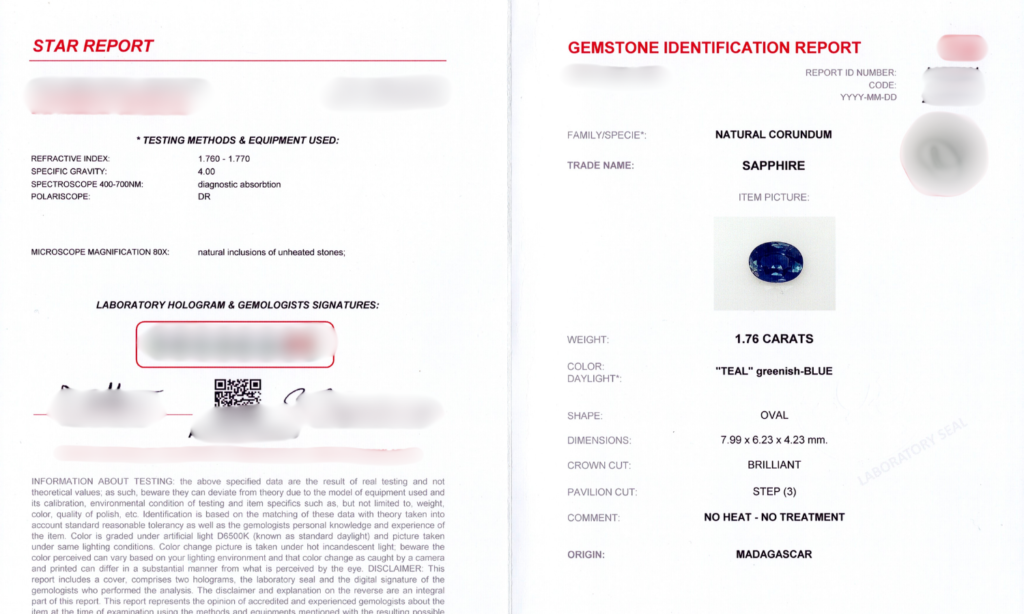
A laboratory report is powerful because it answers certain questions with evidence. It can identify a gemstone, report detectable treatments and, in appropriate cases, provide an expert opinion on geographic origin. Those are substantial pieces of information.
What it cannot do is replace the experience of the gemstone itself. It cannot decide which colour moves us, which stone feels most alive, or what we personally find beautiful. Understanding a report therefore means understanding both sides of it: what the laboratory has established, and what remains for the gemstone itself to show us.