
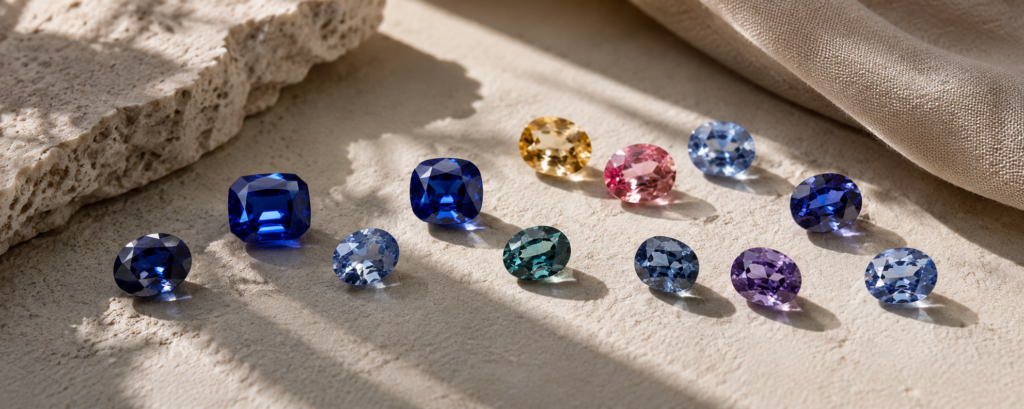
Pink, green, blue, yellow, red, teal and combinations of several colours can all belong to tourmaline. Few gemstone families move across the colour spectrum so freely.
The reason is deeper than tourmaline simply being a colourful stone. Its crystal structure allows substantial chemical variation, and that chemistry can continue changing while a single crystal is growing.
To understand tourmaline’s colours, we first have to understand that tourmaline was never one simple chemical recipe.
Tourmaline Is a Structure That Allows Variation
Tourmaline is a mineral group rather than one fixed chemical composition. Members of the group share a recognisable crystal structure, but different positions within that structure can accommodate a wide range of elements.
Sodium, lithium, calcium, magnesium, manganese, iron, chromium, vanadium and, in some material, copper can all become part of the broader tourmaline chemistry.
That flexibility is fundamental to its extraordinary variety.
The structure stays recognisably tourmaline. The ingredients inside it can change dramatically.
Colour Begins With the Way a Crystal Absorbs Light
A gemstone’s visible colour is connected to which parts of incoming light are absorbed and which return to our eyes. Elements and structural features inside a crystal can change that absorption.
This means a relatively small chemical difference can create a large visual difference. Two tourmalines may share the same basic mineral family while interacting with light in very different ways.
A small chemical change inside the crystal can create a very large visual change outside it.
Iron — One Element, Several Possible Colours
Iron is associated with colour in many tourmalines, including green and blue material, while iron-rich members of the tourmaline group can become extremely dark or black.
But it would be misleading to turn that into a simple formula such as “iron equals green.” Concentration, oxidation state and interaction with other parts of the crystal chemistry can all affect the result.
In tourmaline, knowing which element is present is only the beginning of the colour story.
Manganese — From Pink to Red and Beyond
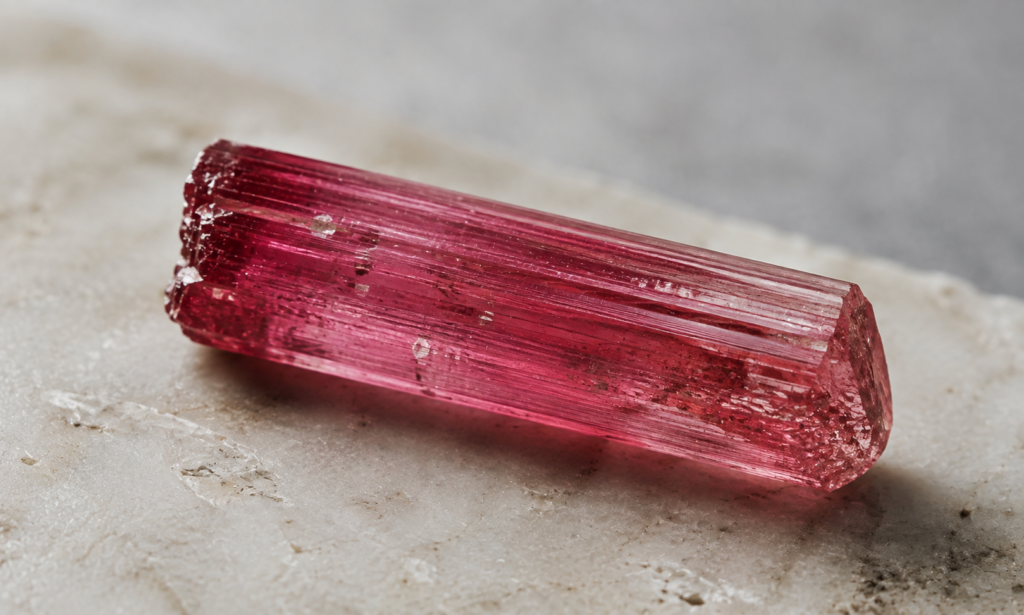
Manganese plays an important role in many pink and red tourmalines and can also participate in other colour systems. As with iron, the presence of manganese alone does not predict one exact finished hue.
This is one reason colour names such as pink tourmaline and rubellite describe an appearance that cannot be reduced to a single elemental label.
Chromium and Vanadium — Another Kind of Green
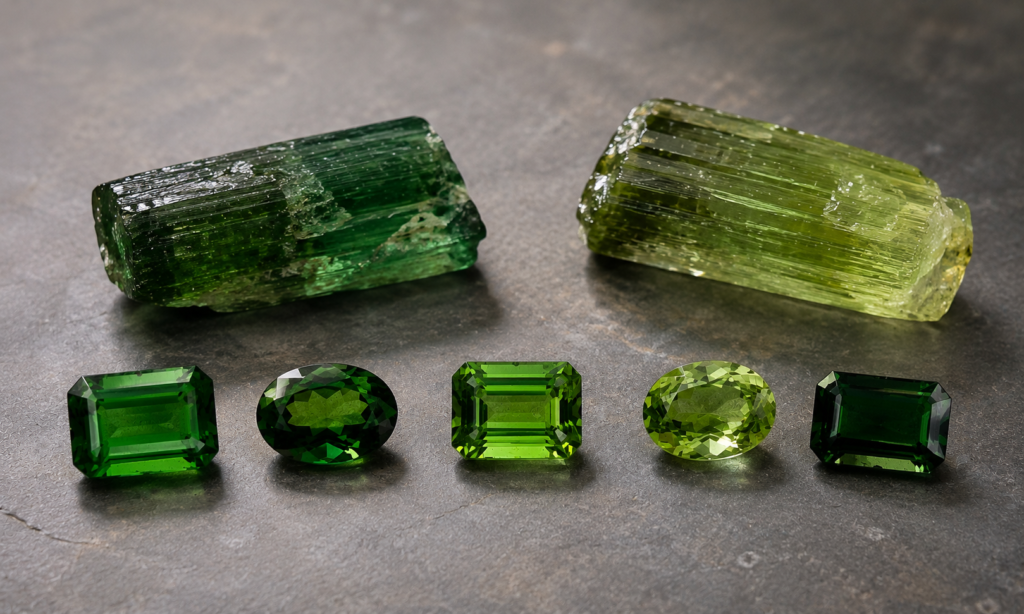
Not all green tourmalines arrive at green through the same chemistry. Some green material is strongly influenced by iron, while vivid material sold as chrome tourmaline is associated with chromium and/or vanadium.
Two gemstones can therefore belong to the same broad green colour family while the mechanisms behind their colours differ.
The same colour family does not always mean the same chemistry.
Copper — The Colour That Changed Tourmaline
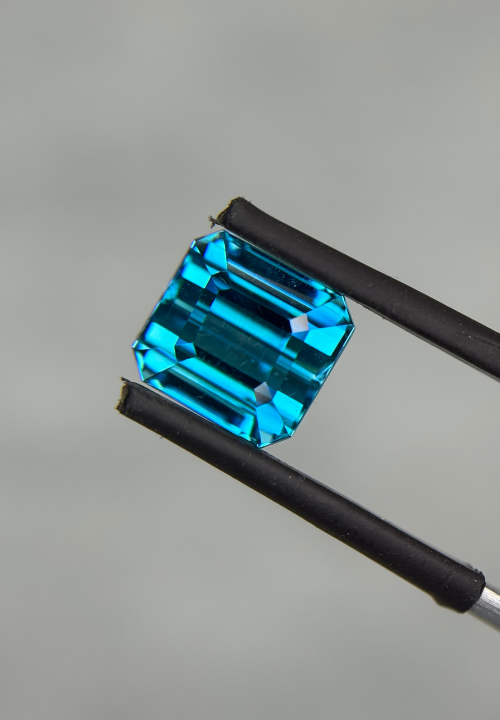
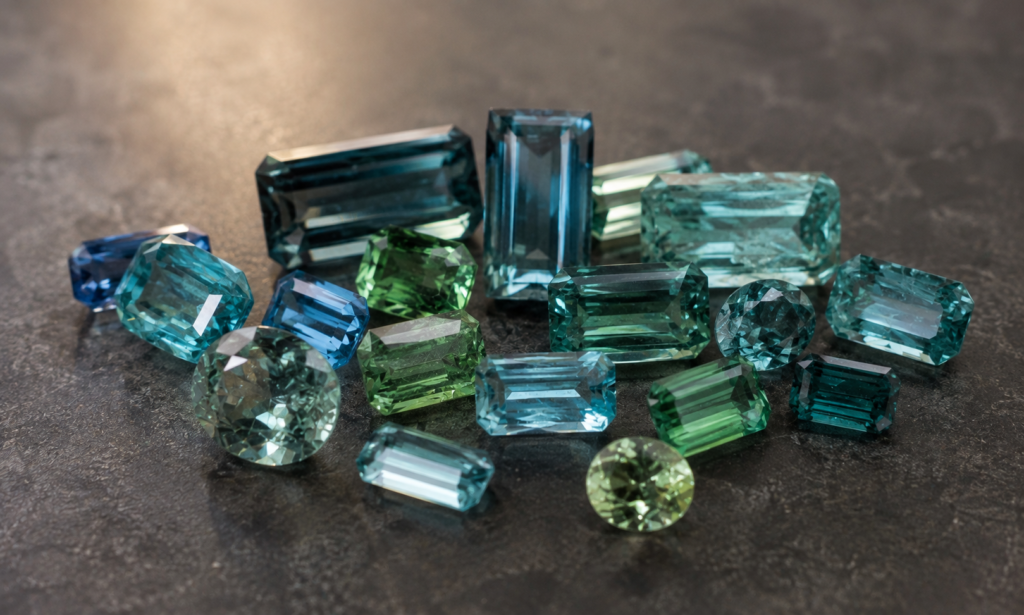
Copper-bearing tourmaline introduced some of the most striking blues, greenish blues and blue-greens associated with the tourmaline family. The material first made famous through Paraíba, Brazil, later became part of a wider story involving other deposits.
Copper is important, but its mere presence is not enough to explain every appearance. Concentration and the broader chemistry matter too.
An element does not simply need to be present. Sometimes the amount matters just as much.
Sometimes Colour Comes From More Than an Element
Tourmaline colour cannot always be explained by a neat list of colouring elements. Structural effects, oxidation states and colour centres can also participate, and radiation-related colour centres are relevant to some pink and yellow material.
This is why an element-to-colour chart can be useful as an introduction but misleading as a complete explanation.
Tourmaline colour is chemistry, but chemistry is more complicated than a list of colouring elements.
The Chemistry Can Change While the Crystal Is Growing
This is where tourmaline becomes especially interesting. The fluid or melt surrounding a growing crystal does not necessarily maintain the same chemistry from beginning to end.
As the environment changes, the ingredients incorporated into new layers of the tourmaline can change too. A crystal can therefore preserve different chemical stages as distinct growth zones.
A tourmaline crystal can record changes in its environment as bands of colour.
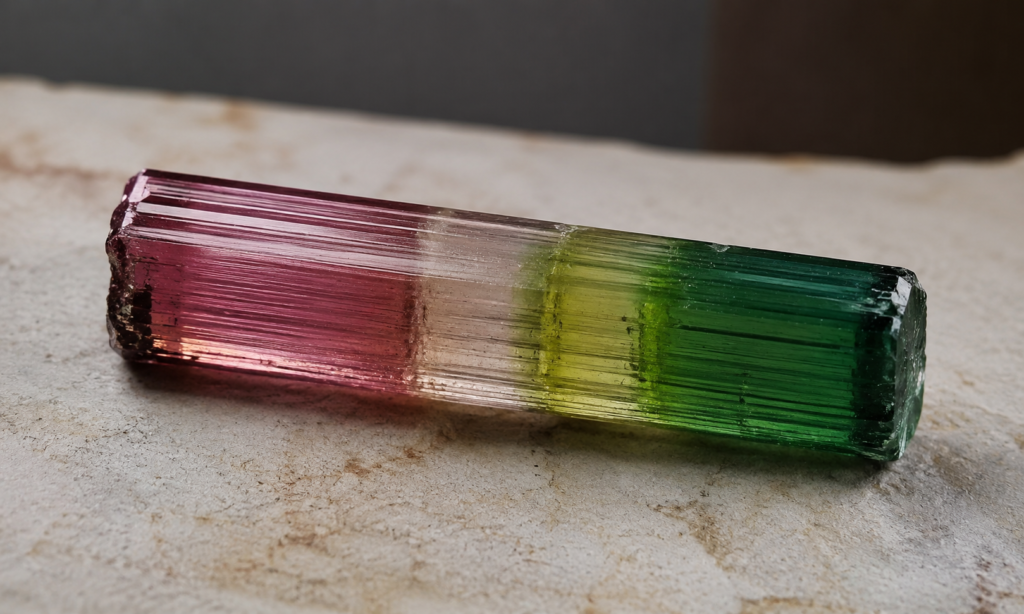
This Is How Bi-Colour and Watermelon Tourmaline Happen
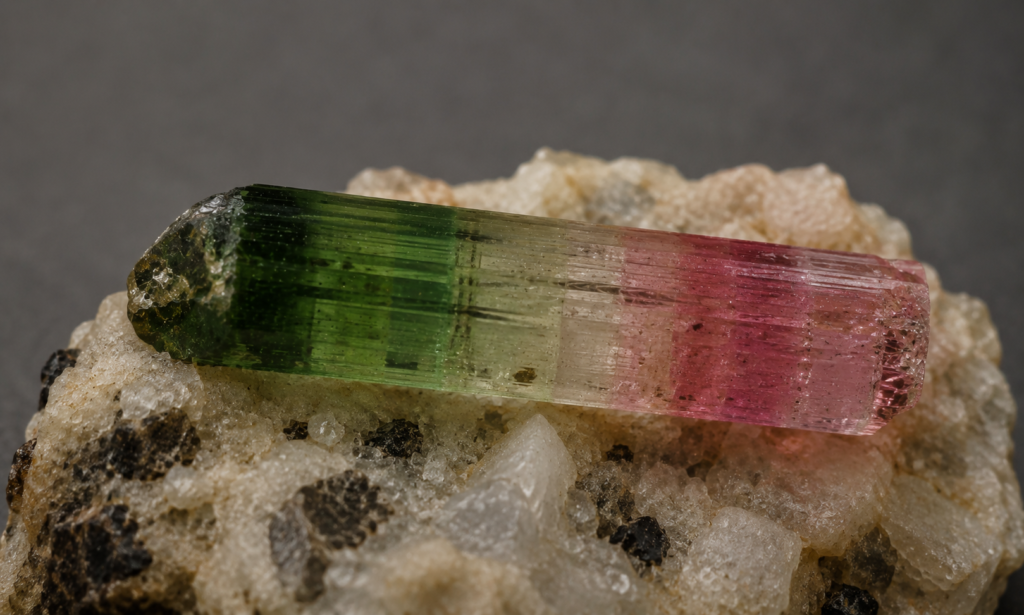
When the chemical changes during growth produce visibly different colours, one crystal can become bi-colour or parti-colour tourmaline.
Pink may transition into green, yellow into green, or several zones may appear in sequence. Watermelon tourmaline is a famous example in which pink or reddish inner growth is surrounded by green outer growth.
The colours are not separate gemstones assembled together. They can represent different chapters in the growth of one crystal.
A bi-colour tourmaline is not two gemstones joined together. It can be one crystal that grew through two different chemical moments.
Colour Zoning Can Be Something to Celebrate
In some gemstones, obvious colour zoning is something cutters try to minimise because an evenly coloured face-up appearance may be preferred.
Tourmaline offers another possibility. A striking boundary between colours can become the reason a stone is cut a particular way. Instead of hiding geological variation, the cutter can make it the design.
Tourmaline can turn geological inconsistency into design.
Why Can Two Tourmalines of Similar Colour Still Look Different?
Chemistry is only part of what we finally experience. Tone, saturation, crystal thickness, pleochroism and cutting orientation all influence appearance.
Tourmaline can show strong pleochroism, meaning colour or intensity changes with viewing direction. A cutter must therefore consider not only which colour exists in the rough, but which direction will present it most successfully face-up.
Nature creates the colour. Cutting decides which part of that colour we experience face-up.
Does Origin Determine Tourmaline Colour?
Geology influences which chemical ingredients are available, so particular deposits can become known for particular types of tourmaline. Copper-bearing material associated with the Paraíba story is an obvious example, with important deposits known from Brazil and later from Nigeria and Mozambique.
But origin is not a rigid colour formula. One country can produce many colours, different pockets within a region can differ, and even one crystal can record changing chemistry.
Geology influences the palette. It does not issue every crystal the same colour.
Every Colour Is a Record of What Happened
When we describe a tourmaline simply as pink, green or blue, we are naming the final appearance of a much longer process.
Behind that colour may be particular elements, their concentrations and oxidation states, structural effects, the chemistry of the growth environment and, in some cases, colour centres. In a zoned crystal, different bands can preserve changes that happened at different stages of growth.
That is what makes tourmaline’s enormous palette more than a decorative curiosity. Its colours are part of the crystal’s geological history.
A tourmaline’s colour is not simply painted onto the crystal. It is a record of how that crystal came to exist.