
Ask someone to picture a garnet and the first image is often a deep red stone: wine red, brownish red or the dark glowing red familiar from antique jewelry. That association has good reason. Red garnets have been used for thousands of years and became especially visible in European jewelry traditions. But the colour history remembers most clearly is only one part of a much larger mineral family.
Garnet’s reputation was built largely in red. Its mineral family was never limited to it.
Garnet Is a Family, Not One Mineral
The word garnet does not describe a single mineral species. It names a mineral group whose members share the same basic crystal structure while allowing substantial variation in chemical composition. Among the species most important as gemstones are pyrope, almandine, spessartine, grossular and andradite. Uvarovite is another striking green member of the group, although its crystals are commonly too small for conventional faceted gems.
That distinction changes how we should imagine garnet. We are not looking at one gemstone that happens to occur in several colours. We are looking at a related family whose members can develop very different appearances.
One Crystal Structure, Many Chemistries
The diversity begins inside the crystal. Pyrope is magnesium-rich, almandine is iron-rich, spessartine is manganese-rich, while grossular and andradite are calcium garnets with different elements occupying other structural positions. These chemical substitutions occur within the shared garnet framework.
Different chemistry changes which wavelengths of light are absorbed and returned to our eyes. It also influences physical and optical properties. Garnet’s variety is therefore not an accidental collection of trade names; it grows naturally from the mineral group itself.
Garnets share a structure, not a single appearance.
Nature Rarely Keeps the Species Completely Separate
Natural garnets also refuse to stay neatly inside pure chemical boxes. Many are solid solutions containing components of two or more garnet species. This creates a continuum between familiar end members rather than a collection of perfectly separated categories.
Rhodolite is associated with the pyrope–almandine side of the family. Many colour-change garnets lie within pyrope–spessartine compositions. Mali garnet occupies territory between grossular and andradite. These intermediate compositions help explain why garnet diversity extends beyond the appearance of the individual end-member species.
Red Became the Reputation for a Reason
The familiar red image should not be dismissed as a misunderstanding. Red garnets are widespread, and varieties dominated by almandine and pyrope have been available to people across long periods of history. Garnet jewelry appears in ancient cultures, and later traditions such as Bohemian garnet jewelry made richly clustered red stones particularly recognizable.
Red garnet did not become the public face of the family because the other colours were impossible. It became the face because red material was historically visible, widely used and deeply established in jewelry culture.
Then the Colour Palette Opens Up
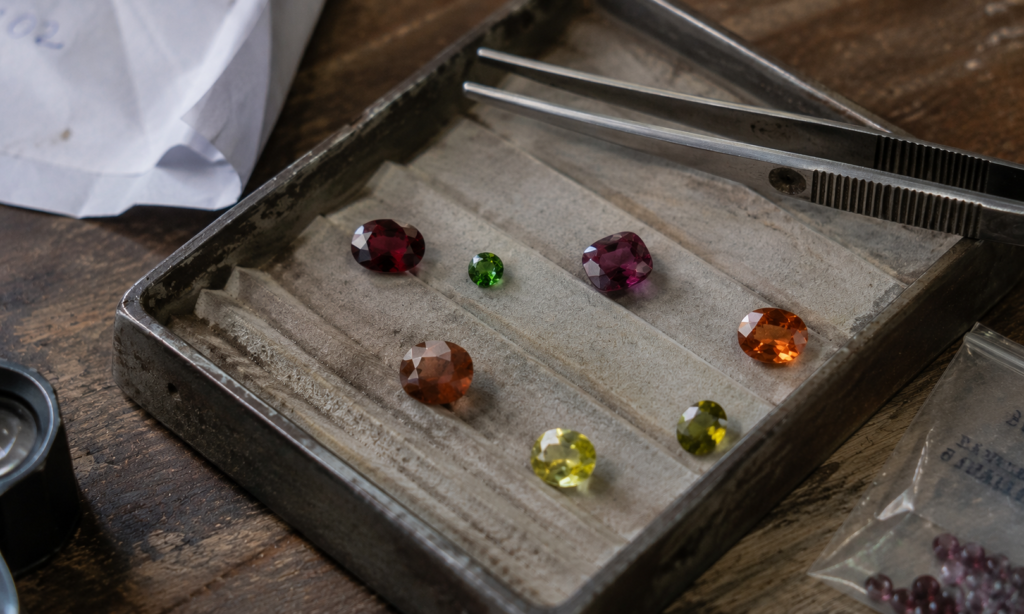
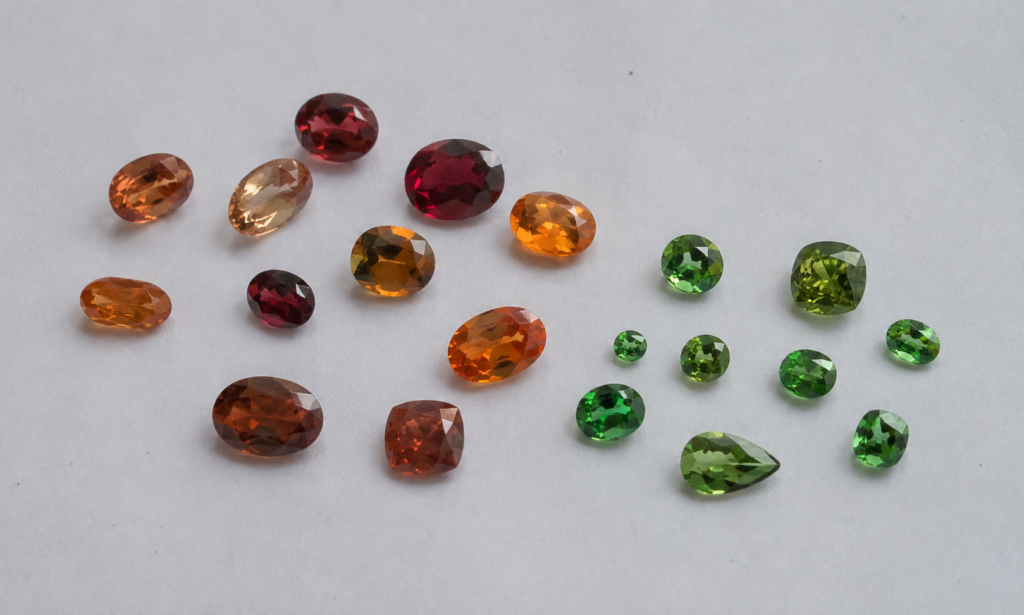
Once we move beyond that historical image, the palette expands quickly. Pyrope and almandine can move through deep red, purplish red and orangy red. Rhodolite brings rose, raspberry and purple-red impressions. Spessartine can appear yellow-orange, vivid orange and red-orange. Hessonite occupies honey, cinnamon and reddish-brown warmth.
The green side is equally varied. Tsavorite expresses vivid green grossular, while demantoid is the famous green variety of andradite and can combine green body colour with unusually strong dispersion. Mali garnet can move through yellow-green, green, olive and golden territory. Some colour-change garnets even enter blue-green, purple, pink and orange appearances as the illumination changes.
Even the Same Species Can Look Completely Different
The diversity does not stop between species. Grossular alone can range from colourless and pale material through yellow and warm orange-red expressions to vivid green. Hessonite and tsavorite make the contrast especially clear: one is known for honey, cinnamon and orange-brown warmth, while the other can be intensely green, yet both belong to grossular.
This is one of the most useful ways to understand garnet. A species name tells us something important about mineral identity, but it does not necessarily predict one narrow visual personality.
Garnet Can Change More Than Colour
Garnet diversity also reaches beyond body colour. Demantoid is notable for high dispersion, which can produce vivid spectral flashes when the cut and lighting allow them to appear. Colour-change garnets respond dramatically to different illumination. Garnets displaying asterism or a cat’s-eye effect are also documented.
These phenomena remind us that two garnets can differ not only in hue but in the way they interact with light. One may be appreciated for a dense field of colour, another for fire, another for a shifting colour identity, and another for a moving optical effect.
Different Garnets Can Feel Like Different Gemstone Families
Place demantoid, hessonite, rhodolite, tsavorite and spessartine apart from one another without their labels and their shared identity may not be obvious. Their colours, tones, transparency, dispersion and internal character can create very different visual experiences.
Mineralogy is what connects them. The further we move through the group, the more useful it becomes to think of garnet not as one familiar red gemstone with a few unusual exceptions, but as an entire family of related possibilities.
The further we explore garnet, the less it behaves like one gemstone and the more it reveals itself as a family.
Diversity Also Comes From the Earth
Garnets form in a range of geological environments, and those environments provide different chemical ingredients. Red garnets are widespread in many metamorphic rocks. Other members of the family depend on more particular combinations of host rock, pressure, temperature and available elements. Pyrope can also be associated with rocks derived from the mantle, while grossular and andradite occur in geological settings where calcium-rich rocks have undergone metamorphic or contact-related processes.
Different rocks and geological histories therefore contribute to different garnet compositions long before a crystal is ever cut as a gemstone.
The Reputation Is Finally Catching Up
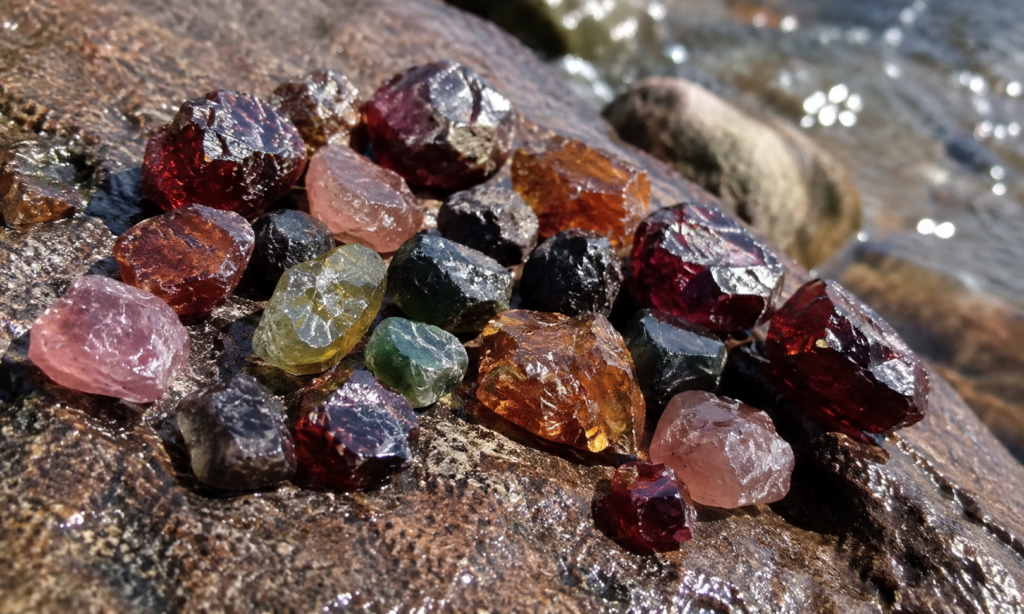
Modern gemology and the gem trade now use a much richer vocabulary for garnet: tsavorite, demantoid, spessartine, rhodolite, hessonite, Mali garnet and colour-change garnet each reveal a different part of the family. Discoveries have also overturned familiar assumptions. The old phrase that garnet occurs in every colour except blue became difficult to maintain once blue-green colour-change pyrope–spessartine material was documented.
None of this means garnet suddenly became more diverse. The minerals were already there. Exploration, gemological study and a broader appreciation of coloured stones simply allowed more of that diversity to become visible.
Garnet did not suddenly become diverse. We simply became better at seeing how diverse it had always been.
More Than the Gemstone We Remember
The classic red garnet remains an important and beautiful part of the family, and its historical prominence deserves its place in our collective memory. But stopping there leaves out vivid green tsavorite, fiery demantoid, orange spessartine, warm hessonite, purple-red rhodolite, green-gold Mali garnet and stones whose colour changes with the light.
Red garnet may be the face history remembers most clearly, but behind it is one of the most varied families in the gemstone world. The more closely we look, the harder it becomes to describe garnet by a single colour—or even by a single kind of beauty.