
A blue sapphire can look vivid and open beside a window, deeper under warm indoor light, and slightly different again beneath a neutral studio lamp. The stone itself has not changed. What changed is the light illuminating it—and therefore the light returning to our eyes.
This is one of the most useful things to understand when looking at sapphire colour. We never see the gemstone’s colour in isolation. We see an interaction between the sapphire, the light source and human vision.
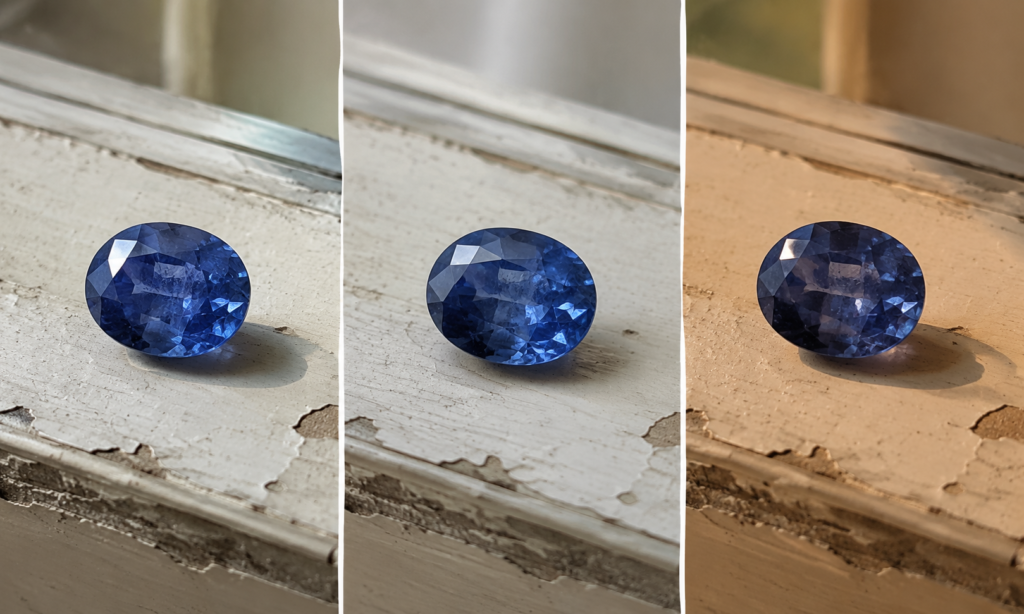
Colour Needs Light
A sapphire appears coloured because different wavelengths of incoming light interact with the material differently. Some wavelengths are absorbed more strongly than others, and the light that eventually reaches our eyes creates the colour we perceive.
The important part is that the incoming light is not constant. Change the illumination and you change the wavelengths available for the sapphire to absorb and return.
The sapphire stays the same. The light arriving at it does not.
Not All “White” Light Is the Same
Daylight, fluorescent lamps, LEDs and incandescent or warm household lighting can all look broadly white to us, but they do not necessarily contain the same balance of wavelengths. This is why gemologists specify lighting conditions when colour needs to be compared consistently.
For sapphire, a different light source can change the balance of blue, violet, green, yellow or red that is available to interact with the stone. The result may be a subtle shift in hue, a change in how saturated the colour feels, or simply a different impression of brightness and depth.
This also explains why colour temperature alone cannot tell the whole story. Two lamps that are both described as “white” or even have a similar stated colour temperature can still render a gemstone differently because their spectral output is not identical.
Why Blue Sapphire Can Look Different
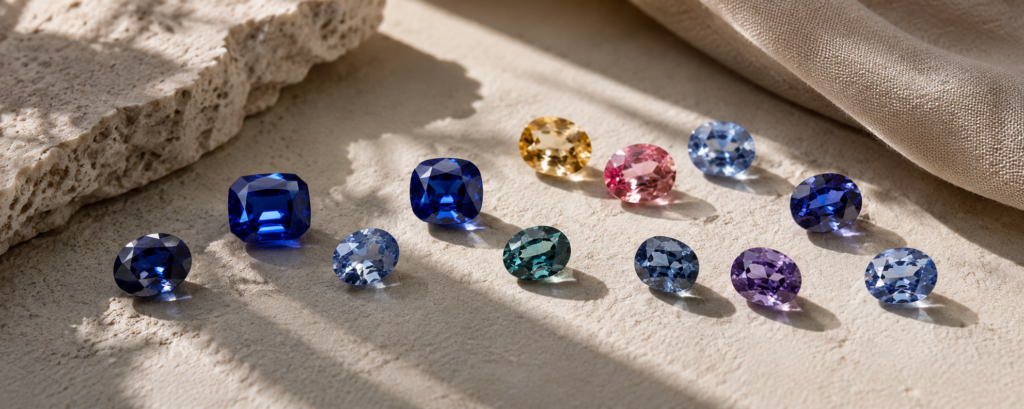
Blue sapphire itself covers a range from greenish blue through blue to violetish blue. Different stones also have different absorption characteristics, secondary hues, saturation and tone.
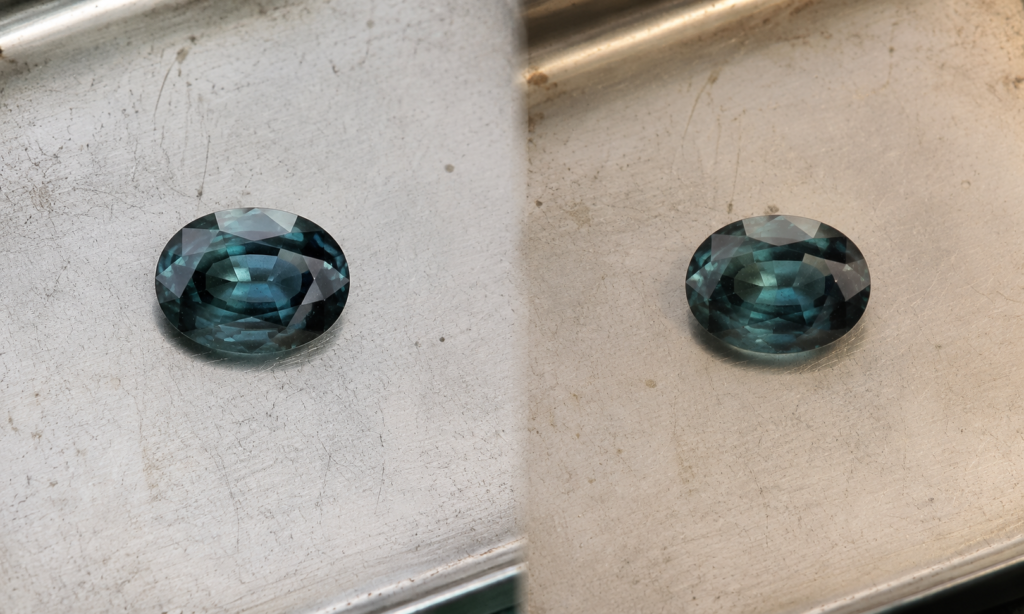
Under one light, a sapphire’s blue may feel particularly clear and dominant. Under another, a violet component may become easier to notice, or the stone may simply look deeper and less lively. A blue-green sapphire may appear more blue in one environment and more green in another.
There is no reliable rule that warm light will make every blue sapphire behave in exactly the same way. The result depends on both the spectrum of the light source and the optical characteristics of the individual stone.
Brightness Changes the Experience Too
The type of light is only part of the story. The amount and direction of illumination also influence what we see.
In stronger illumination, facet reflections and areas returning light can become more obvious. In a dim environment, darker areas may occupy more of our visual impression and a sapphire can feel deeper or less open. A change that we casually describe as “the colour becoming darker” may therefore include a change in brightness, not just hue.
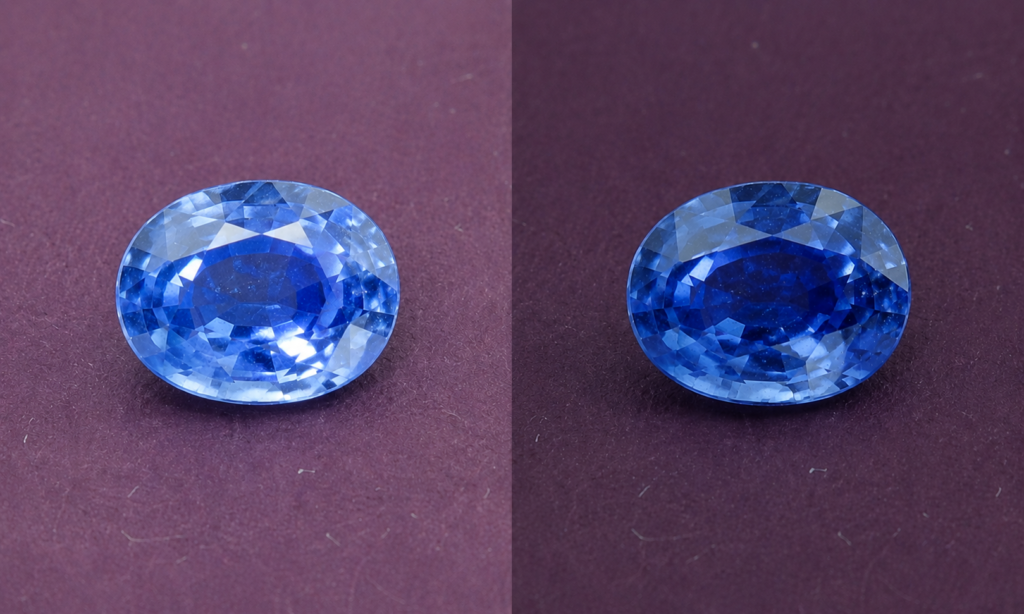
Why Some Sapphires Change More Than Others
Two sapphires placed side by side do not have to respond to a lighting change equally. Their colour-causing trace elements and absorption patterns can differ, as can their secondary hues, saturation, tone, colour zoning, orientation and cut.
One sapphire may remain visually consistent across several everyday environments. Another may reveal noticeably different blue, violet or green influences as the light changes. Neither behaviour is automatically a sign of better or worse quality; it is part of the individual stone’s optical character.
Colour Zoning Can Reveal Itself Differently
Sapphire often contains uneven colour distribution. In teal and parti sapphires this can be especially easy to appreciate because blue, green or yellow areas may coexist within one stone.
Changing the illumination does not create new zoning, but it can change how strongly the existing zones contrast with one another. A blue-green stone that appears relatively blended in one environment may reveal a greener area more clearly in another.
Looking Different Is Not Automatically “Colour-Change”
This distinction is important. Ordinary sapphires can look somewhat different when the lighting changes. Colour-change sapphire refers to a more specific optical phenomenon in which a distinct change in colour is observed between different illumination types.
GIA notes that typical colour-change sapphires range from blue to violet in daylight-equivalent fluorescent or LED lighting and from violetish purple to strongly reddish purple under incandescent light. Rare examples can show other transitions.
So a blue sapphire looking slightly more violet under your living-room lamp is not, by itself, enough to conclude that it is a colour-change sapphire. The degree and nature of the change matter.
A Different Phenomenon: Colour Stability
There is another phenomenon that should not be confused with ordinary lighting differences. Some sapphires can develop or lose an unstable yellow or orange colour component after exposure to particular light conditions, including light containing ultraviolet radiation.
GIA has documented this behaviour in certain pink, orange and padparadscha-like sapphires and uses colour-stability testing when appropriate. In these cases, the material can undergo a reversible colour-state change rather than merely appearing different because it is being viewed under a different spectrum.
This behaviour is specialised and should not be used as the default explanation whenever an everyday sapphire looks different indoors and outdoors.
What About Fluorescence?
Ultraviolet light can also cause fluorescence in some corundum. Fluorescence is light emitted by the gemstone in response to higher-energy radiation, and gemologists use it as one of many observations when examining ruby and sapphire.
Its strength and colour vary with the material and its chemistry, and fluorescence can sometimes contribute to appearance when a suitable UV component is present. But it is not a universal explanation for why sapphires look different between ordinary light sources. For most everyday comparisons, the spectral character, intensity and direction of the visible illumination remain the more useful starting points.
Why a Photograph Can Look Different Again
Once a camera enters the process, another layer is added. The camera does not simply preserve exactly what the eye experienced.
Automatic white balance, exposure, HDR, computational processing, colour profiles and even the screen used to view the image can all change the final representation. Two phones can therefore photograph the same sapphire under the same lamp somewhat differently, which is why controlled lighting, consistent white balance and restrained processing are useful when gemstone colour needs to be compared.
This is why a gemstone photograph should ideally be accompanied by information about the lighting used, especially when colour is central to a buying decision. This is why consistency matters in gemstone photography. When lighting, white balance and processing are controlled, photographs become much more useful for comparing colour from one sapphire to another.
Understanding Colour Across Different Light
There may not be one appearance that represents every environment. A controlled photograph gives us a consistent reference, while additional lighting conditions help us understand how the sapphire may appear in everyday life.
A controlled light gives us a reference. Everyday light tells us how the sapphire will live.
How to Look at Sapphire Colour More Reliably
If colour matters to your decision, a few simple habits make comparison more useful:
- Start with a consistent neutral light. Use the same lighting when comparing one sapphire with another.
- Then look in daylight. Indirect daylight provides another useful real-world view.
- Check your normal indoor environment. The light in which you will actually wear the stone matters too.
- Keep comparisons consistent. Changing both the stone and the lighting at the same time makes differences harder to interpret.
- Look for consistency across multiple views. When viewing a sapphire online, photographs or videos taken under clearly identified lighting conditions can provide a more complete understanding of how the stone appears.
For online viewing, consistency is more useful than trying to make a sapphire look its most dramatic. A controlled lighting setup provides a reliable reference for comparing gemstones, while additional views in daylight or indoor light can reveal how the same stone behaves beyond that reference.
The goal is not to find one image that represents every possible environment, but to understand the sapphire through a clear and consistent set of views.